
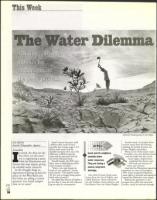

A farmer breaks ground in the Negev.
GIL SEDAN
Jewish Telegraphic Agency
Jerusalem
I
n Israel, the skies are dry
too often, yet the coun-
try is negotiating a peace
with the Palestinians and
Syrians that may require giving
up valuable water resources.
As the drought drags on,
opponents of giving up land for
peace on the West Bank and
the Golan are asking a crucial
question: Can Israel compro-
mise on its water?
1/7
2000
18
Israel's natural resources yield
2 billion cubic yards of water
annually, but average usage is 2.6
billion cubic yards, and the
shortfall increases every year. The
difference is filled by ground
water and by reservoirs built by
the Jewish National Fund.
Ronald Lauder, the JNF's pres-
ident, drew a bleak picture of the
water situation in Israel.
"Many rivers and streams in
Israel are now polluted," Lauder
said recently. "The aquifers under
Tel Aviv are no longer being replen-
ished with rainwater."
He added that the Sea of Galilee is
so low that it "runs the risk of becom-
ing too salty for consumption."
„
monVEI SIF"
El,
•
:
:7
w
a, tl
's
t.. t
s t
• AoenlWaValk,"
Israel and its neighbors
uneasily share
water resources.
They are facing a
severe, long-term
shortage.
One third of Israel's fresh water
comes from the Sea of Galilee, also
called Kinneret, whose tributaries
are the Hasbani, from Lebanon, and
the Banias, from the Golan Heights.
Further south, the Jordan River
receives water from the Yarmuk,
marking the border between the
Golan Heights and Jordan.
Water is one of the major issues
of conflict, not only between Israel
and the Arabs but also in the
entire region. Experts have
predicted that future wars
will breakout because of
water, not territory.
Israel and the Palestinians signed an
agreement on water and sewage in
1995. Israel recognized Palestinian
water rights in principle and agreed to
expand the Palestinian water supply.
Behind the agreement is the
premise that while the territorial
conflict could be resolved through