
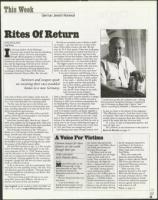

Photo by Krista Husa
German Jewish Renewal
Rites Of Return
SAM ENGLAND
StaffWriter
I
n the long shadow of the Holocaust,
Germany only recently has seen the rekindling
of Jewish culture. Survivors and escapees,
through official programs or of their own
accord, have pensively returned to visit their old
hometowns and see the remnants of their communi-
ties, and the beginnings of Jewish revival. Several
from the Detroit area have made the journey.
Germany is interested in hosting displaced Jews,
according to Marianne Nakao of the German
Consulate-General's Detroit office. But, she said,
She did not necessarily come to Berlin to dwell
on wounds — the city's, her own, or those of her
hosts. Of her fellow travelers, she said, "By that
time, by '94, I think people, if they were at all going
to be either assimilated or satisfied with their lot or
whatever, they were by that time. You know, they
were already old and had children. They had settled
in. I didn't recognize any sadness; I think they were
all sort of excited to see — to come back to Berlin.
"My biggest surprise was that I was told there
was a Jewish community in Berlin still. And some
people have gone back, of course, not only to
Berlin, but also to wherever else they came from."
It was more important, said Netzorg, to be a
polite guest than to discuss the Holocaust
with resident Germans. "I didn't explore
it that much — whether they felt guilty
or not guilty, and how they portrayed
that to their children, particularly," she
said. Though she did have one home
visit, she felt "those things are not really
easily discussed among strangers."
Huntington Woods resident Walter
Stark, a Munich native, describes himself as "a refugee
from Hitler." He left in 1938, and first returned to
Germany in 1952, as an American representative for
the Marshall Plan. Now he visits frequently. Stark
toured Berlin with his wife a few years ago.
Trained in chemical engineering, Stark continues to
work in the plastics industry, and speaks regularly at
the Holocaust Memorial Center in West Bloomfield.
"I'm probably the exception to the rule," Stark
said, in that he doesn't blame all Germans for the
actions of an older generation and feels the need to
spend time in the country addressing the legacy of
the Holocaust. "And I felt (that) since I went back
in 1952, and I have not changed my mind."
Like Netzorg, Stark enjoys visiting Germany. And
Survivors and escapees speak
on revisiting their once-troubled
homes in a new Germany.
such cities as Berlin and Cologne, rather than the
national government, sponsor revisitation programs
on a "very individual basis" for returning exiles.
The few cases she has seen in the Detroit area
have involved metro Detroiters initiating their own
trips, traveling separately or in tours set up by their
former hometown's governments.
"Simply, the people voice their wish to go back
and see, either life, or meet people or visit cemeter-
ies, or whatever," Nakao said.
Some have returned often. Most do not. Some of
these native speakers use the language daily, while some
never ado. The flawless English of these local individuals
still carries an accent of some German dialect.
Petra Netzorg's mementos of her 1994 trip to
Berlin are in the basement of her Southfield town-
house, stowed away with stacks of books.
"I'm not a great joiner," she said, "so I'm not part
of an organized Jewish group here in Detroit." Still,
she decided to join a group revisiting the city under
the auspices of the Berlin mayor's office.
She had fled Germany at age 15, a few months
before Kristallnacht, the name given to the infa-
mous pogroms of Nov. 9, 1938. Netzorg contin-
ued her education in the United States, traveled,
and ran an antiquarian bookstore in Detroit with
her husband. Netzorg applied for the revisitation
program, though she said the city mayor typically
sends an official invitation.
As far as she knows, only Jews participated. "And
they gave you even spending money," she said. "It's a
very generous, generous program." Netzorg enjoyed
the accommodations and getting to see Berlin, after
most of a lifetime away.
"Once you've been away for 60 years or so, every-
thing looks pretty much different, with the war in
between and much of [the city] bombed."
Sam England can be reached at (248) 354-6060, ext.
263, or by e-mail at sengland@thejewishnews.com
► °ice
"I would never go there for a pleasure visit... Having
been persecuted, having been harassed. I would never
stay in Germany any longer than I had to," said
Martin .Lowenberg of Southfield, a Holocaust survivor.
he does not object to the rhetoric of tour organizers.
"The official line you get is, 'Look how nice it is here
in Germany.' They want to have Jews come back and
re-settle, there's no question about that. That's part and
parcel of the reason why they invite you back
"In a sense, it's also a compensatory gesture, and
that's all right, too."
This, however, is not tantamount to the quick re-
RITES OF RETURN on page 12
For Victims
German lawyer for slave
laborers sees the world
through their eyes.
TOBY AXELROD
Jewish Telegraphic Agency
Berlin
ichael Witti refers to the
"German side" in the
slave labor talks as "they." But
the Munich attorney for
Holocaust survivors is really one
of "them."
He just doesn't feel that way
any more.
"I am so involved in the
Jewish interests and the victims'
side that I see myself as part of
the victims' side and not the
German side," said Witti, who is
not Jewish and was born in
Germany 42 years ago.
"My clients took me and
adopted me from the very begin-
ning, and this made me so
strong. They accepted me as 'the
German guy who fights for
them,' a representative of a new
generation, the new Germany."
Last week, German govern-
ment and business leaders
agreed on a $5.1 billion plan to
pay more than one million slave
laborers — 135,000 of them
Jewish concentration camp sur-
vivors — and non-Jewish forced
laborers, most of whom did not
live in the death camps. Among
the 60 companies expected to
contribute to the fund are a
General Motors subsidiary,
Adam Opel, and a Ford unit,
Ford Werke.
Witti, who works with
American attorney Edward
Fagan on claims talks for World
War II-era slave laborers, has
represented Holocaust survivors
in Germany since 1991.
"After one year, I was
absolutely devoted to this work,"
Witti said. He became part of
the team of lawyers who in 1996
sued the Swiss banks on behalf
of survivors, and he has prepared
lawsuits against German banks
and industry as well.
VOICE on page 14
,
11