
Or, my memorable adventures
at summer camp.
ELIZABETH APPLEBAUM
AppleTree Editor
I
guess what I remember best is the
laundry.
I was already long past the age
when I could still be a camper,
even in the oldest group, when my par-
ents discovered Camp Ramah in
Wisconsin.
But my younger brother, Avrum, and
my sister, Rebecca, attended for many
years, and it was always an extraordinary
experience for both. They would return
to our small-town home in Missouri
singing song after Jewish song, recount-
ing stories of people from around the
country they had met and grown to
love, telling all about adventures and
programs and plays.
And they would have trunks filled
with tons of laundry, scrunched-up and
caked with dirt even after it had suppos-
edly been washed.
In college at the Jewish Theological
Seminary, Rebecca was reunited with a
camp friend, Loren Sykes. Then he
became her sweetheart, and the two
were married at the Seminary. Rebecca
sang that charming ballad "Always" to
him as they stood on a stage and imag-
ined their happy future together.
Several years ago their lives seemed
to come full circle when Loren was
named director of Ramah Darom,
Camp Ramah's brand-new camp in
Atlanta, Ga. At the time, virtually
nothing was there; today, it has a huge
pool, tennis courts, a dining hall that
seats hundreds, top-of-the-line video
equipment, a radio station and dorms
with polished wooden floors.
Rebecca kept telling me I had to
come for a visit.
Last summer, I decided to take her
up on her offer.
This is my story.
The key word to any successful camp
stay, especially when you are an adult, is
flexibility. Nothing is what you imagine,
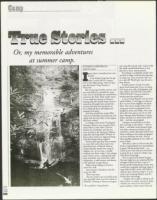
The waterfall at Camp Ramah.
yz
12/10
1999
106
and camp life is hard work. Camp is like
the whole world boiled down to one
place for a short, intense period.
Everything is multiplied: people who
are kind to begin with become amazing
at camp; you want to borrow their car
on a day off? They'll give you the car to
keep forever.
Another person is kind of cranky
about loud noises past 9 p.m.; at camp,
he'll come over with a loudspeaker and
yell, "SHUT UP OR I'M CALLING
THE POLICE!" if you so much as
breathe past the sacred hour.
I was at Camp Ramah with my three
small children. I was happy to discover
that my next-door neighbor was Janet
Katz, who was in charge of the swim-
ming pool, and accompanied by her
daughters, Jamie and Hallie, who were
about the same age as two of my chil-
dren. Because Janet had been to camp
before, she knew so much more than I
did — and she was prepared.
Campers are restricted as to what
they can keep in the cabins — like no
food — and that's smart because bugs
and other creatures are always in the
mood for a snack. But adult staff (I was
there working on the camp newspaper)
can have whatever we want. And as
Janet quickly explained to me, what we
want is food.
Now first, I have to tell you that the
food at Camp Ramah was extraordinari-
ly good. All that kosher food — as
much as you want and you never have
to shop for it or cook it or clean it up.
Talk about living high.
But at camp you're always hungry.
Day and night you are consumed by the
thought of food and how to get it. I
found myself eating things I never, ever
would have imagined touching: bags of
sugar-laden kiddie cereal; cold, leftover
cholent; spicy chicken wings at 11 p.m.
when I sat watching Rebecca and her
friends play mah-jongg.
I imagine the hunger is related to all
that exercise. At camp, you get in shape
whether you want to or not. It's the
great outdoors, which means hills and
Scanned image of the page. Keyboard directions: use + to zoom in, - to zoom out, arrow keys to pan inside the viewer.
December 10, 1999 - Image 106
- Resource type:
- Text
- Publication:
- The Detroit Jewish News, 1999-12-10
Disclaimer: Computer generated plain text may have errors. Read more about this.