
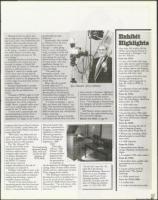

"Because of the war, there were
not enough men to staff the stations,
and I got a job. I was drafted into the
infantry and eventually became the
chief announcer for radio aimed at
the Armed Forces. When I got back
to the States, I enrolled in what then
was called Wayne University, and
soon was hired as an actor on The
Lone Ranger."
Although Newhouse tried acting
in California, the money was not
enough to support a family He
moved back to Detroit in 1950 and
become a staff announcer at
Channel 4, where he worked until
1976. Since then, he has had his
own production company, traveling
around the world to do programs for
a wide range of commercial and gov-
ernment clients.
Seymour Kapetansky is another
personality who has enjoyed a long
career, only his was behind the
scenes.
"I started at WXYZ radio in 1943
as a news writer," recalls Kapetansky,
who also tried his luck in California
and became one of the writers for
Duffy's Tivern, a popular radio series
set in a bar and thought to be the
model for the TV series Cheers.
"I wrote news, commercials and
special programs and have been a
contributing editor in the news
department. I'm happy to say I never
. , .
experienced any anti-
Semitism."
Kapetansky, who worked
at Channel 4 for 38 years,
has watched so many
changes — radio going
from a variety of program-
ming to mostly records and
talk, and TV that required
two tapings for national
shows because of the differ-
ent time zones. The most
significant change, he
believes, has to do with sta-
tion ownership.
"The trend is for
monopoly control," says
Kapetansky, who shared an
office for many years with
Sonny Eliot.
Eliot, who also worked
in both radio and TV,
Specs Howard (ferry Liebman
recently won an award from
the Michigan Association of
three months, it became a lightheart-
Broadcasters in the Broadcast
ed look at the weather," recalls Eliot,
Personality/Team category. He cur-
who
was chosen for the weather
rently has a pair of daily, five-minute
based on his experience in the Air
weathercasts on WNX/J-AM.
Force. "The language in broadcasting
"I've done everything — sports,
has changed, and people would have
talk, quiz shows and features," says
been fired for the terms acceptable
Eliot, who entered broadcasting in
today."
1947 and is best known for his joke-
Dell Warner, seniors reporter for
filled weathercasts that evolved from
Channel
4, also regrets broadcasting
serious reporting.
that
uses
baser language.
"I started out doing it formally
and using technical terms, but after
BEHIND THE MIKE on page 80
.....
..
....
Historical Society who
programs that featured local commen-
also was instrumental in
tator Lou Gordon, youth talent pro-
bringing a Jewish-theme
moter Auntie Dee (Parker) and movie
exhibition to Detroit —
hostess Rita Bell.
"Becoming American
"We've been very lucky with our
Women: Clothing and
work and interests," says Mary Lou
the Jewish Immigrant
Zieve, who recalls many of the devel-
Experience, 1880-
opments shown at the museum.
1920."
The '50s, '60s and '70s
There also
saw the rise of radio as an
This broadcasting
will
be a "Wall
important music enter-
equipment dating
of
Fame"
with
tainment medium, and a
from 1920 was
pictures and bio-
complete radio station is
used for the first
graphical infor-
on display. Bringing the
broadcast of
mation about
story up to the present,
WWJ Radio.
the personalities
the WDIV-TV anchor
so important to
desk invites visitors to
the development of Michigan broad-
imagine themselves in the role of
casting. Many of them will be attend-
newscaster on Channel 4.
ing the preview, a fund-raiser to bene-
Children will be able to enter a do-
fit the staging of this exhibit.
it-yourself sound effects studio, while
"The Michigan Association of
their parents may prefer an adjacent
Broadcasters
and its members have a
reading area featuring a variety of
lot to be proud of and celebrate,"
broadcast history materials.
says former MAB board chair Scott
"Several of the local stations are
Blumenthal. "The rich history tells
sponsoring panels that have been per-
a story of growth, changes and
sonalized for them," says Mary Lou
advocacy."
Zieve, a vice president of the Detroit
•
"On the Air!" runs Oct. 26-
April 30 at the Detroit
Historical Museum. Hours are
9:30 a.m.-5 p.m. Tuesdays-
Fridays and 10 a.m.-5 p.m.
Saturdays-Sundays. $4.50
adults/$2.25 seniors and chil-
dren 12-18/free for children
under 12. (313) 833-1805.
:sh ibit
Highlights
More than 500 artifacts fill the
exhibit capturing the history of
broadcasting in Michigan. "On
the Air!" features:
From the 1920s
• A circa 1918 Grebe CR7 long-
wave radio receiver used by Rogers
City radio station WLC to broad-
cast weather reports and shipping
news, link ships together and corn-
municate with other cities.
• A re-creation of the first COITI
me rcial radio broadcast in
Michigan, which happened on
Aug. 20, 1920, at V/WJ in
Detroit.
• A collection of rare and vintage
radios from the decade.
From the 1930s
• Memorabilia and sound clips
from The Lone Ranger, which first
aired on Jan. 20, 1933.
• A 1930s radio store.
• A 1930s sound effects studio
with hands-on activities.
• Sound clips from 1930s radio
shows, including The Lone Ranger,
The Green Hornet and a Detroit
Tigers game.
From the 1940s
• Displays showing the role of
radio in keeping America
informed about World War
• Wilcox-Gay recording, whtc
allowed people to record their
own voices.
• A 1948 television.
From the 1950s
• Memorabilia from Howdy ;:
Doody, Hopalong Cassidy a id
Rogers.
• A complete 1950s radio sta gy
From the 1960s
• Sound bites from note
personalities such as Ernie
Harwell.
• A gown and hat worn by
Martha Jean "The Queen"
Steinberg.
• A 1960s record store.
From the 1970s/1980s
• A satellite dish.
• A modern broadcasting studio.
10/22
1999