

<*:•
Newhouse
Maur Kapetansky
SUZANNE CHESSLER
Special to the Jewish News
helby Newhouse has many memories of
working in live television, but the one that
stands out has to do with a commercial
for unbreakable dinnerware.
After being told at the final rehearsal that he was
not hitting a plate hard enough to demonstrate its
durability, Newhouse gave all his strength to the
on-air demonstration and made a hole in the sup-
posedly unbreakable product.
"If this happens to you, take the plate right
back," Newhouse told viewers in a face-saving --
and client-saving -- improvisation. "This dinner-
ware is fully guaranteed."
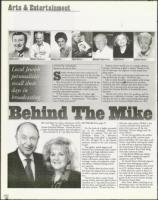
Mort and Mary Lou Zieve, chairpersons of the
"On the Air!" Preview Par at the
Detroit Historical Museum. "Detroit has been
a ma or broadcasting market-, and were glad to
focus attention on it," says Mary Lou Zieve.
10/22
1999
ON THE AIR
Am*
Today's viewers would not see a similar emon-
stration, Newhouse is glad to report. Thanks to the
use of videotape, the segment would simply have
been reshot.
"In the early days, performing on television was
like performing on stage," Newhouse says.
Like so many broadcast personalities with a lono -
history in the businessioNe
.; _whotise has watched
technical and other changes that have been revolu
tionary. He is among many Jewish pros whose
voices have become familiar in households across
the state.
"Society and culture drive the medium, and the
area reflection
e
of society,"
who
s start
announcing before
se
el\e
fTorwehg°rau d
uating from Cass Technical High School in 19 -
from page 73
On the heels of a highly successful
run at the Michigan Historical
Museum in Lansing, "On the Air!
Michigan Radio & Television
Broadcasting 1920-2000" is scheduled
for Oct. 26-April 30 at the Detroit
museum, located in the city's Cultural
Center.
The exhibit, which begins with
Detroit's first commercial radio station
and ends with high-definition televi-
sion (HDTV), takes visitors on a
chronological walk that features
radios, televisions, sound clips, a video
montage, music, microphones, scripts
and photos, while providing interac-
tive exercises.
The Detroit show has been modi-
fied from the original look in Lansing
to reflect a greater metro area perspec-
tive.
"Detroit has been a major broad-
casting market, and we're glad to focus
attention on it," says Mary Lou Zieve,
who has done commercials and been a
talk show co-host. "We have the first
full-time radio station (WWJ) in the
country, and there were many pro-
grams that came out of the city,
including The Lone Ranger and The
Green Hornet."
On the evening before the exhibit
opens to the public, preview party
guests will follow the route open to all
visitors. Just before entering the exhib-
it, they will see a showcase depicting
the innovations of Detroit radio pio-
neer and inventor Tom Clark along
with early crystal set radios.
In the Booth-Wilkinson Gallery,
they will find a display of original
equipment used by WWJ.
An Armed Forces Network segment
features items belonging to John
Fetzer, a broadcast pioneer who served
as a U.S. military censor. A replica of
a 1950s television studio is shown in
the midst of the evening weather fore-
cast. A nearby monitor shows TV pro-
grams of the era and includes footage
of Detroit's Soupy Sales.
Mort Zieve, before switching to an
advertising career, was the director for
Soupy Sales. Zieve also directed the