

ly public affairs show based on the
campus of American University.
I didn't know anything about radio,
but I had some common sense, and
The New Republic was actually very
good preparation for that job, because
I'd learned who knew what about
what — I knew who was out there
and what their expertise was.
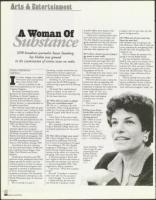
NPR broadcast journalist Susan Stamberg
has broken new ground
in the examination of serious issues on radio.
DIANA LIEBERMAN
Staff Writer
I
is a clear, ringing voice, edged
with humor and carrying more
than a hint of New York.
And it's as familiar to the
baby boom generation as the voice of
Captain Kangaroo.
But Susan Stamberg has more
going for her than precise diction.
Stamberg, in Detroit Tuesday as
keynote speaker for the National
Council of Jewish Women, Greater
Detroit Section, is a groundbreaker in
broadcast journalism.
Her work has transcended the ghet-
to of""women's issues" and given credi-
bility to radio as a medium for the
serious, in-depth examination of
broader issues and personalities.
In 1994, she was inducted into the
Broadcasting Hall of Fame, and, in
1996, the Radio Hall of Fame.
The first woman to anchor a
national nightly news program,
Stamberg was co-host for 14 years of
All Things Considered, National Public
Radio's acclaimed newsmagazine. She
then hosted Weekend Edition/Sunday,
the NPR morning newsmagazine,
from its 1987 premier through 1989.
According to her own estimates,
she has interviewed about 30,000 peo-
ple, including Nancy Reagan, Rosa
Parks, Dave Brubeck and James
Baldwin.
Stamberg has hosted several PBS
television series; moderated three Fred
Rogers specials for adults; was com-
mentator, guest or co-host on various
commercial television programs; and
appeared as narrator in performances
of the St. Louis and National
Symphony orchestras. Her disembod-
ied voice debuted on Broadway in the
Wendy Wasserstein play, An American
Daughter.
She is married to Louis C.
10/8
1999
80 Detroit Jewish News
Stamberg, recently retired from the
Department of State's Agency for
International Development. They have
one son, Joshua, an actor.
Stamberg, 61, now reports on cul-
tural issues for all NPR programs,
while serving as guest host of Morning
Edition.
The Jewish News reached her by
phone in Miami, in the wake of
Hurricane Floyd, as she was preparing
for her latest interview.
JN: What did you study in college?
Were you a journalism major?
SS: Oh, no — nothing to do with
journalism. When young people have
asked me, I've always told them, "Get
yourself a good, solid liberal arts edu-
cation."
I don't know if that advice holds
anymore. Now you just have to learn
computer chips.
But I majored in English and soci-
ology at Barnard College. Both were
very good preparations for the work I
do.
JN: How did you begin your career?
SS: I always thought I'd get an inter-
esting job in publishing. And I did,
but it wasn't as interesting as I'd hoped.
I was working on The New Republic
magazine in Washington, and I was
kind of bored. Mostly because I was
secretary to the editor, so it meant lots
of typing. This was in the early '60s.
A television-producer friend told
me I ought to call this radio station in
town that was starting a new network
— this was long before NPR. They
might have a job as a producer.
I said to her, "What does a produc-
er do?"
She said, "A producer is someone
who won't take 'no' for an answer.
And I thought, "I can do that."
I called and they, for some rea-
son, hired me to produce a week-
JN: Is there a theme you are trying to
get across in your work?
SS: As journalists, we're supposed to
be hard-nosed and tough. But I did
that for so many years. I was news
anchor at All Things Considered for 14
years and then put our Sunday morn-
ing program on the air.
All through those news years I tried
to make sure the arts got a proper
amount of attention.
When the chance came to drop the
anchor and take up reporting, that
became my mission. I think it's so
important to enhance the world of the
listeners through great art. I don't
mean "high" or "low" art, I
mean art that's wonderfully
crafted, done with passion
and rakes you to anoth-
er place.
That is what I want
to cover now
JN:Does your being
Jewish affect your per-
spective in the inter-
viewing process?
SS: I think so much
affects that. My age
does; the fact that
I'm a woman; the
fact that I'm an
urban person, that I
grew up in New York;
that I'm interested in the
arts — everything. I can't
Susan Stamberg: "That's
what I enjoy the most,
preparing for and
getting ready for
the next story Im
going to do,
whatever
it is."
imagine that it's just what my reli-
gious background is.
JN: What part of your career has
been the most fun?
SS: Probably what I'm going to do
this afternoon. That's what I enjoy the
most, preparing for and getting ready
for the next story I'm going to do,
whatever it is.
Here in Miami, for instance, I'm
going to see the Rubell family.
You may be familiar with Steve
Rubell, who used to run Studio 54 in
New York. His older brother, Don,
and his wife, Mira, are here in Miami,
and they buy up great old art deco
hotels and refurbish them. They are
also major, major collectors of con-
temporary art.
They've opened their own collec-
tion in a former drug enforcement
agency confiscation center, in down-
town Miami, where they have the
most wild and outrageous "today" art.