

Battling The Evil Eye
The Enlightenment (17th-18th
centuries) diminished belief in super-
stition in the mainstream Jewish
world. Today, we think of demonolo-
gy, and superstition in general, as
something quaint; we're almost embar-
rassed by it, even if it comes up in
practice. "We dismiss things as super-
stition if we don't believe in them,"
Frieden says. For example, we have
replaced some demons with scientific
theories of bacteria and viruses."
Still, there's no harm in being careful!
Now women have entered the tra-
ditionally male realms that denigrated
folk belief, which may put a different
spin on superstition.
"The missing piece has been that
women were kept out of the academy
and prevented from learning law, so
what was left for them was folklore,
Frankel says. "It was a Catch-22,
since then the women were conde-
scended to for their beliefs and pre-
vented from entering the academy on
those grounds.
Its no surprise," says community
educator Ruth Bergman of West
Bloomfield. "You breed ignorance by
not allowing women to study and then
)))
saying, You are too ignorant to study
))
A gray area
Jewish belief stretches from main-
stream liturgy to the mystical studies of
kabbala and gematria (the search for
meaning in the numerical values
assigned to Hebrew letters), with
superstition forming a kind of gray area
related to the two. For Rabbi Aharon
Feldman, a guest lecturer at
Congregation Beth Jacob in Toco Hills,
an Atlanta suburb, it's all of a piece.
"What is your definition of super-
stition?" he asks. "We have our preju-
dices. We decided science tells us
what the five senses perceive, but
there are some areas that defy our
experience."
Historically, Jews have been attuned
to this gray area. The power of lan-
guage remains particularly prominent
today. An utterance by a Jew is consid-
ered as strong as an action; the crime
of loshon hora, slander, was considered
worse than murder. Therefore, you're
tempting the demons by expressing
anger or bad news aloud.
In medieval times, this concept even
extended to the reading of the Torah.
Because there are stories in the
Torah that express curses, some con-
gregations were afraid to read them in
public because they thought spirits
would believe the curses were directed
10/8
1999
32 Detroit Jewish News
against the community, Trachtenberg
writes. To counteract this worry, they
would have the passages read by a
much-beloved member, one who had
no enemies.
Written words also could bring
tragedy. If a house had been visited
by misfortune, the cause could be a
damaged or miswritten prayer inside
a mezuza. To ward against such hap-
penings, one old custom was to check
the mezuzot regularly.
Jews also take names very seriously.
One longtime Ashkenazi Jewish tradi-
tion is to name children after beloved
— and dead — relatives; you rarely
find a Jewish "Junior." One reason for
this is simply to honor the dead. But
another was that a child with the
same name as a parent was considered
a challenge to the demons, or even
the Angel of Death, who, upon enter-
ing the home, could confuse father
for son and take the wrong person.
If someone was close to death, that
person's name might be changed so
when the Angel of Death came, he
would be confused and go away. For
the same reason, the name Chaim or
Chaya, which mean "life," could be
added to a dying person's name,
Rabbi Yedwab says.
Ari Kresch of Oak Park, interviewed
while taking his child to toddler gym
class at the Jimmy Prentis Morris
Building of the Jewish Community
Center, recalls that, in his home, the
furniture in a bedroom could not be
arranged so the bed was closest to the
door — "because that's the way they
carry out corpses, feet first."
Incantations
against evil
The evil eye — in Hebrew, ayin
hara — figures in countless supersti-
tions. For some talmudic rabbis, it
was a literal thing: Certain people,
with just a glance, could turn men
into "a heap of bones."
The concept of the evil eye in some
Jewish cultures is an outside force," says
U-M's Tsoffar. "But frequently it repre-
sents supernatural power in other peo-
ple. A lot of times, these were people
who were seen as different — non-Jews,
Arabs, women, old people, ugly people,
hairy people. Or it could be a jealous
neighbor. Once words are emitted, it
invites the appearance of supernatural
power from that person."
Throughout different Jewish com-
munities, the phrase kenna hora — the
JEWISH
SUPERSTITION on page 14
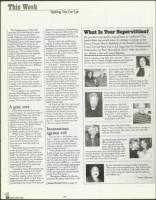
What Is Your Superstitio
Do you have any family superstitions or traditions? The
Jewish News uncovered many by talking to people at the
Jimmy Prentis Morris Building of the Jewish Community
Center in Oak Park and at the Stage and Co. Restaurant &
Delicatessen in West Bloomfield. Here's what they had to
say. Maybe a few will sound familiar.
Pauline Schreiber, Oak Park, JCC volunteer: "If my
mother and her friends thought someone gave them the
evil eye, they would put a knife under a mattress."
. . . . .
Ari Kresch, Oak Park, at the
JCC toddler gym (with wife,
Lynn, and daughter Julie, 22
months): "My mother
believes you can't walk over
a person, for instance, if they're lying on the
floor, because they'll stop growing. if you do,
you have to walk back over the other way.
.
Helen Hauer, Oak Park, JCC volunteer: "If some-
body said you had a nice-looking child, you had to
say kenna hora, or else a bad thing would happen."
Manny Hauer, Oak Park,
JCC volunteer: "Sometimes
they would ask dead people
for forgiveness. I asked my
son-in-law — he's a doctor
— why, and he said, "Because
dead people don't talk."
.
,40.--A00000,06va' --
Florence Ashin, Oak Park, home-
maker: "Tie a red ribbon on a baby's crib or carriage to
keep the spirits away Also, don't name the baby after
someone who is alive."
:;:RR:IMKVZrPrMTAMV,:i'NSRfWag:'MSMsltl:WM::W**P;Q.M :.
Lisa Binder, right, Farmington
Hills, preschool teacher:
"Don't ever talk about the
good stuff. If you say, "My
husband is doing well," then
you say kenna hora, so you don't break the spell.
Carolyn Mauler, left, Farmington Hills, owns
Viva Cappuccino: In poker, the same thing —
you don't talk when you're winning."
ESIWIESNMEMERTNOMEMOMESMAW.IMUCKC:
Eleanor Minkoff, Farmington Hills, homemaker:
"My mother was so superstitious. She died in room
413 on the 13th. of March. If she had known she
was in that room, she would have gotten right up
and walked out."