

tion
Over the centuries, Jews have developed a host of protective
rituals and utterances to ward off evil. Who can blame them?
discussing the genesis of the tradition of
"But there is also a 'folk Torah,' a
breaking a glass at a wedding," he says.
grassroots tradition that includes sto-
"Tradition has it that we break the
ries, songs, proverbs, superstitions and
glass as a reminder of the destruction of lullabies, that was primarily transmit-
the Temple, so we should remember
ted by women.
that great tragedy even in times of our
Through this tradition comes much
greatest joy. It also seems to come from
of Jewish culture, she says.
a Talmud story about breaking a plate."
Many of the folk beliefs took hold in
Another possibility is that the tradi-
medieval times, revolving around estab-
tion's origins are not Jewish at all. As far
lished talmudic ideas involving a "mid-
back as the Middle Ages, Rabbi Yedwab
dle world" of angels, demons and other
says, men used to break their glasses
spirits — many of whom, in turn, had
when sealing a solemn agreement.
been derived from earlier cultures.
So is breaking the glass a tradition,
The demons and evil spirits were the
a religious ceremony or a superstition?
most feared, described in the Talmud as
"No one knows for sure," Rabbi
being between angels and men. Their
Yedwab acknowledges.
attributes included wings, invisibility and
Also open to discussion, he says, is
an inability to cast shadows. They could
the notion of knocking on wood for
disguise themselves as humans, animals
good luck.
or inanimate objects, and generally lived
"Why do Jews knock on wood?" says
in uninhabited and unclean places.
Rabbi Yedwab. "The wood is the wood
According to talmudic tradition,
of (Christ's) cross. We shouldn't be
God created these evil spirits at
doing it. But we do it because
twilight on the first Sabbath
we're Americans, and
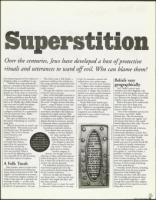
Checking
eve. After creating their
Americans do it."
regularly to
souls, Trachtenberg writes,
make sure there
Rabbi Dannel Schwartz
Shabbat started and God
were no mistakes in
of Temple Shir Shalom
"was obliged to cease His
a mezuza scroll was
agrees that the superstition
labors to sanctify the first
believed to avert
stems from non-Jewish
day of rest." That's why
rtune.
sources, but wonders if the
spirits have no bodies.
cross was involved. When a
Another category of
tree was hit by lightning, spirits
demons was thought to be the
were reputedly let in, and knocking
offspring of Adam and female demons,
evokes those spirits, he explains.
fathered during his 130 years without
Eve. A third class of demons was creat-
ed from the recently deceased.
The kabbalistic division of the uni-
Ellen Frankel, editor-in-chief of the
verse between good and evil is the
Philadelphia-based Jewish Publication
only justification Trachtenberg offers
Society, observes that much of this "folk
for the creation of demons.
religion" was handed down by women.
However, he adds, the hierarchy
The mainstream religious tradition, of
was always clear — God was the most
Torah written and oral, is primarily the
powerful, then angels and then, and
teachings of rabbis — an elite male
only then, demons.
group that has been communicating
You didn't want to tempt the wrath
Jewish law for generations," she says.
of demons. Unfortunately, it was easy
A Folk Torah
to do. For example, a person who
walked alone was a prime target.
Travelers were even more conspicu-
ous; villagers often would accompany
a visitor part way out of town for his
protection. A villager who traveled to
another town alone would sometimes
take a piece of the village gate with
him; that way, the community sup-
ported him by proxy.
People didn't leave liquids open
overnight or drink from a well after
dark. Nighttime was especially danger-
ous — if you weren't either tightly
wrapped in your bedclothes or
engrossed in your studies, God's pro-
tection was withdrawn.
Beliefs vary
geographically
Prof. Tsoffar's parents were
mizrahim, Jews from Baghdad, who
settled in Israel during the wave of Iraqi
immigration in the 1950s. In their cul-
ture, demons were thought to be afraid
of garlic, water and the color blue.
Eastern European Jews traditionally
used the color red to keep away
demons. They often tied bits of red
yarn to a baby's crib.
"One of the midrashim says that. the
first woman was Lilith," Rabbi
Yedwab says. "She was destroyed,
because she became too 'uppity,' and
she became this demon who would
snatch babies from their cribs. The red
yarn would keep her away."
Not all rabbis believed in demons.
Those in the southern lands,
Maimonides (Rambam) and Ibn Ezra
among them, Trachtenberg writes, took
no stock in the so-called "middle
world." But in eastern Europe, the
beliefs were part of everyday Jewish life,
particularly in chasidic communities.
"In provincial settlements, there
was no modern science — even a real
bias against it," says Ken Frieden, a
professor of religion at Syracuse
University. "They took the view that
God controls everything. The rebbes
were even opposed to going to doctors
because, if God controls everything,
you don't need doctors."
Ironically, Jewish doctors, including
Maimonides, were the most popular
physicians of the Middle Ages.
Christians saw Jews, with their scien-
tific knowledge and advanced educa-
tion, as powerful magicians — and
though they mistrusted their religion,
they respected their expertise as some-
thing akin to sorcery.
10/8
1999
Detroit lewish News
la