
The BiG Story
most non-Ashkenazi communities,
the scroll does not have rollers, but
is fitted into a case of wood or
metal.
The Torah is divided into five
parts, or books. In Hebrew, these
are: Bereshit, Shemot, VaYikra,
BaMidbar, Dvarim. The titles are
taken from the first word, or from
the first sentence, of the opening
chapter of each book. The words
mean "In the beginning," "Names,"
And called" (as in And the Lord
called unto Moses ..."), "In the
wilderness," and "Words."
In English, the names of the
books are derived from Greek
sources through Latin. Their mean-
ings are somewhat different from
the original Hebrew: Genesis,
meaning "birth"; Exodus, "a going
out"; Leviticus, "the Levitical book";
Deuteronomy, "second law."
Many people do not know what
the word "Torah" means. Gram-
matically, it is the hifil conjugation
of a verb meaning "to teach," and
thus torah literally means "teach-
ing." Many gentile sources define
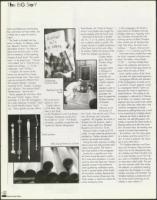
Celebrating
Simchat Torah
Reading from the
Torah
the word incor-
rectly as "law."
English editions
of the Bible often
refer to the Torah
as the Pentateuch or the Five Books
of Moses. Pentateuch comes from
the Greek for "scroll." "Five Books
of Moses" probably comes from the
traditional Hebrew designation
Torah pointers
Rolls of parchment for a Torah
10/8
1999
108 Detroit Jewish News
Torat Moshe, the "Torah of Moses,"
since it was Moshe who taught the
Jewish people what the Torah said.
Each book of the Torah is divided
into 10, 11 or 12 portions. Each por-
tion is called a sedra or parsha. The
chapter divisions in English translations
of the Torah are not the work of Jew-
ish scholars. Rather, the division of the
Torah into chapters was done by
Christian theolo-
gians. Because
Christian clergy-
men often
engaged rabbis
in dialogue on
the Torah — often
unfriendly dia-
logue, in the form
of public disputa-
tions — and
needed to refer to
specific biblical
passages, the
Jews accepted the
Christian division
of chapters.
In most
Hebrew print-
ed books of
the Torah, the Jewish and Chris-
tian divisions are included
together. All together, the Torah is
divided into 54 portions, read in
order, every week from Shabbat
Bereshit until Simchat Torah.
Because a year is made up of 52
weeks, in some weeks the portions are
doubled up. Tradition dictates which
portions are paired with another.
During the week, every Jew is oblig-
ated to read and study privately each
week's Torah portion. The Torah is
then read publicly in the synagogue.
Jewish law is specific as to how
the Torah should be read in public.
As in most such recitations, it is tradi-
tional to chant the Torah text. Persons
specially trained in the traditional
chant (guided by cantillation marks
found in printed books of the Torah)
do the public reading. Because the
sefer Torah consists of bare text, the
Torah reader, or baal kria, learns the
entire reading by heart.
In the synagogue, the Torah is
read aloud on Shabbat morning,
Shabbat afternoon, Monday morn-
ing, Thursday morning, and the
morning service of Rosh Chodesh
(new month) and all holidays (the
High Holy Days, the three major
holidays — Pesach, Shavuot and
Chanuka and Purim).
Sukkot —
Why three times a week? Like water,
the Torah is essential to the Jew% exis-
tence. The rabbis, noting Exodus
15:22, "... and they traveled three
days in the wilderness and found no
water," said that three days should not
pass without the study of Torah.
Each weekly portion of the Torah
is divided into eight small segments.
Synagogue officials call members
of the congregation to come up for
a recitation of each segment. Usual-
ly, congregants literally "come up"
because the Torah is read from a
raised platform. This calling to the
congregant is referred to in Hebrew
as an aliya, an "ascent," and each
segment also has come to be called
an aliya. (And yes, aliya also is the
word for immigration to Israel
because by settling there one is said
to be ascending to a higher place.)
Because the Torah is read by the
baal kria, the oleh (the person who
makes or receives the aliya) recites a
blessing before and after the recita-
tion. For each aliya, the reading must
consist of at least three sentences.
By tradition, the first aliya goes
to a kohen and the second to a
Levi. If none is present, the aliyot
go to any other Jews.
On Shabbat afternoon and Mon-
days and Thursdays, there are three
aliyot; four on the intermediate days
of a holiday and Rosh Chodesh; five
on a major holiday; six on Yom Kip-
pur; seven on Shabbat morning, plus
an extra aliya called maftir.. The per-
son who receives maftir also recites
the haftorah, an additional reading,
usually from the Prophets. If a major
holiday coincides with Shabbat, the
Shabbat reading is postponed and
the Torah portion pertaining to the
holiday is read instead. LJ
Scanned image of the page. Keyboard directions: use + to zoom in, - to zoom out, arrow keys to pan inside the viewer.
October 08, 1999 - Image 116
- Resource type:
- Text
- Publication:
- The Detroit Jewish News, 1999-10-08
Disclaimer: Computer generated plain text may have errors. Read more about this.