

get a movie made if a star is attached.
Thus Jacob the Liar became a
Robin Williams film. With Robin
Williams serving as executive produc-
er. And his wife serving as a co-pro-
ducer.
Let's play a guessing game. Where
do you think the camera spends most
of its time? Williams, who is a bril-
liant comic and improvisational actor,
gives a remarkably restrained perfor-
mance. There is only one obvious
instance of shtick, where he's trapped
in a factory bathroom reserved for
the soldiers — but that's one too
many.
A far worse casting decision was
Alan Arkin, who plays Mel Brooks.
No, not really Mel Brooks. He plays
Frankfurter, the father of the girl
Mischa is dating, as though
Frankfurter was Mel Brooks. Perhaps
the worst scene in the film is when
Frankfurter, afraid the community
will suffer because of Heym's radio,
sneaks into Heym's apartment to steal
it.
When Heym returns unexpectedly,
Frankfurter and his comrades dash
into and out of closets and other
rooms, and the film sinks to the level
of farce.
A side story involves a 10-year-old
girl Heym takes in after she escapes
from the train carrying her parents
to the death camp. It serves no real
purpose except to distract from the
film's central theme, which is or
should have been about man's
resiliency and ability to spring back
from the worst — to find hope,
where there is none.
Life is Beautiful had a similar
theme. Its plot was preposterous, but
it had a center, it had tam. It wasn't
all over the place the way Jakob is,
seemingly unsure what it wants to be
— a vehicle for Williams, a comedy
or a drama.
There are three exceptional perfor-
mances here: Schreiber's; Bob
Balaban, as a barber who puts off sui-
cide when he hears about the
approaching Allies; and Armin
Mueller-Stahl, as the local doctor.
They should have had more screen
time.
The film opens with a sequence in
which a sheet of a newspaper blows
in the wind in the way a feather did
in the opening scene of Forrest Gump.
The Holocaust, however, is no box of
chocolates. 7
Curt Schleier is a New York-based
fi-eelance writer.
Not-So-
Pret
In 'American Beauty,"
English-Jewish director
Sam Mendes explores the
dark side of the
American family.
PHILIP BERK
Special to the Jewish News
ituquing the musical Cabaret
year ago, this reviewer wrote:
CI had expected something
along the lines of Nicholas
Hytner's Carousel, which offered a new,
darker look at an old masterpiece.
Instead I was confronted by something
totally surprising, a painful reminder of
the horrors of the Third Reich.
"By the end of the performance, I
was moved beyond tears, gasping for
breath by the powerful ending added by
the young English director, Sam
Mendes, who if he is not a Jew deserves
to be an honorary one."
When I recently met Mendes, I told
him of my reaction to Cabaret, and he
reassured me that he is indeed Jewish.
(It's surprising how many Jews have won
success in the English theatre, despite its
inherent anti-Semitism. Among the
impressive list: playwrights Harold
Pinter, Arnold Wesker, Patrick Marber
and director Peter Brook.)
The occasion for our meeting was a
junket for Mendes' first film, American
Beauty, rated R, which opens today,
exclusively at the Main Art Theatre in
Royal Oak. Not surprisingly, it is pro-
duced by Steven Spielberg's
DreamWorks. It was Spielberg who
brought Mendes to Hollywood after see-
ing a performance of Cabaret on
Broadway.
American Beauty is a searing
examination of American dysfunc-
tion. If it's not the best movie of
the year thus far, it's certainly the
most controversial.
The script had been gathering
dust because no one had the dar-
ing to produce it. You may ques-
tion its bleak view of American
family life, but you cannot deny its
urgency. You may not like what you see,
but you will not be repulsed.
The screenwriter is Alan Ball, whose
other main credit was as staff writer on
TV's Cybill. But don't expect sitcom
quality here. American Beauty offers a
bleak, dark, cynical view of American
success.
The parents live separate lives. The
daughter has no relationship with her
father. The neighbors are equally unhap-
py with a son who deals drugs but con-
vinces his father he's the All-American
kid. His father, of course, is a retired
army officer with his own
sexual hang-ups.
I What we have here is
dysfunctional America at its
worst.
I realize art is supposed
to hold a mirror to human
nature, but surely some-
thing constructive could
have emerged from all this.
I couldn't find anything.
The director believes that
Spacey's character's brief flir-
tation with happiness makes
it all worthwhile. I'm not
sure I agree.
However, Mendes makes
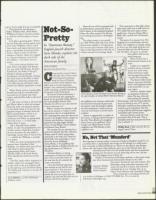
Kevin Spacey as Lester Burnham and Annette Bening as an impressive directorial
his wife, Carolyn, in Dream Works' 'American Beau." debut. He does a fine job
restructuring the material
(eliminating
a trial that book-ended the
ter's girlfriend, the character could easily
story
and
turned
it into a TV movie),
have skirted the bounds of good taste,
although I could have done without his
but Spacey treads the boards so lightly,
insistent use of mastershots. His fine-
the only comparison I could come up
tuning of all the performances suggests a
with was Fred Astaire in his best dance
remarkable career ahead of him.
numbers.
American Beauty is easily the most
Spacey is supported by a number of
provocative
film of the year. This is
fine actors, including Annette Bening as
decidedly
adult
fare and parental discre-
his wife, Thora Birch as his daughter,
tion is advised. 7
Mena Suvari as her girlfriend, Chris
Cooper and Allison Janney as their
neighbors, and Wes Bentley as their
Phillip Berk is film critic for the Los
Angeles Jewish Times.
neighbors' son.
Above all, you will be impressed with
its performances, particularly that of
Kevin Spacey as the dissipated husband-
father who takes control of his life just
as everything around him is disintegrat-
ing.
The subject matter is not entirely
new Billy Wilder dealt with some of the
themes more nimbly in The Apartment,
but not even Jack Lemmon could come
close to what Spacey does in this role. As
a father attracted to his teenage daugh-
o
No, Not That `Mumford'
Also opening in theaters today is Lawrence Kasdan's Mumford, rated PG-13,
a comedy about a psychologist who hangs out his shingle in a small town
that, curiously, is called Mumford (no relation to the school, says Kasdan,
whose wife, the former Meg Goldman, grew up in the Detroit area). Dr.
Mumford soon wins over the quirky locals with his no-nonsense
therapy, but the doctor can use some help of his own. He har-
bors the biggest secret of them all.
Kasdan, a University of Michigan graduate, is the recent recip-
ient of an International Achievement Award in the 1999
Governors' Awards for Arts and Culture. The
filmmaker, along with other honorees, will
Lawrence Kasdan: receive his award at a dinner and ceremony
1999 Governors'
scheduled for 6 p.m. Tuesday, Nov. 6, at
Award recipient.
Henry Ford Museum and Greenfield Village.
Those interested in attending should con-
tact ArtServe Michigan at (248) 557-8288, Ext. 10, or e-mail to
pr@ArtServeMichigan.org .
9/24
1999
Detroit Jewish News
85