

■
■
■
On The Bookshelf
•
•
•
•
•
•
•
a
•
•
•
•
•
•
•
Start the New Year
with our best!
Gefilte Fish
House made with Bubbie's
blend of Whitefish,
Pickerel and Lake Trout
Slightly sweet for a rich
New Year!
$4.25 full size (1/3 lb.)
$2.50 small (1/4 lb.)
Rosh Hashanah
September 10
■
■
Stage & Co.
■
Deli • Dining • Catering
•
■
■
•
•
•
•
•
•
•
•
Serving the Finest
Jewish Delicatessen
Open until 10 pm
Fri/Sat. until 11 pm
248.855.6622
■
"On the Boardwalk"
OUR NEW
SUMMER HOURS
OPEN
MONDAYS
CLOSED
SUNDAYS
MON. thru SAT. 10 a.m..- 9 p.m.
Fri. & Sat. (Carry-Out) 9 p.m.-11 p.m.
g hE RD
(131956P
Lincoln Shoppin i g Center
•
10-1/2 Mile Road 4 Greenfield
Oak Park ■ (248) 968-0022
D'IrTROIT =WISE NEWS
Wow
FOR SALE
at:
9/3
999
i
p
INTERNATIONAL NEWS PLUS
372 Oullette Avenue
Windsor, Canada
'98 Detroit Jewish News
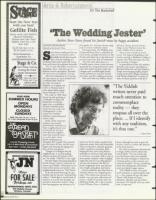
`The Wedding Jester'
Author Steve Stern found his Jewish muse by happy accident.
SANDEE BRAWARSKY
Special to the Jewish News
S
teve Stern's retelling of how he
came to write fiction with a
decidedly Jewish slant sounds
like it has the makings of a
trademark Stern tale, laced with events
that can't always be explained rationally.
The 51-year-old author was born in
Memphis, Tenn., and grew up in a
Reform Jewish community "divested
of every ounce of tradition," he says.
After his confirmation at 16, in lieu
of a bar mitzva, he "never looked back."
A self-described "child of
the '60s," he lived in
England, on a hippie corn-
mune in Arkansas and in
other places before return-
ing to Memphis in 1979.
On a day in 1983 when
he lost his job teaching at
a Memphis College and
heard from his literary
agent that no publishers
seemed interested in his
novel, he took a job "out
of desperation" at the
Center for Southern
Folklore, transcribing oral
history tapes.
Some of the interview
subjects were Jewish
pawnbrokers working in a
black neighborhood, and
he learned for the first
time that the neighbor-
hood had a Jewish histo-
ry, as the place where
Jewish immigrants to
Memphis first settled. His curiosity
got the better of him, and he soon
began interviewing the aging chil-
dren of the immigrants.
"I began to re-imagine the old
neighborhood. It was like pulling
Atlantis up from the bottom of the
sea," he recalls. "I felt like it was a gift."
He then began educating himself in
Jewish history, culture, mysticism, lit-
erature and Yiddish. Ultimately, he set
many of his stories and novels in the
neighborhood known as "The Pinch."
As for his Jewish learning, he says
humbly that he has just "scratched the
surface. I think that it was the lack of
tradition in my life that brought me
around to fascination with it, rather
than having grown up with any of it."
He speaks of a "real sort of siren song
tug" to return to Jewish culture.
His latest book, The Wedding Jester
(Graywolf Press; $14), a collection of
nine stories, includes several set in The
Pinch, and others set in the shred and
on the Lower East Side of Manhattan.
The title story takes place in a
Catskills resort, where a bride become
possessed by a long-dead Jewish comic
who does shtick nonstop under the
chuppa until a middle-aged Jewish
writer performs an exorcism amidst
the jokes, and the wedding continues.
Rich with fable and folklore, Stern's
Writer's Choice Award and the
Edgar Lewis Wallant Award for
Lazar Malkin Enters Heaven.
Stern is now at work on a new
novel, The Angel of ForgeOdness. He
teaches writing at Skidmore College in
upstate New York and spent the sum-
mer teaching in Prague.
In generational terms, he's midway
between such master storytellers as
Bernard Malamud and Isaac Bashevis
Singer and emerging highly praised
young writers like Allegra Goodman
and Nathan Englander. In terms of
style, he shares qualities with all of
"The Yiddish
writers never paid
much attention to
commonplace
reality — they
trespass all over the
place. ... If I identi
with any tradition,
it's that one."
— Steve Stern
stories are full of vitality, peopled with
characters tender, feisty and memorable.
There are dreamers, talmudic geniuses,
rabbis, wanderers, merchants, folks
longing for love, Jews trying hard to
assimilate to American ways and those
in no hurry, a succubus "with a voice as
tart as prune compote" and a bungling
angel who loses his way, although he's
not the only character who flies. In
Stern's imaginative work, past and pre-
sent mingle, as do ghosts and others.
Stern's publisher describes him as
"fiction's answer to Chagall's paint-
ings." The author has penned two
novels, two previous collections of
stories, a book of novellas and two
children's books. He is the recipient
of an O'Henry Prize, a Pushcart
them, although his work is quite dis-
tinctive. Stern is a writer who deserves
to be better known.
His work is sometimes characterized
as magic realism, but he rejects that
and all labels. No two writers that
you find listed under that umbrella
have the same strategies or reasons for
violating reality, or the common con-
ventions of reality," he says, wondering
aloud why Shakespeare and Homer
aren't also labeled magic realists.
"The Yiddish writers never paid
much attention to commonplace reali-
ty — they trespass all over the place.
There's wild fantasy in Peretz,
Aleichem, Mendele and all of their
successors. If I identify with any tradi-
tion, its that one."
(