
Obituaries are updated regularly and archived on JN Online:
www.detroitjewishnews.com
Stanley Winkelman's Call To. Jews: `Embrace Detroit'
city, physically and emotionally. African
American and Jewish relations were
Editorial Assistant
mired in divisive national issues like
affirmative action "quotas" and United
s a young naval officer in an
Nations Ambassador Andrew Young's
amphibious force during
overtures to Palestinians.
World War II, Stanley J.
In his acceptance speech, Mr.
Winkelman made a vow that
Winkelman
issued a clarion call for
if he could return home safely to his
Jewish
interests
to be linked to the city
wife and the newborn baby he had
of
Detroit
and
its
people.
never met, he would do everything in
"Prayer, peoplehood, culture and
his power to eliminate human misery
fund raising
and strife from the world.
were
not
At the time, Mr.
enough,"
he
Winkelman was already a
told the
man of brilliance and
assembled
accomplishment. He had
Jewish leaders.
earned a chemistry degree
"Involvement
from the University of
in the general
Michigan at age 20 and been
community is
employed for several months
an important
as a research chemist at top
aspect of
California universities. After
involvement
the war, he would join the
in the Jewish
family retail clothing busi-
community.
ness in Detroit and embark
"One with-
on a 50-year mission of
out the
righting society's wrongs.
other is not
Mr. Winkelman, a giant
enough."
of Detroit retailing, Detroit
Born in
renaissance and Detroit
Stanley J. Winkelman
Sault
Ste.
Jewish leadership, died Aug.
Marie,
Mich.,
19 at age 76, after suffering a
in 1922, Mr. Winkelman was most
heart attack in his Bloomfield Hills
widely known as the head of
home. He had fought back from com-
Winkelman's, a chain of women's fash-
plications of diabetes over the past year.
ion stores founded in Detroit by his
"He was a wonderful spirit," said
father Leon and uncle Isadore in 1928.
Margaret "Peggy" Winkelman, his
He joined the firm in 1946, working his
wife of 56 years. He was a man of
way
up to chairman and chief executive
wide vision. He felt an interlocking of
officer by 1976.
all people, that we all are responsible
In 1957, he made his first buying trip
for everyone else, that we all live on
to
Europe,
analyzing the market and
this earth together."
adapting
the
product line for
Since the 1950s, Mr. Winkelman
Winkelman's
customers' tastes. Under
held key leadership positions with the
his
leadership,
imported merchandise
Jewish Community Council, the
was
readily
available
at Winkelman's,
Jewish Welfare Federation and myriad
offering
Midwest
shoppers
European
other Jewish and civic organizations in
flare
at
affordable
prices.
The
chain grew
metropolitan Detroit.
to
include
more
than
100
stores.
Mr. Winkelman's response to the
Mr. Winkelman retired from the
1967 Detroit riots was not to give up
business
in 1984 after its acquisition
on the city he loved, but to help estab-
by
Petrie
Retail Inc.; the stores were
lish the New Detroit Committee, an
closed
in
1998. After leaving
urban coalition to help residents and
Winkelman's
in 1984, he established a
businesses rebuild.
management
consulting
firm that spe-
Twenty years ago, Mr. Winkelman
cialized in strategic planning.
received the Jewish Federation's highest
A tall man standing 6 feet 4 inches,
honor, the Fred M. Butzel Award, and
Mr.
Winkelman had a keen interest
he used the moment to share his inspi-
and
curiosity
in areas other than fash-
ration with the upcoming generation
ion
and
retailing.
He delved into pho-
of Jewish leaders present. •
tography,
art,
music,
architecture,
It was 1979, 12 years after the
nature,
journalism
and
technology.
Detroit riots, and many businesses and
Two weeks before his death, he'd corn-
Jews were moving farther away from the
DAVID SACHS
A
8/27
1999
11111%_111".1,e,64-IntAti c h N ovac
pleted a draft of a book that explored
different facets of his life, in business,
community and politics.
Mr. Winkelman's eldest child,
Andra Soble, the one born after he left
for the war, described her parents' rela-
tionship. "They were more than a
team; they were a real kindred spirit,"
she said. "Whatever they did, they did
it together, with this wonderful love
that surpassed anything.
"He loved being with his family Yet
he had to leave his family to be active in
the community. He felt very strongly
that this had to be done. He was pas-
sionate about social justice."
It was in community service that Mr.
Winkelman fulfilled the vow he made
during the war. Mr. Winkelman had
long been a force in the Detroit Jewish
community He was on the board of
Federation and Council since 1956,
serving as Council president from 1960-
1963. He also served with the Jewish
Home for Aged and the United Jewish
Foundation, and other agencies.
He served with the NCCJ Greater
Detroit Interfaith Round Table, the
United Foundation, Detroit Institute of
Arts, and both Wayne State University
and the University of Michigan, among
others.
The 1967 riots in Detroit had a great
effect on his public life. Mr. Winkelman
was a founder later that year of New
Detroit, the nation's first urban coali-
tion, and served as its chairman in 1971.
Over the years he established close
friendships and working relationships
with prominent figures in the African
American community.
Rabbi David Castiglione reflected on
the man's character at his funeral Sunday
at Temple Beth El, where Mr.
Winkelman was once a board member
and vice president. "Stanley had a pro-
found trust in his faith and an optimism
in the goodness of people," Rabbi
Castiglione said. "He had a feeling that
right would prevail if only its seed were
given a chance."
Attorney and close friend Alan E.
Schwartz, who served with Mr.
Winkelman in numerous community
endeavors, also spoke at the funeral.
"Stanley and I sat together around board
tables and in committee rooms,"
Schwartz said. "He was a leader who
could cause change to occur because he
was a man that was trusted and people
were willing to follow.
"He sensed the reality of the circum-
stance and always brought to it
enthusiasm and optimism."
It was Schwartz who introduced
Mr. Winkelman when he received the
Butzel Award in 1979, saying at that
time, When we take inventory of the
great institutions of the metropolitan
area, we find in almost every instance
the dynamic presence and leadership
of Stanley Winkelman."
Schwartz's words were not only true
then, but also prophetic.
Twenty years after Mr. Winkelman's
speech to Federation, some synagogues
and Jewish organizations maintain
thriving social action, outreach and
bridge-building programs with the
people of Detroit.
David Gad-Harf, executive director
of the Jewish Community Council of
Metropolitan Detroit, said his group's
current focus is to become partners
with Detroiters in the areas of educa-
tion, health care and economic devel-
opment.
"In many ways, the Council in
1999 is a reflection of what Stanley
Winkelman wanted the Jewish com-
munity, to do and be," Gad-Harf said.
"I think he lived to see the day when
the Jewish community has made
major investment, both in terms of
financial investment and human
resources, to be the kind of partner
that I think he would want."
Mr. Winkelman is survived by his
wife Margaret, daughters and sons-in-
law Andra and Bruce Soble of
Farmington Hills and Marjory and
Donald Epstein of Bloomfield Hills;
son and daughter-in-law Roger and
Linda Winkelman of Bloomfield Hills;
grandchildren Pamela and Tracey Barr,
Lilly and Lena Epstein, Jackie and
Julie Winkelman and Alan and
Rebecca Barr; great-grandson Sean
Barr; brothers and sisters-in-law
Frederick and Carol Winkelman of
Southfield, John "Jack" Winkelman
and Henry and Judith Winkelman of
Scottsdale, Ariz.
He was the son of the late Leon
Winkelman and the late Josephine
Winkelman and the son-in-law of the
late Sidney Wallace and the late Eve
Wallace.
Interment was at Beth El Memorial
Park. Contributions may be made to
the Stanley and Margaret Winkelman
Fund for Social Justice at the Jewish
Federation of Metropolitan Detroit.
Arrangements by Ira Kaufman
Chapel.
❑
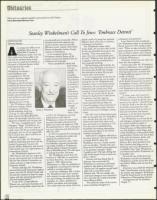
Scanned image of the page. Keyboard directions: use + to zoom in, - to zoom out, arrow keys to pan inside the viewer.
August 27, 1999 - Image 166
- Resource type:
- Text
- Publication:
- The Detroit Jewish News, 1999-08-27
Disclaimer: Computer generated plain text may have errors. Read more about this.