

•
$ -!• ,•,••',
•
In Jewish Education
Confronting Entropy
A year-long Israel program would help students
handle the Jewish void on campus.
RABBI RICH KIRSCHEN
Special to the Jewish. News
A
crucial segment of Reform
Jews is being woefully under
served, if not overlooked —
students ages 18 to 27.
This group represent 98 percent of
all Reform Jews at one time or anoth-
er. But the fact that there has been
almost no college representation at the
biennial conference is symptomatic of
how the Reform movement relates to
our college and post-college students.
Many students arrive at college
with an extraordinarily low level of
Jewish literacy. Consequently, they
may feel intimidated bv other Jews
who are more knowledgeable and
aggressive. Ironically, because of their
background, Reform students actually
need a type of "affirmative action"
through campus Hillel centers.
Reform Jews need someone in
their corner" to say they are legiti-
mate. If there is something they don't
understand vis-a-vis Jewish tradition,
someone must be willing to explain it
with excitement and joy, not conde-
scension.
Most campuses face tremendous
difficulty in building a strong Reform
community. Many rimes the age
group from 18-28 finds itself in a
Jewish world on campus where
Reform is often perceived as a pejora-
tive term; young Reform Jews find
themselves on the defensive. This
needs to be one of the top concerns
-
for the movement.
Many of our young people grow up
in supportive congregations and have
experienced NFTY, UAHC summer
camps and Israel programs. The youth
programs have had a powerful effect
on these young people.
HoweYer, much of this progres-
Rabbi Rich Kirschen is associate direc-
tor of the University of Michigan Hillel.
8/6
999
18 Detroit Jewish News
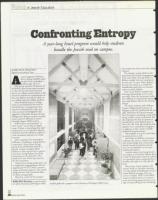
Students gather for as program at the University of Michigan :c Hillel Center
sion stops once they enter the college
campus.
On campus, young adults are far
away from their home congregations.<
They most likely won't go back to a
Reform temple with any consistency
for the next 12 years. Many Reform
Jews do not return to a temple for
membership until they are married
with two small children.
How many Reform temples have
thriving memberships of 18- to 28-
year-olds? Does the movement realize
how difficult its institutional structure '-
has made Reform life for the 20-some-
things?
For many students, only Hebrew
Union College-Jewish Institute of
Religion or Jewish professional life can
offer relief from this brutal entropy.
Not that there is anything wrong with
being a rabbi, cantor or educator, but
this indicates the lack of options in
Jewish life for most Reform Jews in
their 20s. We must ask ourselves what
options we've created for young Jews
in addition to the current available
professional opportunities.
The problem is true for other liber-
al communities as well.
And when the Reform movement
confronts this issue, it needs to hon-
estly acknowledge that communities
already bound by Haiacha (Jewish
law) are not beholden to the same
professional option.
Another reason why being Jewish
on campus is so hard for Reform Jews
is that the dominant American culture
is so powerful and so tempting that it
literally rolls right over their Jewish
lives.
How many of our students will
choose Torah on Saturday morning
over the college football game? Even a
model Reform teenager who was
active in temple, NFTY and UAHC
camp is confronted by an awesome
array of exciting opportunities in col-
lege having nothing to do with being