

LEVINE
from page 75
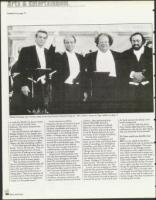
Placid() Domingo, Jose Carreras, James Levine and Luciano Pavarotti bring the "The 3 Tenors" concert to Tiger stadium on July 17.
to mark the World Cup Soccer match-
es and Carrera's recovery from
leukemia. The tenors donated their
fees to charity.
The second concert took place at
Dodger Stadium in Los Angeles four
years later. After the tenors decided to
go on a world tour of 14 cities in 1996
and '97, Levine was invited to replace
Mehta, who had scheduling conflicts.
"I love these guys and what they are
doing," Levine, 56, has said. "They are
communicating their love of music
and our love of making music togeth-
er, which, over the years, we have done
in many circumstances. It matters a lot
to artists to reach so many people.
"You can listen to records, but
there is something fundamentally dif-
ferent about being present, even in a
place that seats thousands, at the
actual moment the performance is
taking place. There is an intensity of
communication when these guys are
in action that cannot be duplicated
except in a live performance."
7/9
1999
90 Detroit Jewish News
Levine was born in 1943 in
Cincinnati, the son of Lawrence (Larry)
and Helen (Goldstein) Levine. Larry
had been a bandleader and crooner in
California before returning to Ohio to
join his father in the clothing business.
Helen, a Chicago native, had a brief
career as an actress in New York before
meeting Larry and settling down to
married life in the Buckeye state, where
the couple produced three children.
Tom, two years younger than James, is
a skilled painter, and Janet, five years
younger, is a clinical psychologist.
James Levine (whom almost every-
one calls Jim) expressed his passion for
classical music throughout his child-
hood. He memorized opera scores dur-
ing elementary school recesses and
designed productions with a toy theater.
He made his debut as piano soloist with
the Cincinnati Symphony at age 10.
In his teens, he worked with
George Szell and the Cleveland
Orchestra, and spent summers at the
Aspen (Colorado) Festival and School
of Music. After graduating from
Walnut Hills High School in
Cincinnati, he studied at Juilliard.
Before he turned 30, he made his
debut at the Met, and served as direc-
tor of the Ravinia Festival, the sum-
mer home of the Chicago Symphony.
During those summers, in
between travels to European and
Asian concert halls and making hun-
dreds of recordings, he developed a
friendship with Robert Marsh, who
had been chief music critic of the
Chicago Sun-Times for 37 years.
Marsh, who interviewed Levine for
many articles, kept his tapes and last
year edited and put them together in
a book, Dialogues & Discoveries:
James Levine - His Life and Music (A
Lisa Drew Book/Scribner; $27.50).
Levine, who has mapped out 1999
with the Met premiere of Schoenberg's
Moses and Aron and the world pre-
miere performance of John Harbison's
The Great Gatsby, has tried to keep his
personal life private. Only briefly does
the book mention his family or his
Jewish background.
In an interview with the Jewish
News, Marsh talked about his writing
collaboration with Levine, their friend-
ship and ultimately Levine himself:
JN: How would you describe your
book?
RM: It is not a book by me about
Levine. Most of the way, it's a book that L\
Levine and I did together. This is par-
ticularly true in the dialogue section.
We started out with a taped conversa-
tion, which I transcribed on paper and
sent to Jim. He went over it and made a
great many changes. Then, I would
make similar changes, prepare a second
version and send that to him. He went
over it again, and that went into type.
He got the typed galley proof and went
over that again. Then, we made what
we thought were the final revisions and
sent it back to Jim, and he made even
further changes. He's that meticulous in
everything that he does.