

JN: To whom did you gear this book?
RM: This book is intended for people
who listen to classical music and want to
have some further understanding of how
these performances come about. The
performances that we see are products of
a long series of events, beginning three
years before [the program] with the early
planning stages, preliminary talk about
casting and that sort of thing. Jim and I
wanted to create some insight into what
the creative process is like.
thing a weekly magazine found a few
years ago when they were going to
write a feature on him. They aban-
doned it because the writer they
assigned came back and said, 'He's
too nice. I can't get anything that
makes a colorful story.''')
RM: He went to Meadow Brook right
at the beginning, and he was there for
four years, from '68 to '72. During
the time he was at Meadow Brook, he
directed concert performances of
Rigoletto and II Trovatore. He didn't
just come in for one performance and
go. He was around for a little while.
JN: Does, Suzanne Thomson, whom
he met in Michigan, continue to per-
form?
RM: I'm under the impression that she
JN: What did you learn about Levine
from doing the book?
RM: What I learned is his total dedi-
other conductors. Half the music he
is playing in the upcoming season
with the Munich Philharmonic
Orchestra [where he'll spend 10
weeks a year over several years] is
real 20th-century music.
JN: What has he brought to opera in
the United States?
RM: An affirmation that you must be
faithful to the composer's intentions to
the highest degree is the very essence
JN: What attitudes toward music do
the two of you share?
RM: The root of it all is a common
dedication to music. Jim and I do not
regard classical music as entertain-
ment. Classical music is the highest
art. You don't turn to it to be amused.
You turn to it to find out things about
vour inner self and to look for tran-
scendent experience. In that respect,
music is very similar to religion.
JN: How did the two of you first
meet and how did your friendship
develop?
RM: I first met him during a rehearsal
of the Cleveland Orchestra in 1965. I
knew he was the assistant conductor of
the orchestra, and I was there working
on a history of the orchestra published
the following year. We started talking
and found great satisfaction in exchang-
ing ideas. As soon as he appeared at
Ravinia, we saw a lot of one another.
JN: Did the two of you come to an
agreement about the book before you
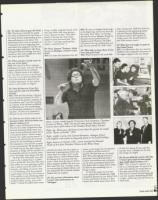
Above: Levine, conducting the University Circle Orchestra, Cleveland
started working on it?
Institute of Music, 1968. During the same period, Detroiters first
RM: It wasn't anything that formal.
became aware of his talent at the Meadow Brook Music Festival.
The two of us were in agreement that
Right, top: Eleven-year-old James Levine shows his parents his model
the book should be about music and
center on his professional career. Jim is
set for "Barber of Seville," 1954.
a very private person, which I accept
Right, middle: Levine with Leonard Bernstein, colleague, friend
because I'm a rather private person. It
and neighbor with whom he frequently dined on the Jewish holidays.
must not be inferred that he is private
because he has something to conceal.
Right, bottom: In October 1997, Levine received the National
My impression is that his life is actual-
Medal of Arts from President Clinton at the White House.
ly very conventional. We decided that
we would not pay any great amount of
cation to the music, his commitment
still plays the oboe. Jim has a piano at
attention to things that he considers to
to excellence and his notion of
home and is playing piano all the time.
be basically irrelevant to artistic issues,
growth. He feels that we can't stand
I don't know for certain, but I would
and I was happy to go along with that.
still. We're either going forward or
imagine there is a little informal cham-
He feels that the public owns the
backward. Going forward means
ber playing with musicians that they
artist as he is appearing in a public
intense concentration and evaluation
know.
I
don't
think
she
has
any
further
role as performer. But what the artist
in the most uncompromising terms.
desire to-appear publicly. She was a stu-
does when he is not playing a public
He doesn't like to repeat pieces unless
dent when they met. A student orches-
role is pretty much the artist's own
he feels he has something new to
tra was starting at Meadow Brook, and
business, providing, of course, that
bring to them.
she auditioned. She was hired instantly
it is in harmony with the accepted
In all of his career, Levine has
because she was so good.
social mores of the day. For instance,
never played the Tchaikovsky Fifth
if Jim prefers to go swimming rather
Symphony because he just doesn't feel
JN: Do you have information about
than play tennis, who cares? (As his
he has anything to bring to it that
Levine's early performances in
mother, Helen Levine, says in the
hasn't been heard many times from
Michigan?
book: "I think he suffers from some-
of what he's doing. It's not only the
way the music is played; it's the way
that things are staged.
JN: Do you think the concert with The
3 Tenors opens opera to more people
than would otherwise listen to it?
RM: "The 3 Tenors" concert, as I
see it, is nothing new. It's part of an
old, old tradition. If we go back to
the early years of the century, we
find Enrico Caruso barnstorming all
over the country demanding $5,000
a night, which was a lot of money in
those days.
7/9
1999
Detroit Jewish News
EL