

On The Bookshelf
A new biography of Aaron Copland details the life of
the composer who gave Americans their own musical language.
TheVoiCe .
ofikinerica,
The I .ife and NkOrk
of an I :nemontoo %Ian
)N\
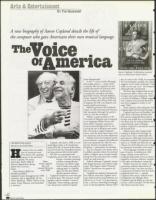
Aaron Copland: A distinctive musical
voice in American concert music.
were disappointed.
A new — and at nearly 700 pages,
downright massive — study of the
composer lifts the Copland veil and
probes the psyche of America's most
beloved musician. Authoritative,
scrupulously researched and often
gracefully written, Howard Pollack's
Aaron Copland: The Life and Work of
an Uncommon Man (Henry Holt and
Copland, who died in 1990, is a ven-
erated figure today, as he was during
much of his life. In honor of the centen-
nial of his birth this November, concerts
is name is the very defini-
are being planned all over the world.
tion of American music.
Still, few are acquainted with
Even those with a passing
Copland's personal side. He remains a
interest in the arts know
benign, avuncular personage
Aaron Copland. For many
Above:
without
a strong identity.
Americans, Rodeo, Billy the
Aaron
Copland,
His
plain
but docile visage,
Appalachian
Spring
Kid and
left, with
with its hawk nose and pro-
define their country's
Leonard Bernstein,
truding teeth, is a familiar
music.
circa 1980.
sight, but the man behind
Even director Spike Lee
the face remains obscure.
liberally sprinkled
Copland
himself was never the type
Copland's music throughout his 1998
to
spill
his
guts.
His two-part autobi-
cinematic ode to basketball, He Got
ography
was,
he
stressed,
a musical
declaring:
"When
I
listen
to
his
Game,
biography. Those seeking a glimpse
music, I hear America, and basketball
into the private world of Copland
is America."
GEORGE BULANDA
Special to the Jewish News
7/2
1999
86 Detroit Jewish News
Company; $37.50) is an eloquent and
much-needed examination.
Pollack's portrayal, like Copland's
music, is well structured and emotion-
ally restrained, although the author's
tone is a wee bit reverential.
Pollack, a music professor at the
University of Houston and a biograph-
er of composers Walter Piston and
John Alden Carpenter, possesses a
sound musical background, but his
critical eye isn't as sharp as one would
like. He tends to regard Copland's
music, even his dense later scores, with
too much awe and too little objectivity.
Pollack writes that Copland was by
nature discreet, someone who believed
that one's personal life, after all, was
private. Rumors circulated about
Copland — particularly his sexuality
— but the composer was always clever
to deflect questions about his personal
affairs. Copland never invited scandal,
being from the old school that empha-
sized tact and decorum.
Pollack addresses Copland's private
life dispassionately and without judg-
ment. The'chapter titled "Personal
Affairs" should sate the appetite of
the curious.
Copland was indeed a homosexual,
but Pollack avers that Copland never
once disavowed his sexual identity, nor
did he try to "cover" it by getting mar-
ried, a common subterfuge among gay
men in the homophobic climate of his
day. As early as the 1920s, he accepted
his homosexuality, possibly, the author
suggests, as the result of therapy. "God
made me the way I am," the composer
philosophically commented.
We learn that Copland had several
homosexual affairs, often with much
younger artists and composers. And in
a rare bit of titillation, Pollack suggest:',
that Copland and Leonard Bernstein
may have engaged in nooky in the
early 1940s.
Some implied, often obliquely, that
Copland ignored his Jewish heritage.
Copland was born in Brooklyn, but
came from Lithuanian Jewish stock.
His parents emigrated from Eastern
Europe and settled first in Scotland. Lt/
was there that the author believes the
original family name of Kaplan
became Copland in the heavily accent-
ed Scottish burr.
Pollack attests that Copland did
nothing to disguise his heritage; he
simply never was a traditionally reli-
gious person. Although Jewish music
sometimes surfaces in Copland's scores,
such as in Vitebsk and Music for the
Theatre, his chief objective was to forge
an American vernacular in his music.
That language included an amal-
gam of genres, including jazz, folk
songs, cowboy tunes and so on.
Copland deliberately strove to create a
singularly American identity, charged
with vigor and rhythmic invention.
Pollack may lose the reader in his /
c`
sometimes pedantic discussions of
Copland's music, but there are fasci-
nating areas of analysis that have been
neglected until now — namely
Copland's film music. Pollack writes
intelligently and tellingly about
Copland's special ability to write for
movies, which included The Red Pony,
The Heiress and Our Town.