

IMAGE from page 77
15, at the Star Theatre in Southfield.
"We have very different back-
grounds and are in different genera-
tions, but we connected on a human
level. I respected their lives and their
way of living, and that helped us
become close.
The film follows the drama group
as members rehearse and perform an
original play. Drawn from the comedy
and drama of the seniors' lives, the
play features elderly people looking for
dares through the personal ads.
As the rehearsals progress, the cam-
era turns to the individual members of
the group at their homes in an
attempt to uncover both the joys and
sorrows of growing old in America
and capture their longing for love, sex
and relationships.
Ibi met the seniors through her act-
ing teacher, Seth Glassman, who also
works with the theater group. They all
became acquainted at a party in
Glassman's home.
"If I had made this film with
Japanese seniors, it would have been
very different," says Ibi, 32. She
cemented her own romance while
filming and married her cinematogra-
pher, Greg Pak. "Japanese people are
very private and wouldn't talk about
things that happened in their families,
but Jewish people are very expressive."
When Ibi began working on her
film, she never dreamed the project
would go so far. The Oscar winner
had not done a documentary before,
and she thought she would learn as
she went along. She liked the medium
and is currently working on another
documentary about cheerleaders.
"The experience of making the film
has changed my life a little," says Ibi,
who also is writing a feature screenplay
about comfort girls, young women
forced into prostitution for the
Japanese army during World War II.
"I value time more, and I try to do
the best I can and have no regrets. I'm
not too afraid of getting older. Despite
the fact that there will be problems, peo-
ple can be in good spirits and enjoy life.
Whether they find what they really want
or not, pursuing keeps them alive."
Jody Podolsky came home in 1997
to film All of It (USA; 1998), which
explores a mother-daughter relation-
ship, and returns this year to discuss
the filmmaking process. Her talk
comes after the festival screening of
her movie, which starts at 5 p.m.
Wednesday, June 16, at the Star
Theatre, Southfield.
Suzanne Chessler is a Farmington
Hills-based _freelance writer.
6/4
1999
"Since it premiered in Montreal,
the film has been sold to Lifetime
cable to be shown in September and is
having foreign distribution," says
Podolsky, who directed, wrote the
script, co-wrote the score and pro-
duced the movie. "This project has
helped me learn how important it is to
be relentless in pursuit of a goal."
Already halfway into her next
script, a character-based family drama,
Podolsky works hard at getting her
characters to sound true. She believes
that too many films deal with plot at
the expense of character.
A strong character is the subject of
Soleil (France, Germany and Italy;
1997), director Roger Hanin's semi-
autobiographical film starring Sophia
Loren. Playing at 7:30 p.m. Sunday,
June 13, at the Star Theatre, the film
introduces a Jewish Algerian family
and is told in flashback.
According to Terry Lawson, Detroit
Free Press film critic, Soleil is both a
coming-of-age story of a boy who
must confront the laws of France's pro-
Nazi government and a dying man's
tribute to his indomitable mother.
"The film shows that the people of
•
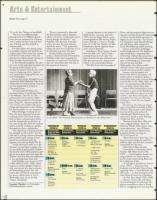
A scene from "The Personals: Improvisations on Romance in the Golden Years."
THURSDAY
- JUNE 10
SUNDAY
JUNE 13
MONDAY
SONE 14 "
TUESDAY WEDNESDAY
ZONE 15
JUNE 16
AARON BERM' STAR THEATRE, STAR 'T'HEATRE, STAR THEATRE, STAR THEATRE,
SOUTHFIELD
SOUTHFIELD
SotrrunELD
W. BLOOMFIELD
THEATRE; JCC, Soirrarnam
Free preview
of new local
documentary
Generation to
Generation
Patron
Reception:
Galleria
Officecenter
I. My Mother's
First Olympics
2. Hitchhikers
Welcome:
Dr. Jerome
Kaufman
Speaker:
Jody Podolsky
3. Mah-Jongg:
The Tiles
That Bind
4. The Personals:
Improvisations
on Romance in
the Golden Years
PAL
A Life Apart:
Hasidism
in America
In Our
Own Hands
All Of 't
2. Odessa Steps
Speakers:
Sue Marx &
David Techner
Speaker:
Rabbi Elimelech
Silberberg
1. Divine Food:
100 Years in
Kosher Deli Trade
P.M.
Soleil
Speaker:
Terry Lawson
Arit.
1. Human
Remains
2. A Letter
Without Words
Speaker:
Lisa Lewenz
MM.
Hollywoodism:
Jews, Movies 6-
The American
Dream
Introductory
Remarks:
Sandy Schreier
Autumn Sun
Speaker:
Rabbi Leonardo
Bitran
France and the people of Algeria are not
the same and that. the Jewish experience
in France and the Jewish experience in
Algeria are not the same," says Lawson.
He will preview other festival offerings
and will discuss what constitutes a
Jewish film following Soleirs screening.
Lawson, a University of Michigan
screenwriting instructor who happens to
enjoy Jewish delis, is impressed with
Divine Food, a behind-the-scenes look at
how a family-owned kosher foods corn-
pany is maintaining its 125-year tradi-
tion. He has seen and liked
Hollywoodism: Jews, Movies and the
American Dream, which takes a hard look
at studio executives and their empires.
Lawson, who has spoken at a
Jewish Film Festival in Dayton, will
explain why it is harder to define a
Jewish film today than it was to define c
a Jewish film in the 1920s, when sub-
jects were immigration and assimila-
tion and father always knew best.
"Ethnic film festivals give a sense
of history, a sense of the shared expe-
rience and different aspects of [one]
culture," says the critic/teacher, who
joined the Free Press in 1995 after
working as a critic for the Dayton
Daily News.
One person who plans on attend-
ing as many films as possible is Elliot
Wilhelm, film curator at the Detroit
Institute of Arts and author of
VideoHounds World Cinema: The
Adventurer's Guide to Film Watching
(Visible Ink Press, $19.95).
"Because Jewish films offer such
wide-ranging subjects, from the
Shoah to Woody Allen's latest, they
invite discussion," says Wilhelm,
who also introduces feature films
broadcast Friday evenings on
WTVS-Channel 56.
"When films are at their best, view-
ers come away seeing the world in a
different light and find that [cinema]
can be balm for the soul."
Other festival films include:
• Generation to Generation: Jewish
Families Talk About Death (USA;
1999) — Local Academy Award-win-
ning producer Sue Marx explores
Jewish rituals surrounding death and
the celebration of life.
• A Life Apart: Hasidism in America
(USA; 1997) — Directors Oren
Rudaysky and Salvador Daum bring
opposing views — assimilationist and
observant — to their portrayals of the
many facers of American Chasidism.
• In Our Own Hands (USA; 1998)
— Director Chuck Olin tells about
the Jewish brigade of volunteers who
played extraordinary roles in World
War II, smuggling arms, hunting Nazi