

officers in Europe and ultimately
paving the way for the founding
of Israel.
• Human Remains (USA and
Denmark; 1998) — Director Jay
Rosenblatt presents portraits of
Mao, Hitler, Mussolini, Stalin and
Franco and challenges viewers never
to surrender their lives to fools.
• Odessa Steps (USA; 1997) —
Director David Mehlman captures
the daily struggle of immigrants
from the former Soviet Union.
• Mah-Jongg: The Tiles That
Bind (USA; 1998) — Directors
Bari Pearlman and Phyllis Heller
provide a humorous glimpse at
how two cultures, Jewish and
Asian, converge in America.
• My Mother's First Olympics
(Israel; 1997) -- Director Ron
Carmeli celebrates the determina-
tion of an Israeli wife and mother
who enjoys lawn bowling despite
her blindness and prepares to par-
ticipate in the 1996 Para-
Olympic Games in Atlanta.
• Hitchhikers (Israel; 1998) —
Director Asher Tlalim introduces
a family man who picks up a var-
ied group of riders and listens to
them comment on Israeli stereo-
types and prejudices.
• Autumn Sun (Argentina;
1996) — Director Eduardo
Mignogna presents a love story
about a woman who seeks a Jewish
fiance but finds a non-Jewish tutor
in the ways of romance.
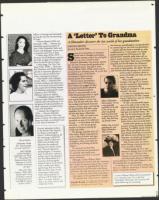
Top to bottom:
Filmmaker Keiko
Ibi: "Jewish people
are very expressive."
Jody Podolsky,
screenwriter/direc-
tor/producer of "All of
It"• "This project has
helped me learn how
important it is to be
relentless in pursuit
of a goal"
Film critic Terry
Lawson: "Ethnic film
festivals give a sense
of histog,. a sense of
the shared experience
and different aspects
of [one] culture."
General admission tickets
to the Jewish Film Festival
are $6 per screening/$5
seniors. A festival pass to all
the screenings is $451$35
seniors. Patron tickets are
$250; they include early
admission for preferred
seating and a patron recep-
tion. General admission
seating begins 15 minutes
prior to the show. Advance
tickets may be purchased at
the West Bloomfield JCC
in person during regular
business hours; or by phone
with a credit card. Space
permitting, they are avail-
able one hour prior to the
.
screening at each venue.
Only tickets paid for in
advance will be held at the
door. For more informa-
tion or to order tickets, call
(248) 661-7649.
A `Letter' To Grandma
A filmmaker discovers the lost world of her grandmother.
tion between granddaughter and grandmoth-
er, connecting two eras and two generations.
Special to the Jewish News
Lewenz said she chose to embark on what
would
become a 17-year project "to change
ome of us remember our deceased
people's
perceptions of German Jews. My
loved ones in thoughts and dreams.
grandmother's
materials really share with us
Others attempt contact by writing let-
what it meant moment-to-moment [to be in
ters we never intend to send.
Germany at that time]. There was an incredibly
Baltimore filmmaker Lisa Lewenz remem-
beautiful and rich life before the Holocaust."
bers her late German-Jewish grandmother,
Ella Lewenz was Jewish, but Lisa Lewenz
Ella Arnhold Lewenz, through A Letter
was
raised an Episcopalian. Her father "felt that
Without Words (USA; 1998), which will be
anti-Semitism had been going on for centuries,
screened 8 p.m. Monday, June 14, at the Star
and he made a conscious choice to
Southfield as part of the Jewish
protect his family and make our lives
Community Center's Lenore
better," she said.
Marwil Jewish Film Festival.
When discovering her Jewish
The 62-minute documentary
heritage at the age of 13, Lewenz
premiered at the 1998 Sundance
said she retained her Episcopalian
Film Festival and snagged the Best
religious orientation. But
Documentary/Audience Award at
"[Judaism] enriched it. I felt a sense
the Denver International Film
of pride," she said.
Festival. It aired nationally on the
In order to complete her exten-
Public Broadcasting System in April.
sive research for the film, Lewenz
Lewenz's grandmother died
lived in Berlin for a year in 1993 as
nine months before Lewenz was
a Fulbright Scholar.
Above:
Filmmaker
born. The 44-year-old artist, who
"It was a very powerful experi-
Lisa Lewenz: "It was
has worked with famed American
ence to be able to live in the city
a very powerful
sculptor Christo, grew up knowing
experience to be able where my family had once lived
her grandmother had been a pho-
and to spend time in the house that
to live in the city
tographer, but she never realized
where my family
had been my family's home," she
she had also been a filmmaker.
had once lived and
said. On the other hand, she also
Then, in 1981, as Lewenz root-
to spend time in the called the period deeply "troubling,
ed around her father's attic, she
house that had been because I felt so connected to the
stumbled on reels of 16-millimeter my family's home."
darker history that occurred there."
footage — in both black-and-white
Lewenz said reaction to the docu-
and color — shot by her grand-
Below: Lisa Lewenz's mentary among her family members
mother in Germany during the
grandmother and
has been "incredibly proud, which is
fellow filmmaker,
1920s and 1930s.
great. When you spend that many
Ella Lewenz.
The footage included shots of
years doing something, no one actu-
Nazi rallies, family acquaintances
ally believes you're doing [it]. For a
such as Albert Einstein and signs
long time, my family just thought I
boasting anti-Jewish sentiments —
was being extraordinarily lazy."
all despite a Nazi censorship law
Still, Lewenz does not recom-
prohibiting the filming of Jewish
mend filming a documentary on
subjects.
one's own life or family.
To construct her first film,
"I think people say it's so easy
Lewenz interwove her grandmoth-
because it's familiar, but it's very diffi-
er's material with family testi-
Cult," she said. "There's no line
monies and scenes shot in contem-
between your private life and this
porary Germany.
work that you're doing. It's difficult to
Although A Letter Without Words
remain
objective.
I'm the main character in the
is a documentary, Lewenz said she "construct-
film
chasing
after
my grandmother."
ed it to give it a narrative that is like a novel."
long run, she described making the
the
In
In order to trace her grandmother's life, she
film as a "cathartic experience. It doesn't really
tracked down her grandmother's old diaries
blame. It looks for answers." ❑
and letters. She also returned to the exact loca-
tions — at the exact time of day and season
A Letter Without Words will be screened 8
— that appear in her grandmother's footage.
p.m. Monday, June 14, at the Star
The project thus evolved into a collabora-
Southfield. Filmmaker Lisa Lewenz will
speak following the screening.
Amanda Krotki is a staff writer at our sister
publication the Baltimore Jewish Times.
AMANDA KROTKI
s
Detroit Jewish News