

Memorial Day
ESTHER ALLWEISS TSCHIRHART
Copy Editor
la
Rabbinic
Patriots
in his new book,
The Fighting Rabbis, 1.1
a rabbi-colonel explores
the role played by
Jewish military chaplains
in American history.
5/28
1999
.80 Detroit Jewish News
onday, May 31, is Memorial Day in
the United Stares, the day designated
for remembering those who died in
America's wars.
While Jews — and Jewish chaplains — have a
long tradition of military service to this country over
the past three centuries, that history is not widely
known.
Rabbi Albert Isaac Slomovitz, a colonel and
senior chaplain at the Naval Air Station in
Pensacola, Fla., has written about rabbinical patriots
in the armed forces in The Fighting Rabbis: Jewish.
A/Mita?), Chaplains and American History (New York
University Press: $35). He makes the case that "rab-
bis and their Christian colleagues, working together
as military clergy, helped create a practical ecu-
menism that promoted interfaith understanding."
During the American Revolution, 50 officers
were among the approximately 100 Jews who enlist-
ed in the Continental army. Gen. George
Washington believed that a unified army allowing
for the free exercise of reli-
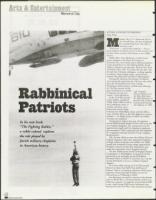
gion would serve as a model Left: Chaplain
of tolerance for the new
Maurice Kaprow uses
nation," writes Slomovitz.
the Holy Helo (short
In the Civil War, Jewish
for Holy Helicopter) to
Union soldiers numbered
g et from ship to ship to
6,500, while 2,000 served in visit personnel during
the Confederate Army. A
the Gulf war in 1991.
combat unit from a pre-
dominantly Jewish neigh-
borhood near Philadelphia chose a Jewish officer,
Capt. Michael Allen, as the 65th Regiment's spiritu-
al leader ---, an illegal action, as Allen was neither
Christian nor ordained.
Attempting to make a test case, the regiment
invited Rabbi Arnold Fischel of New York to be the
new chaplain-designate. The controversy over his
appointment raged until the chaplaincy regulation
was amended in 1862, requiring only that chaplains
be "a regularly ordained minister of some religious
denomination."
Still, the first rabbis to enter the military did so as
hospital chaplains rather than regimental chaplains.
As large military hospitals were staffed, two rabbis
joined with hundreds of other clergy appointed by
President Lincoln and the War Department and
under the supervision of the Surgeon General.
The first, Rabbi Jacob Frankel of Rodeph Shalom
Congregation in Philadelphia, arranged for Jewish
personnel to get furloughs on Jewish holidays.
Bernhard Henry Gotthelf of Louisville, Ky., was the
second individual to serve as a military hospital
chaplain.
Of civilian rabbis during the Civil War period,
Slomovitz relates that Rabbi Max del Banco of
Indiana "died in a steamboat explosion while return-
ing from conducting High Holiday services for
Union forces at Vicksburg in 1864."
•
Anti-Semitism increased in America in the decades
prior to World War I, and the patriotism of Jews was
called into question. In response, activist Simon Wolf
wrote a book listing 8,000 Jewish individuals who
had served in the Civil War, with comments of praise
c_\