

For The Hungry
ALAN ABRAMS
Special to the Jewish News
ichard A. ("Rick")
Loewenstein runs one
of the largest food dis-
tribution networks in
the Midwest. But unlike his peers
in the food chain, his business is
not out to make a profit.
The 38-year-old Loewenstein is
the president of the Gleaners
Community Food Bank, the oldest
and largest food bank in Michigan.
Although Gleaners is a non-profit,
Loewenstein has successfully
applied business methodology to its
operations.
"The business of a non-profit is
really what were engaged in here,"
said Loewenstein. Its a business.
And we run it as a business. We
have a responsibility not to our
shareholders, but to our communi-
ty and our donors. And our share-
holders are our donors.
Loewenstein is only the second
president of the Gleaners in its 22-
year history. But he is the first with
retail and food service experience.
He also is fascinated with the
food bank's links to Jewish tradi-
tion. Our name, Gleaners, comes
from the Book of Ruth. And Joseph
was the first food banker.
Essentially, as Jews, we were taught
early on to share our harvest with
those who were less fortunate. So
whether the less fortunate are
white, black, Catholic, Jewish or
Arabic, it is still in our nature as
Jews to give back to the communi-
ty," said Loewenstein.
Gleaners distributes more than
15 million pounds of food annual-
ly to 300 agencies that provide
nutritious meals to the hungry of
southeastern Michigan. Of the 1.2
million meals served monthly in
the five-county Detroit area, close
to 50 percent go to children and
seniors, plus the disabled, the ill,
single-parent households and that
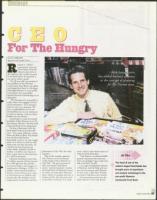
Rick L©er stein
has added business imen
to the concept of gleaning
for the Detroit area.
r.
Lou.senstein has taken
Gleaners to e
€
phenomena of the '90s: the work-
ing poor.
One of the member agencies
that Gleaners and Loewenstein
works closely with is Yad Ezra in
Oak Park. "We pick up some of
their non-kosher food (dona-
tions)," said Loewenstein, "as does
the Food Bank of Oakland County.
In return, we send them fresh pro-
duce, which is a product that (a): is
kosher and (b): that they have had
to purchase in the past. It is recip-
rocal, which is the whole essence of
what the food bank does.
"This Passover, we donated 8,000
pounds of potatoes that went into
their care packages. I get a rush to be
able to do that," he said.
Lea Luger, development director
of Yad Ezra, said the help and sup-
port of Loewenstein and Gleaners
is vital to the 1,000 client families
serviced by Yad Ezra every month.
As Loewenstein points out, the
food industry is rich with Jewish
At
The head of one of the
nation's largest food banks has
brought years of experience
and modern technology to the
non-profit Gleaners
Community Food Bank.
5/21
1999
Detroit Jewish News
67