

"Get specific" or "Study opening
San Diego Zoo and considered a
lines," that corresponds to a chapter
career as a scientist; at the same time
T in the book. Chapters may be read
she took acting classes and acted in
in any order, and each offers practi-
avant-garde theater in San Diego.
cal advice for writers based on anec-
After moving to Berkeley, Calif,
dotes and tips from a broad range of
and taking jobs in diverse fields,
contemporary and historic authors,
including impOrtinig folk art masks
as well as Epel's own suggestions.
from Mexico, Epel began her literary
For Epel, writing is a natural reflec-
escort Career in 1989. Now, she's
tion of her general curiosity and desire
become very popular in her field, and
to learn. "I consider myself a
researcher in almost everything
I've done. I like to ask ques-
tions," she says.
Getting writers to "open up"
isn't always easy, she's found, and
the best writers are not necessari-
ly, the best conversationalists.
"At first people want to protect
themselves," she notes. "Some
varir to be quiet because they
want to put all their energy into
their public appearances."
Epel brought to her projects
interviewing skills she developed
deck
working in market research, as a
private investigator for a law
firm and as co-host of Booktalk
on a San Francisco radio station.
"I usually begin by asking,
- Have you ever had a dream
that influenced your work?" she
writes in Writers Dreaming.
Authors describe dreams that
helped them with book titles
and plots, characters and sub-
ject matter.
Elmore Leonard told Epel
that during the early years of
this career, he dreamt of falling
off rickety ladders and down
flights of stairs or of being stuck
in his advertising agency with a
lifetime supply of food. Epel
writes that William Styron
wrote the opening paragraphs
of Sophie Choice after dreaming
about a woman with tattooed
numbers on her arm.
Interested in dreams since
her 20s, Epel worked at a
California residential treatment
center, where dream analysis
was used to treat schizophrenic
adolescents and adults. Years
later, she became a dream
"facilitator," helping people
• nterpret their dreams and use
them creatively.
Epel attended the University
of Michigan and studied film-
making and biology at the
University of California at San
Diego, from which she graduat-
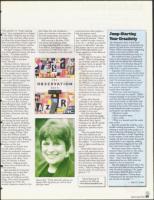
Naomi Epel: "Think about the need you are
ed. During the 1970s, she
hoping to fill, the person you wish to touch
worked in genetics research at the
with your work."
OBSERVATION
sometimes hires other people to
help during busy times.
While being an author was not
something she planned, "I knew
that I wanted to make a mark in
some way — perhaps as a scientist
or actor or filmmaker," she says.
Her parents, Beatrice and Joseph
Epel of West Bloomfield, were
always supportive of her efforts to
find her niche.
"My dad was my guru," she
recalls. When I was growing
up, he always told me, 'You're
so smart. You're so special.' He
taught me to focus on the
positives."
Epel's parents and four
siblings are mentioned in
The Observation Deck, for
which sales have been good,
says Epel. Based on e-mail to
her Web site, it is popular
with "literate people from all
over the country who write.
Most are women. Some are
professional writers and oth-
ers want to be more cre-
ative."
Author John Berendt
(Midnight in the Garden of
Good and Evil) called The
Observation Deck "the most
innovative, practical guide to
writing I've ever seen."
Now that she's finished
most of the speaking engage-
ments and promotion for The
Observation Deck, Epel is
working on an idea for anoth-
er project, one about self-
exploration and the creative
process.
"How do people find out
what their talents are and
what we're put on this earth to
do? I don't write just to write,"
she explains. "I write because I
want to figure something out
myself."
Meanwhile, Epel contin-
ues to seek opportunities to
lead workshops about writ-
ing and the creative process.
She hopes to develop a syn-
dicated radio show and teach
in a University of California
extension program. As she
notes, "Talent is doing what
you do easily. Do what you're
good at." ❑
Naomi Epel may be
reached at her Web site,
www.observationdeck.com .
Itunp-Starting
Your Creativity
The Observation Deck: A Tool Kit for
Writers offers inventive and practical sug-
gestions for both fiction and nonfiction
writers. What's encouraging to beginning
writers is the book's revelation that
famous writers sometimes get stuck, too.
For would-be writers, a good first
lesson is the realization that ideas and
words will not always flow effortlessly
and quickly; serious bumps along the
way are neither uncommon nor neces-
sarily fatal to a good end-product.
Regardless of the format or subject
matter, writes Epel, a writer should "think
about the need you are hoping to fill, the
person you wish to touch with your
work. Put someone's picture over your
desk, or keep your ideal reader in mind."
Based on what has enhanced her
own creative process, Epel recom-
mends these techniques:
• Read your work out loud to a
friend or even just to yourself. (While
writing Midnight in the Garden of Good
and Evil, John Berendt phoned his
voice mail number in New York, read
into the phone, then dialed back and
listened to his words. The sound of his
words helped him make corrections
and improve the rhythm and flow.)
• Eliminate words.
• Write yourself a letter.
• Take a walk.
• Write in a journal until the words
start to flow.
Epel also stressed the need for a corn-
fortable working environment. "I find it
calming to work with other people, so I
take my dog and a shopping cart with my
computer and files to a cafe. Depending
on the weather, I work either indoors or
outside. My dad was worried that people
would think I was a bag lady, walking
around Berkeley, dragging all that stuff,
but I can't work at home," says Epel.
For every writer, there comes the
moment when you have to ribe tuchus,
which translated from the Yiddish
means, "rub your bottom on the
chair." That's what Epel's father
admonished her as a child when she
needed to do her homework.
Her book dispenses the same advice, "Sit,
even if you don't think you have anything to
write. Sit until the muse says, OK, I guess
you're serious. Maybe I'll drop in and dis-
pense a little inspiration.' If you're always
running around, she may never find you. So
put your seat on that chair." 17
fi
— Shari S. Cohen
`‘.
'T. •
ar
e
4/30
1999
Detroit Jewish News
87