
Husband-Wife Collaboration
At Michigan Theater
MORRIE WARSHAWSKI
Special to The Jewish News
W
hen Kurt Klein emi-
grated to the United
States from Germany
in 1937, he was a
bright, energetic 17-year-old boy full
of ambition and the brash confidence
of youth. He was sure that through
hard work and some patience, he
could secure visas and ship passage
for his parents to escape the Nazis.
Klein's first impression of
America was formed by the sight of
a looming Statue of Liberty and a
Wrigley's spearmint gum billboard
— two potent symbols for the free-
dom and free-spiritedness of his
new homeland.
What Klein could not know then,
and cannot comprehend to this day,
was the web of bureaucratic lies,
dense red tape and immovable brick
walls that his newly adopted govern-
ment would erect in one of the sad-
dest chapters of American history.
At 9 p.m. Monday, April 12, just
in time for Yom HaShoah, which
falls the next day, Detroit's Public
Broadcasting System affiliate,
WTVS-Channel 56, will present a
90-minute documentary, "America
and the Holocaust: Deceit and
Indifference," as part the PBS
'American Experience" series.
PBS has launched a Web site for
the program, first aired in 1994, at
www. pbs.org/amex/holocaust. The
site includes additional information
and discussion guides.
"America and the Holocaust" is a
riveting and scathing indictment of
the U.S. response to Nazi persecution
of Jews during World War II. It is
crammed with evidence, images and
recollections that will make many
Americans — Jews and non Jews alike
— ashamed of their country's leaders,
major institutions and citizenry.
Director Michael Ostrow, who
also wrote the script, has created a
clever framing device for the pro-
gram by interspersing a history of
the war with the personal history of
Morrie Warshawski writes about
culture and the arts from his
home in St. Louis.
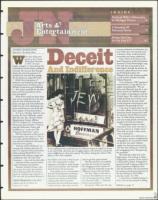
As the nightmare that would become the Holocaust began to unfold in Europe
in the mid-1930s, American Jews struggled against anti-Semitism and govern-
ment indifference in their own country. This photo, dating from about 1943,
depicts a New York storefront.
Kurt Klein as he tries to free his par-
ents. The counterpoint is often
poignant, and helps to make human
sense of the inhuman and clinically
aloof decisions by bureaucrats.
One minute we see a memorandum
from the State Department ordering a
slowdown in the process of granting
visas; the next minute we hear Klein
reading a letter from his parents
interred in the Gurs detention camp in
southern France, where they can never
seem to get their papers cleared.
The documentary very carefully
provides the context for America's
foot-dragging and the creation of
paper walls that ultimately meant the
difference between life and death.
The first villain in the story is
America's formidable pre-war sys-
tem of immigration laws, which
one historian called "... blatantly
biased and prejudiced."
During the 1920s and '30s, this
country embraced anti-Semitism as a
way of life. Jews were denied access
to beaches, clubs, medical schools,
universities and many professions.
More villains of the time are the
State Department itself and Assistant
Secretary of State Breckinridge Long.
Not only does Long endorse anti-
alien bigotry through his policies, he
institutes a planned and covert strate-
gy of hiding facts about the
Holocaust from the American public
as well as from President Franklin
Delano Roosevelt.
In his infamous 1940 "postpone"
memorandum, Long tells his con-
sulates internationally: "We can
delay and effectively stop for a tem-
porary period of indefinite length
the number of immigrants into the
United States. We could do this by
simply advising our consuls to put
every obstacle in the way which
would postpone and postpone and
postpone the granting of visas."
I am sorry to report that one of
the other villains in this story is the
American Jewish community itself.
As historian David Wyman points
out, "A weak Jewish community
and non-caring Jewish community
equaled a formula for disaster."
The program points out that
many Jews were, until very late in
the war, reticent to "make waves."
They did not wish to draw atten-
tion to themselves.
For example, one rabbi gives a
Yom Kippur sermon castigating his
congregation for its passivity based
on the fear that their children
might lose their government jobs.
The day after fasting he is fired by
the congregation for "disrespecting
the president."
This dark story does have a few
bright spots. One of them is Henry
Morgenthau, secretary of the treasury
in Roosevelt's Cabinet. Morgenthau
presses his staff to dig up evidence of
State Department duplicity, then
risks his friendship with the president
by making a personal presentation of
the facts during an Oval Office
meeting on Jan. 16, 1944.
Asecond hero is Rabbi Stephen S.
Wise, who devotes himself to telling
DECEIT on page 71
4/9
1999
Detroit Jewish News
67
Scanned image of the page. Keyboard directions: use + to zoom in, - to zoom out, arrow keys to pan inside the viewer.
April 09, 1999 - Image 123
- Resource type:
- Text
- Publication:
- The Detroit Jewish News, 1999-04-09
Disclaimer: Computer generated plain text may have errors. Read more about this.