

•
Learning To Scroll Torah
igh Tech Jewish
ligation
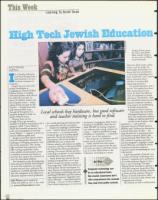
Lindsay Peisner moves
the mouse and Rachel
Klein watches closely as
the two create a Hebrew
crossword puzzle.
JULIE WIENER
StaffWriter
' t's a Tuesday afternoon,
and Noah Krugel looks a
little frazzled as he scur-
ries from computer to
computer.
Krugel, the part-time tech-
nology coordinator at
Congregation Shaarey Zedek's
Hebrew school, is working
with third graders, each class in
for half-hour intervals. As
about 20 children clamor into
the computer room — many
asking if they can play on the
Internet — Krugel seats them
and instructs them to go
through all the games on a
program designed to help rec-
ognize Hebrew letters.
Because there are not
enough CDs to go around, a
handful of children instead play with a
program called "I Love Hebrew,"
which has beautiful animation, but —
with entire paragraphs.of conversa-
tional Hebrew — appears to be for an
entirely different grade level.
Krugel's somewhat chaotic session
with the third graders illustrates the
challenges of bringing computers into
the Jewish classroom. The cutting-
edge machines look impressive and
offer exciting capabilities: audio,
video, global communication, access
to research materials and hands-on
activities that capture the attention of
even the most jaded children.
But hardware is only the beginning.
Most educators familiar with comput-
ers stress that computers are simply
another tool and not a substitute for
teachers or a carefully planned curricu-
lum. For computers to be effective in
education requires trained profession-
Education Week article, policy
makers and the public are
increasingly demanding "evi-
dence that their investments
in education technology have
been worthwhile" and "experts
lack a consensus about
whether it is measurably
improving education."
For Jewish education, less is
known. No studies have been
done measuring even the
scope, let alone the effective-
ness, of computers in Jewish
education. Nonetheless, while
few centralized resources exist, (--\
separate computer-in-educa-
tion projects are proliferating
in Jewish communities
throughout North America.
Universities like the Jewish
Theological Seminary in New
York City and Boston's Hebrew
College are offering adult-level
courses via the Internet, while
the former Congregation Beth Achim
institutions
— such as Jewish
building in Southfield. Akiva has set
Service
of North America
Education
aside $50,000 for buying computers
and
Coalition
for Alternatives
(JESNA)
and software and is using a parent vol-
Education
(CAJE)
— are
in
Jewish
unteer — software distributor Irving
to
post
lesson
plans
Internet
using
the
Goldfein of Southfield — to facilitate
teachers'
resources.
JESNA
also
and
teachers' use of the equipment.
sponsored Jewish Web Week (Feb. 21-
But computers in education are still
26), a series of in-person and cyber-
pretty much uncharted territory.
activities designed to highlight notable
Public schools have been experi-
Jewish
Web sites and heighten Jewish cE/
menting with computers for the past
awareness of relevant computer
20 years, but there is still little consen-
resources (check www.jww.org for more
sus as to their effectiveness in the
information).
classroom. According to a recent
A growing number of Jewish com-
munities
are hiring "technology coor-
UNEINr
E
• =near
dinators," computer-savvy profession-
• ower
als to help educators figure out how
W•
a
best to use technology. Chicago's
m4
4 IN a
Talmud Torah Association operates a
$150,000 computer department that
Computer technology can
helps Jewish schools develop technolo-
be an educational boon.
gy plans and buy software. Boston's
Bureau of Jewish Education offers
But Jewish classrooms don't
similar services for its day schools and
offer programmers the rewards congregational schools.
But schools are still a small portion
they reap from public schools.
Lo cal schools buy hardware, but good software
and teacher training is hard to find.
Julie Wiener can be reached at
(248) 354-6060 ext 247, or by e-mail
at: jwiener@thejewishnews.com .
3/19
1999
n n+tni+
101A /I C ELAI PIA/C
als, careful planning and software that
is compatible with the curriculum.
Despite the challenges, Jewish educa-
tion — both in Detroit and elsewhere
in the nation — is moving into the
computer age and is investing signifi-
cant cash. The Jewish Federation of
Metropolitan Detroit has budgeted
$700,000 this year to equip area
Hebrew schools with Internet-accessible
computers, develop an educational Web
site and provide relevant professional
training. The money will also pay for a
technology coordinator to train teachers
and help them choose software.
Many Jewish day schools also are
looking to expand their use of com-
puters. As part of a newly unveiled
long-range plan, Hillel Day School of
Metropolitan Detroit anticipates hir-
ing a director of educational technolo-
gy, developing a technology plan and
spending $100,000 a year for technol-
ogy-related expenses. Upgraded com-
puter offerings — and related teacher
training — are part of Akiva Hebrew
Day School's planning as it moves into
.
?4
•
k•