

of the Jewish software industry.
According to Irving Rosenbaum,
president of Chicago-based Davka
Corporation, the Microsoft of Judaica
software, only 1,500 of the company's
60,000 clients are schools, with most
sales to adults wanting to expand their
knowledge or parents seeking enrich-
ment for their children.
Most Jewish day schools now use
computers — at least somewhat — as a
teacher's tool and in the classroom for
general studies. They are also starting
to use them in Judaic studies classes.
With 40 computers all hooked up to
the Internet, Hillel has the most exten-
sive resources locally, with students
using the technology for everything
from research projects to practicing
Hebrew. Akiva, which has a 20-com-
puter lab of older machines and a hand-
ful of computers distributed among the
classrooms, uses them for drilling
Hebrew skills, creating the yearbook
and teaching basic computer skills.
Yeshiva Beth Yehudah is not wired
to the Internet and uses computers
only somewhat for Judaic studies,
mostly to give students extra practice
with Hebrew or to help teachers pre-
pare Hebrew-language worksheets.
However, it recently implemented
technology (using a video camera and
Internet connection) enabling a
severely ill and homebound student to
watch and communicate with her class
throughout the school day.
A Federation Initiative -
Until now, most local congregational
schools have been only spectators in the
computer revolution. But, with the
$700,000 initiative through the Jewish
Federation of Metropolitan Detroit and
its Alliance for Jewish Education, con-
gregational schools — most of which
are financially strapped — are entering
the fray. Schools will receive anywhere
from one to five computers, depending
on their size and financial need.
In addition to offering hardware
and training, Federation has created
an accompanying Web site: Michigan
Jewish On-line Education (MJOE),
due to go online this month, six
months behind schedule.
Intended for use both in school and
at home, MJOE (vvvvvv.mjoe.edu)
focuses on the bar or bat mitzvah: the
hows, whys, history and a compilation
of Detroiters' stories and pictures from
their b'nai mitzvah. The site, which
was developed with help from
University of Michigan's Department
of Academic Outreach, includes a
teacher's guide, discussion groups for
kids and their parents and links to
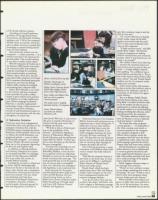
Above, clockwise from top left:
Brandon David types in
Hebrew vocabulary words.
Media Center Director Rachel
Erlich helps Andrew Bialor
(front) and Cliff Haimann.
Photos by Krista Husa
Betsy Callan and Allyson Rice
look over their computer
crossword puzzle.
The media center is brightly
decorated and has 12 computers.
Center: Teacher Hanna
Levy looks over Michael
Novinsons work.
other Jewish Web sites. It may eventu-
ally grow to include information on
other Jewish life cycle events, like
weddings and funerals.
"We look at this as a Detroit gate-
way to the possibilities of the
Internet," said Harlene Appelman,
director of Federation's Alliance for
Jewish Education and the staff person
responsible for MJOE. "It filters peo-
ple in some directions so the Internet
becomes manageable."
The foray into technology was one
of two pilot projects (the other was
Rekindling Shabbat, a series of activi-
ties to generate interest in celebrating
Shabbat) to come out of a task force on
Jewish continuity three years ago. "The
work group felt that one of the projects
that no one was able to accomplish
alone was a first foray into cyberspace,"
said Appelman, in an e-mail interview.
Early advocates for the project
included philanthropists Judge Avern
Cohn and Bill Berman, who con-
tributed startup funds, as well as
Rabbi Irwin Groner of Shaarey Zedek,
Rabbi Harold Loss of Temple Israel
and former AJE Director Howard
Gelberd, said Appelman.
Federation Executive Vice President
Robert Aronson said computers are an
important way to reach young Jews. "I
think that if we can train teachers
properly and help them access the
proper sites on the Internet, it can
make synagogue learning a lot more
fun and a lot more interesting," he
said. "All these kids are very computer
literate and the more Jewish education
that we can bring them through the
Internet the better off we'll be."
One of the big attractions to using
computers in the Hebrew school class-
room is simple: they hold children's
attention.
"Kids like the computer because it
puts them in the driver seat, it's inter-
active and it's different," said Rachel
Erlich, director of Temple Israel's
library and media center.
Temple Israel, which has had a
media center since 1996, and Shaarey
Zedek's Laker Complex are the only
local congregational schools with
extensive computer facilities.
"I can get 24 kids in here and you
can hear a pin drop," said Erlich, who
holds a degree in information manage-
ment from University of Michigan. "It
gets their attention, keeps it and the
kids do have fun.
On a recent afternoon in Temple
Israel's media center, all the fifth
graders interviewed used the word
"fun" at least once to describe their
time on the computers.
"It helps me learn more," said fifth
grader Betsy Callan. "My favorite
computer programs are making
Hebrew word searches and crossword
puzzles, which is cool because you can
make it up yourself."
Her teacher, Hanna Levy, likes that
— because the computer points out
and corrects errors as soon as they are
made — it helps children improve
their spelling. "It's a different way to
teach Hebrew and they like it. This is
one of the ways to attract kids to after-
noon school," she said. Temple Israel's
students use the 12-computer media
center once a month.
Erlich works closely with teachers
plan activities that reinforce what is
ned in the classroom, and she is
!lear
!learned
constantly on the lookout for appro-
priate software.
But, as at Shaarey Zedek, Temple
Israel has found software to be a stum-
bling block. A number of software tides
are on the market, but they are not as
sophisticated or varied as the offerings
for secular studies, so it can be frustrating
finding something that enhances, rather
than distracts from, the curriculum.
"The Judaic software industry isn't
there yet because it serves a relatively
small population," said Erlich.
She noted that many programs
contain glitches — it's impossible to
edit when creating word search or
crossword puzzles on the computer
and a program designed to drill
Hebrew letters operates under the
assumption that kids learn the letters
in alphabetical order, rather than the
whole language approach favored by
Temple Israel and many other schools.
Davka's Rosenbaum conceded that
Judaic software \is not as sophisticated
or varied as general educational soft-
ware, explaining development costs are
high while market potential (with Jews
just a small percentage of the popula-
tion) is relatively small.
Erlich suggests educators adapt to
the shortage with creativity.
"There's no way a software compa-
ny can design something that works in
all settings," she said. "If they're smart,
they'll create more programs where
you can design your own features."
Where possible, Erlich adjusts pro-
grams to make them more relevant to
the rest of the curriculum. For exam-
ple, on Jewish Baseball IQ and Jewish
3/19
1999
Detroit Jewish News
23