

HARRY KT RS BAU M
StaffWriter
0
n March 23, the Jewish
Federation of Metropolitan
Detroit will wrap up its
1999 Allied Jewish
Campaign, but the people responsible
for:where the money is spent will still
have three months of work to do.
The leaders of the three planning
and budgeting divisions of Federation
will be huddling around a conference
table and crunching numbers to
decide how much money will be allo-
cated to each Federation agency.
The Culture and Group Services
Division, the Jewish Education
Division and the Community Services
Division have until June 15 to come up
with a single allocation total to present
to the Board of Governors for approval.
These division members have sat
through weekly meetings since
January, listening to budget requests
from various Federation agencies, but
in May, five months of meetings turn
into two weeks of crunch time.
"You sit around a conference table,
and you have a big board and you write
down what each agency has asked for
and total it," said Allan Nachman, a
Federation vice president. "Then you
start bargaining back and forth."
On March 21-23, some 400 volun-
teers will call donors during .the final
three days of the Days of Decision
phone-athon, -wrapping up a 1999 cam-
paign that seeks to raise a total of $29.6
million. When...that's over, the action
switches back to Nachman's team.
At the first of the year, he said,
Federation gives each budgeting divi-
sion a rough estimate of what it can
expect from the annual campaign. The
divisions canvass the agencies they
underwrite to get a handle on how
much costs may grow for existing pro-
grams and what ideas they have for
new or expanded services.
The divisions do not share informa-
tion until the next step, when about
25 chairpersons and co-chairpersons
of each of the budgeting divisions
meet as members of the Planning and
Allocations Steering Committee
(PASC), and a total number is figured.
PASC members are "seasoned,
knowledgeable and professional volun-
teers who really understand the
process and understand the agency
operation," said Nachman, a former
three-time PASC chairman.
Harry Kirsbaum can be reached at
(248) 354-6060, ext. 244, or by e-mail
at hkirsbaum@thejewishnews.com
3/19
1999
10 Detroit Jewish News
be,
Allot
Divvying up
the Campaign
contributions is
a lengthy process.
These past few years have been
good for the Campaign because of the
gains in the stock market, but
Nachman remembers a harder time for
fund raising back in the late 1970s and
early 1980s when inflation, recession
and the flight of population away from
the rust belt states took their toll.
"There have been times that we've
asked each agency to make a cut
because it looked like the Allied
Jewish Campaign wasn't going to
make its goal," he said.
But the cuts were not across the board.
"I don't like to talk about cutting,"
Nachman said, "but if we had to cut
dollars, the odds are that we'd rather
cut other programs before we cut for-
mal education, which has always been
a high priority"
There is no formula to adjust allo-
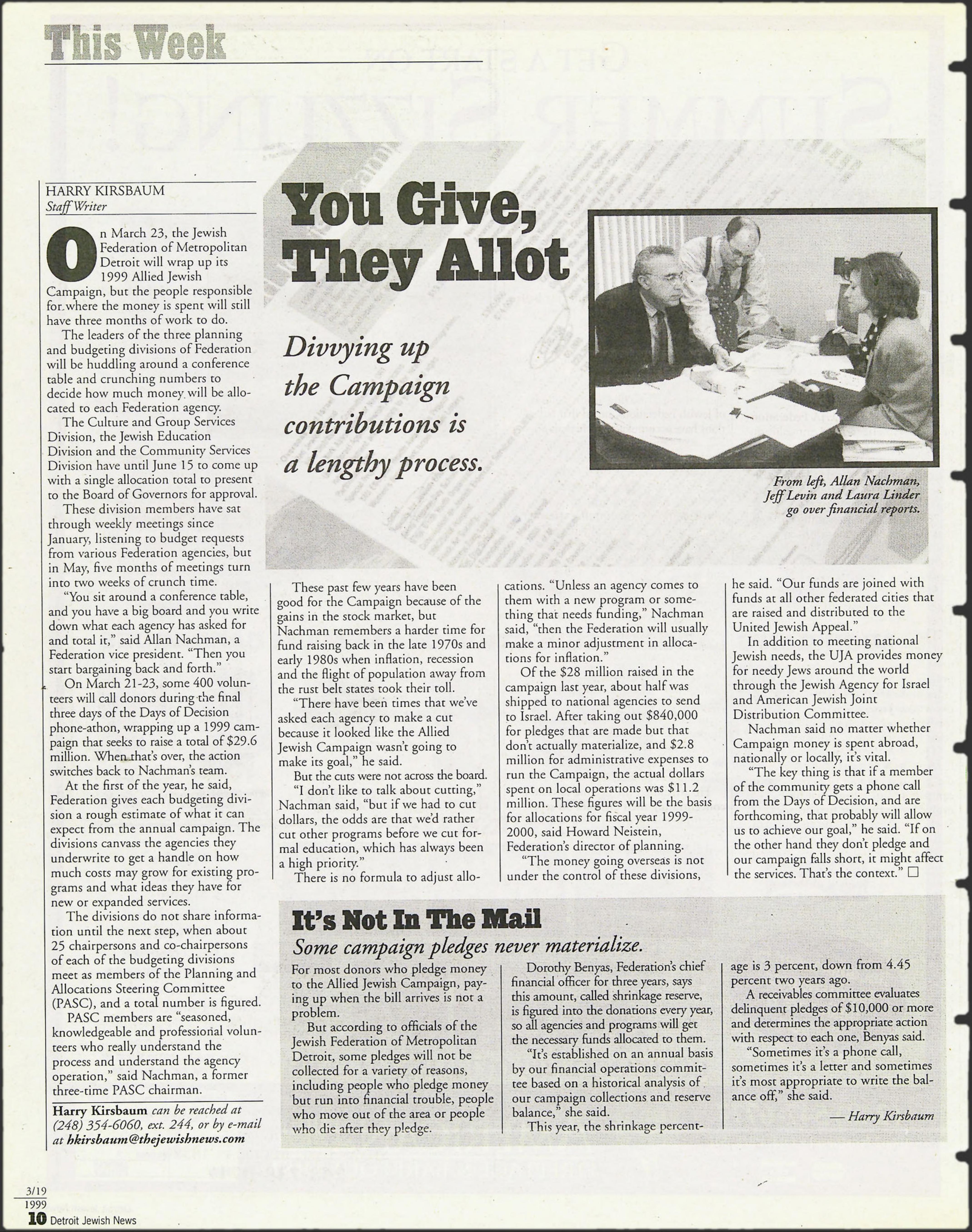
.from left, Allan
Jeff Leviii and Laura
go over financial
cations. "Unless an agency comes to
them with a new program or some-
thing that needs funding," Nachman
said, "then the Federation will usually
make a minor adjustment in alloca-
tions for inflation."
Of the $28 million raised in the
campaign last year, about half was
shipped to national agencies to send
to Israel. After taking out $840,000
for pledges that are made but that
don't actually materialize, and $2.8
million for administrative expenses to
run the Campaign, the actual dollars
spent on local operations was $11.2
million. These figures will be the basis
for allocations for fiscal year 1999-
2000, said Howard Neistein,
Federation's director of planning.
The money going overseas is not
under the control of these divisions,
he said. "Our funds are joined with
funds at all other federated cities that
are raised and distributed to the
United Jewish Appeal."
In addition to meeting national
Jewish needs, the UJA provides money
for needy Jews around the world
through the Jewish Agency for Israel
and American Jewish Joint
Distribution Committee.
Nachman said no matter whether
Campaign money is spent abroad,
nationally or locally, it's vital.
"The key thing is that if a member
of the community gets a phone call
from the Days of Decision, and are
forthcoming, that probably will allow
us to achieve our goal," he said. If on
the other hand they don't pledge and
our campaign falls short, it might affect
the services. That's the context." II
Some campaign pledges n ever materialize.
For most donors who pledge money
to the Allied Jewish Campaign, pay-
ing up when the bill arrives is not a
problem.
But according to officials of the
Jewish Federation of' Metropolitan
Detroit, some pledges will not be
collected for a variety of reasons,
including people who pledge money
but run into financial trouble, people
who move out of the area or people
who die after they pledge.
Dorothy Benyas, Federation's chief
financial officer for three years, says
this amount, called shrinkage reserve,
is figured into the donations every year,
so all agencies and programs will get
the necessary funds allocated to them.
"It's established on an annual basis
by our financial operations commit-
tee based on a historical analysis of
our campaign collections and reserve
balance," she said.
This year, the shrinkage percent
age is 3 percent, down from 4.45
percent two years ago.
ates
A receivables corn
r more
delinquent ple d ges
°re
and determines t e app ropriateaction
with respect to each one, 13efirs sa id .
"Sometimes it's a phone call,
sometimes its .a letter and sometinles
it's most appropriate to write the bal-
ance off" she said.
__/