

come back every summer and say
`you sent me to a kosher camp,
why don't we keep kosher at
home?'
Finally, Eizenstat said he told
his wife, "we're not setting a very
good example.
That son, Jay, is now an
Orthodox Jew and the Eizenstat
home is kosher. In fact, when
tapped in 1993 to be U.S.
ambassador to the European
Union, Eizenstat convinced State
Department officials to supply
extra china for what became the
first kosher U.S. embassy ever.
"It took some explaining," he
says with a smile.
Not long after earning a law
degree at Harvard — where a
young professor named Alan
Dershowitz, the flamboyant
antithesis of Eizenstat, was one
of his professors — the new
attorney gravitated toward poli-
tics and government service.
He did a brief stint in
Washington with the Lyndon
Johnson administration, and in
1968 became research director in
Hubert Humphrey's unsuccessful
presidential campaign.
Later that year Eizenstat
became policy director for a
Georgia state senator with a per-
sistent itch for higher office. In
1971, that man, Jimmy Carter,
became governor. Four years
later, Eizenstat, then an Atlanta
lawyer, become a top adviser.
The next year, Eizenstat was
appointed as President Carter's
domestic policy adviser. From the
outset, he worked at refining his
special brand of Jewish activism.
"I did not consider myself, nor
did President Carter consider me,
his adviser on Jewish affairs," said
Eizenstat. "We have plenty of
those who work specifically for
the Jewish community — and to
a great extent, their influence will
always be limited. That was not
the way I identified myself"
But Carter did use him as an
informal adviser on Mideast
matters and on relations with
3 1
domestic Jewish groups, a prickly
problem for a president whose
own connections to the commu-
nity, were limited.
Eizenstat worked with Vice
President Walter Mondale to find
extra money for Israel's defense
needs; he sat in on meetings with
Israeli leaders, then helped to
explain Israel's special sensitivities
to administration officials.
While representing the admin-
istration in negotiations to end
the Arab boycott of Israel, he
began walking the precarious line
between his Jewish and his public
policy roles. Jewish groups pushed
legislation outlawing corporate
participation in the boycott.
During the presidential debates,
Eizenstat convinced Carter to
support the concept. Powerful
business groups were up in arms.
Eizenstat found himself nego-
tiating between the two. "I was-
n't in a position of being a Jewish
advocate," he said. "But obvious-
ly I brought my own perspective
to the issue."
So he pressed for a compro-
mise — strong anti-boycott leg-
islation with flexibility to limit
the damage to the U.S. economy.
"Stuart had a thankless task,"
said Jess Hordes, then coordina-
tor of the Jewish anti-boycott
effort and now head of the Anti-
Defamation League's
Washington, D.C., office.
Hordes said Eizenstat was "under
enormous pressure from both
sides, and through it all he was
driven by his own determination
to do the right thing."
The result, thanks to
Eizenstat's formidable powers of
persuasion, was a landmark anti-
boycott bill barring U.S. compa-
nies from participating in the sec-
ondary and tertiary boycotts, but
carving out a number of excep-
tions that minimized the damage
to the American economy.
An even more dramatic exam-
ple of the mix of professional
and personal goals came in 1979
MAN IN THE MIDDLE on page 24
• •:,,•••••
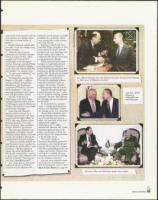
Sen. Alfonse D'Amato met with Eizenstat last June during Senate hearings
on Swiss assets of Holocaust survivors.
Last June, Israel's
Binyamin
Netanyahu met
with Eizenstat.
Eizenstat talks with Palestinian leader Yassir Arafat.
3/5
1999
Detroit Jewish News
23