

Diplomatic Macher
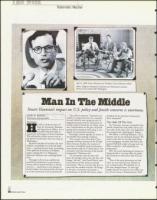
Lefi• In 1980, .Stuart Eizenstat was President Carter's domestic adviser.
Above: Zbzgn
iew Brzezinski, Eizenstat and Democratic nominee
Jimmy Carter prepared for Washington.
Man In The Middle
Stuart Eizenstat's impact on U.S. policy and Jewish concerns is enormous.
JAMES D. BESSER
Washington Correspondent
Washington
II
is title is Undersecretary of
State for Economic, Business
and Agricultural Affairs. It is a
mouthful that does little to
convey the real impact of Stuart Eizenstat.
The soft-spoken public servant may be
the Jewish community's best-ever asset in
Washington.
Iisk recent decades he has been the man
behind a remarkable list of Jewish head-
lines — rescuing Iranian Jews; uncovering
Swiss gold; the economics of Mideast
peace; creating the U.S. Holocaust
Memorial Museum and resettling Soviet
Jews.
Through it all, he has carefully bal-
anced his commitment to government
service with an equal devotion to Jewish
activism — sometimes to the dismay of
Jewish leaders who demand that the loyal-
ty to the communal cause be paramount.
3/5
)99
12 Detroit Jewish News
-
"Yes, there is pressure," Eizenstat con-
ceded in a recent interview. For example,
he said, when he was trying last year to
negotiate ground rules for restitution of
Jewish property looted by the Nazis, there
was "consternation on the part of Jewish
groups that sometimes don't seem to rec-
ognize my government position."
Pursuing a narrow agenda, he insists, is
less fruitful than striking a balance.
"You can get a lot more done if you
represent the best interests of the United
States because, frankly, this country of
ours has a wonderful moral and humani-
tarian history and set of values that is very
consistent with the interests of the Jewish
community," Eizenstat said.
"To the purists, what he does will
never be enough, and in the end they will
charge 'sell out,"' said David Harris, exec-
utive director of the American Jewish
Committee. "But to everyone else this is a
man who has worked miracles. He brings
to the job a seriousness of purpose, a
commitment to Jewish life and an under-
standing of the American bureaucracy
that's unequaled."
Two Sides Of The Coin
For Eizenstat, activism on behalf of the
Jewish community and public service are
two sides of the same coin, one shaped by
his strong Jewish upbringing in Atlanta.
His father, a traveling salesman, "was a
layman, but he was extremely learned. We
used to joke that he was the pinch hitter
at the synagogue; anytime they had a des-
ignated Haftorah reader who got sick, my
father could do it with absolutely no
preparation."
After the usual slackening of interest in
things Jewish as a young adult, he gradu-
ally returned to observance after his mar-
riage.
"One of the early discussions we had
when we were married was whether or
not to keep kosher. We decided not to.
But that changed about 15 years ago,
largely because we had sent our oldest son
to a Jewish camp in Massachusetts. He'd