

Northern Quagmire
NAOMI SEGAL AND GIL SEDAN
Jewish Telegraphic Agency
Jerusalem
ome Israelis believe their
army should withdraw unilat-
erally from southern
Lebanon. Others say the
fighting should be expanded to
include raids on Beirut.
But whatever their differences,
most Israelis believe something has to
be done to get Israel out of the
Lebanese quagmire.
The debate was given added
urgency Sunday, when an Israeli gen-
eral was among four Israelis killed by a
roadside bomb planted by Hezbollah
gunmen in the southern Lebanon
security zone. The latest fatalities came
only days after three Israeli officers
were killed in a Hezbollah ambush.
According to a recent poll, some
two-thirds of Israeli respondents
believe their government is not doing
enough to end the fighting that dates
back to 1982, when Israel launched an
invasion of Lebanon aimed at rooting
out Palestinian terrorists.
This dissatisfaction, which comes
less than three months before the
Israeli elections, is not lost on Israel's
leaders. But just the same, it appears
clear that they do not know which
course of action to adopt.
Israeli officials, who have at their
disposal the strongest army in the
Middle East, keep batting about the
same proposals that have been a part
of the debate for years.
Unlike other issues, where there is a
clear division between the political left
and right, solutions offered to end the
Lebanon quandary cut across party
lines.
Amid the renewed debate this
week, both Prime Minister Binyamin
Netanyahu and his main opposition
challenger, Labor Party leader Ehud
Barak, pledged to get Israeli troops out
of Lebanon within a year after the
May 17 elections.
Some of Netanyahu's supporters
within the party continue to speak out
in favor of a unilateral Israeli with-
drawal.
At the same time, some members of
Netanyahu's government are calling on
Israel to target major infrastructure
S
3/5
999
20 Detroit Jewish News
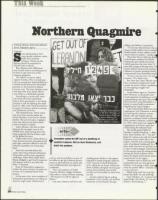
During a demonstration
in Tel Aviv Monday, an
Israeli woman holds up
a poster showing the
of sraeli sol-
dier s killed in Lebanon.
4.x matNenlVre"
am4V-Mffr'
A t
waNE
IN%
-
aNWES
Jerusalem wants the IDF out of a deathtrap in
southern Lebanon. But so does Damascus, and
that's the problem.
sites in and around Beirut as part of
an effort to get the Lebanese govern-
ment to back off from its stance that
any withdrawal from the region be
unilateral.
This is the position of Public
Security Minister Avigdor Kahalani,
who said at a recent Cabinet meeting,
"We should turn off the lights in
Beirut."
Last year, Lebanon and Syria, the
leading power broker in the region,
rejected an Israeli proposal, based on
U.N. Security Council Resolution
425, calling for an Israeli withdrawal
from Lebanon alongside security guar-
antees from Lebanon that attacks
would not be launched on Israel from
its soil.
Another political figure seeking
escalation is Uzi Landau, the hawkish
chairman of the Knesset's Foreign
Affairs and Defense Committee.
"The Syrians should know that as
long as Israeli soldiers die in roadside
bomb attacks, Syrian soldiers could
return home in caskets," Landau
The Labor Party is likewise divide
with Knesset member Yossi Beilin
leading the pro-withdrawal camp,
which questions the more than 13-
year-old strategy of having some 1,50
Israeli soldiers stationed in southern
Lebanon to protect northern Israeli
communities from Hezbollah attacks
"It isn't a security zone," he said
recently. "It's a death trap."
But other key Labor officials warn
that a unilateral withdrawal would
render the entire Galilee a battlefront
in the ongoing struggle with
Hezbollah.
As the debate rages on, President
Ezer Weizman is among the most
vocal supporters of seeking an overall
understanding with Syria. For years
Syria has been using Hezbollah as a
proxy to secure Israeli concessions
regarding the Golan Heights.
Labor leader Ehud Barak also sees
negotiations with Damascus as the ke
to resolving the Lebanon morass.
Barak, who said Sunday that he
opposes a unilateral Israeli withdrawa
from southern Lebanon, recalled thar'
in 1995, when Israel was engaged in`
negotiations with Syria, quiet pre-
vailed along the Lebanese front.
The Israeli general killed in
Sunday's roadside bombing — Brig.
Gen. Erez Gerstein, 38 — was the
head of a liaison unit with the South
Lebanon Army, Israel's ally in the
region. Gerstein was a strong oppo-_, I
nent of unilateral withdrawal. In a
June radio interview he said that such
a move would endanger Israeli forces
in the security zone by raising doubts
among the South Lebanon Army
about the depth of the Jewish state's
commitment in the region.
"Someone who is afraid you will
unilaterally pull out, leaving them
behind, is not going to fully cooper
with the present effort," Gerstein said)
in the interview.
Killed along with him were Sgt.
Imad Abu Rish, 34, and Staff Sgt.
Omer Elkabetz, 22. A reporter for
Israel Radio, Ilan Roeh, 32, was also
killed in the bombing. Fl