

AppLE TrEe
Rabbi Arthur Waskow
Special to The Jewish News
n an era where "the greens"
become key coalition partners in
some countries, the environmen-
talist lobby grows everywhere, and
recycling regulations are common,
observance of Tu B'Shevat, the
upcoming Jewish New Year of
Trees, is spreading quickly.
More than any other Jewish festi-
val, Tu B'Sehvat, which begins this
year at sundown Sunday,_ Jan. 31,
is the celebration of Growing-and-
Becoming. Interestingly, there is no
halachah, or Jewish law, that
defines its observance. It springs
wholly from the spiritual depth and
growth of the Jewish people, in rela-
tion with the One Who always
beckons us to grow and in relation
with the earth where all things grow.
Time To Tithe
The 15th day of the mid-winter
Hebrew month Shevat appears as
a special date of Jewish obser-
vance in the Mishnah, the earlier
section of the Talmud, which
records the rhythm of Jewish life in
the Second Temple times (ending in
70 C.E. with the holy structure's
destruction by the Romans).
In classic talmudic debate, the
House of Shammai says that the
observance should be on the first day
of the month; the House of Hillel
argues for the 15th day. They both
are concerned with tax law: how to
divide the year for purposes of tithing.
Each year, one-tenth of the
increase of the earth — one-tenth of
the fruit of a tree, one-tenth of the
lambs of the flock, one-tenth of the
new-sprouted barley — was brought
to the Temple in Jerusalem to be
offered to God. Then it went to the
priests and the poor for eating.
The decision followed, as usual,
the teachings of Hillel: the 15th, the
full moon of deepest, wettest winter,
came to define the new year for
tithing on a tree.
1/29
1999
72 Detroit Jewish News
As The
r e Grows
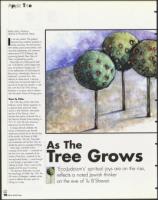
'Eco-Judaism's' spiritual joys are on the rise,
reflects a noted Jewish thinker
on the eve of Tu B'Shevat.