

itorials
Letters to the Editor are updated daily and archived on JN Online:
www.d.etroitjewishnews.corn
Digesting 'Palestine'
S
ome American and Israeli Jews can
hardly bring themselves to say the
word "Palestine," much less accept it
as a country. But for years it has been
a psychological reality for millions of Palestini-
ans and a large chunk of the world.
A "Palestine" delegation competed in the
1996 Atlanta Summer Olympic Games. A
Palestinian observer mission has long operated
at the United Nations. Since 1988, when Yas-
sir Arafat declared himself president of "Pales-
tine," then little more than a fantasy, an
increasing array of governments has effectively
accorded Palestinian leaders national status.
Regardless of their documented corruption
as leaders and their violations of recent U.S.-
brokered Mideast peace accords, Arafat and his
associates are in the process of creating a state.
"Palestine's" infrastructure is more devel-
oped than many American and Israeli Jews
realize. There is a Palestinian airport, passport,
stamps and a host of statehood's other trap-
pings. And, to the absolute dismay of many,
the Arab sector of Jerusalem will in some form
be "Palestine's" symbolic capital. There are
already more than 30 Palestinian ministries
with offices in this eastern area of Jerusalem.
Thankfully, Jerusalem, its population over-
whelmingly Jewish, will remain Israel's eternal
capital. Borders may be redrawn and intricate
security arrangements made, but ownership
and control of Jerusalem is not going to be
rolled back.
Still, within a decade, and possibly much
sooner, there will be a "Palestine," one that, in
some fashion, will be recognized by Israel's
government as well as by the United States, the
United Nations and scores of nations. Political
considerations prevent Israeli Prime Minister
Binyamin Netanyahu from agreeing publicly,
but others on the right, such as minister Ariel
Sharon, do not shy from the facts.
The question now is how we American Jews
can act to most effectively secure Israel's safety
and to continue toward the goal of a Mideast
where nations honor, in letter and spirit, each
others' sovereignty, where peace is inviolate.
What can we do to make sure that the emer-
gent state is a good neighbor in every sense?
As a first step, we must continue to insist
that the United States government embraces
Israel's legitimate security concerns. We must
also make sure that the U.S. tells the Palestini-
ans and their supporters in Syria and Iraq that
those concerns are not negotiable and that vio-
lations will be swiftly punished.
Next, we must pay careful attention to the
terms that will be negotiated on each of the
key issues, such as boundaries, armed forces,
the settlements, water rights and economic
responsibilities. We cannot be useful defenders
of Israel if we fail to stay educated on these
steps. We have to know why one demand from
Gaza City may be acceptable, another intolera-
ble, so that we can explain it to our neighbors
and our representatives in Washington.
If that means that sometimes we will need
to accede to the unpalatable — increased eco-
nomic and technical aid for the entity, for
example — we must remain clear-headed and
able to explain why that aid has to be carefully
monitored against its all-too-likely misuse.
Let there be no mistake: Creation of a new
state must only occur under terms and condi-
tions — whether they be military, political,
economic or otherwise — with which Israel
can concur. Creation should not be a unilateral
decision on the part of the PLO.
A negotiated peace, one that contains the
seeds of hope, must be embraced before anoth-
er generation sows the fields of the Middle
East with blood and hate.
It's hard to talk about "Palestine" outside of
quotations. But denying its potential reality
will lessen our ability to fight effectively for the
Israel we love. 17
IN FOCUS
Helping
Hand
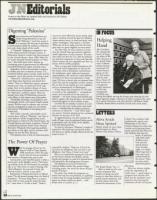
Abe Gornbein,
86, claimed the
honor of being
the eldest of the
600 volunteers at
the Jewish Feder-
ation of Metro-
politan Detroit-
sponsored Vol-
unteer Extrava-
ganza on Dec.
25. He's shown
with his wife
Reva. Nearly 40
local human-ser-
vice agencies
sought assistance
on that day.
Assignments
included corn-
forting the elderly, serving the hungry and cheering the sick.
Many agencies sought volunteers to relieve workers who want-
ed to spend Christmas with their families. Jeff Basch, Mark
Chessler, Randi Sakwa and Barb Tunick were event chairs.
LETTERS
Akiva Article
Mean Spirited
Shame, shame on your mean-
spirited report on Akiva
Hebrew Day School ("Akiva:
The Power Of Prayer
W
ith the passage of time (or the
drop of a ball in Times Square),
1998 turned into 1999. But pray-
ing for the sick and the pained to
heal remains a constant from year to year.
Among Jews, such heartfelt prayer is often a
formal part of the Shabbat service. The haunt-
ing melody of the Mi She-beirach, for example,
asks us to "bless those in need of healing with
rfuah sh'leimach, the renewal of body, the
renewal of spirit, and let us say, amen.
Expressions of healing date back to . biblical
times. The oft-quoted passage from the Book of
Ecclesiastes, "To every thing there is a season,
and a time to every purpose under the heav-
en," notes there is "a time to heal." Psalm 6,
"
1/8
1999
32 Detroit Jewish News
meanwhile, declares: "Heal me, 0 Lord, for
my bones are affrighted. Thy soul also is sore
affrighted. And Thou, 0 Lord, how long?"
Even as we marked the coming of a new year
on the secular calendar last Shabbat, family,
friends and strangers in need of a spiritual boost
still yearned for the healing power of prayer.
The Rabbinical Council of America's
ArtScroll Siddur teaches that certain things,
including prayer, can annul the decree facing a
gravely ill person.
No matter how bleak the prognosis, no
matter how sad the circumstances, it's uplifting
to know that the caring thoughts immersed in
prayer are always within our reach — and
always there to comfort us.
The Roads Ahead," Jan. 1).
Akiva is made up of a com-
munity of parents who,
besides investing time and
money in what they believe is
quality Jewish education, roll
up their sleeves and work
toward the betterment of the
school. Two mothers, both
professionals, spend every
Wednesday in the Akiva
kitchen baking chocolate chip
cookies and preparing home-
made macaroni and cheese for
the children who buy hot
lunch. A physician
with three small
children and a
busy practice
spends almost
every Tuesday
night in a smoke-
filled bingo hall to
help raise much-
needed funds for
the school. There
are many more
dedicated parents
like them.
Akiva has always empha-
sized the importance of
midot tovot — good values, a
program that rewards chil-
dren not for academic excel-
lence but for learning the
rudiments of how to become