

•
ca-
2. )
7
'1 1 ROA /
Everyone Blossoms at the
Fleischman Residence!
'Three Kosher Meals Daily
'Medication Administration
'Health Clinic
'Around the Clock Security
'Respite and Guest Rooms
Available
'Daily, Shabbat, and Holiday
Services in our Synagogue
'Daytime and Evening
Activities
'Transportation, Laundry,
Housekeeping
'Educational Classes
'Registered Nurse &
Personal Care Assistance
'Nosh Nook, Gift Shop,
Beauty/Barber Shop
_Aging Services:
•The Club in the Plaza -
an Adult Day Program
• LeVine Institute on Aging
'Jewish Chaplaincy Program
'Guardianship Program
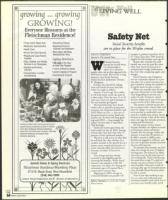
The Marge & Robert Alpern Life Enhancement program
supports planting and gardening activities for residents.
Left to right: Fay Margolis (Fleischman Residence);
Jackie Smith, Life Enhancement Coordinator; Frieda Kates
(Fleischman Residence); and Margaret Parker
(Federation Apartments).
Jewish Home & Aging Services
Fleischman Residence/Blumberg Pfaza
6710 W. Maple Road, West Bloomfield
(248) 661-2999
contact: Tracey Proghovnick,
12/25
1998
L6 Detroit Jewish News
- Director of Admissions
Safety Net
Social Security benefits
are in place for the 50-plus crowd.
SYLVIA TIERSTEN
Special to The Jewish News
IVIIr ill Social Security
money be around when
I'm old enough to
retire? It's a question
people often ask as they approach the
half-century mark. But it's the wrong
question, says Social Security
Administration spokesman Thomas
R. Margenau.
Instead, they should be asking,
what will Social Security look like
when I'm ready to collect?
Answer: If you're age 50 or older,
it will look pretty much the same as
it does today. Over the next 15 to 20
years you won't see radical changes in
the way benefits get figured.
The Social Security Trust Fund,
which takes in payroll tax payments
and pays out retirement benefits, had
$595 billion on Oct. 1, the start of
the government's current fiscal year.
Experts say the fund will keep grow-
ing until 2018 — long enough for
today's 50-year-olds to reach their
70th birthday.
Unless the system gets fixed, the
fund could run dry by 2029, leaving
retirees after that date with only 75
percent of their promised benefits.
The jury is still out as to what that
fix will look like. But whether it's a
modest increase in the payroll tax or a
drastic move toward privatization., it
won't seriously affect the retirement
fortunes of today's 50-and-over
crowd.
One change that has already
occurred is the eligibility age for
receiving full benefits. When Social
Security was created in 1935, life
expectancy was about 63. Setting the
retirement age at 65 seemed like a
conservative measure then.
Beginning in 2003, the age at
which full benefits are payable will
Sylvia Tiersten is a writerfor Copley
News Service.
increase in gradual steps from 65 to
67. Those born after 1959 won't be
eligible for full benefits until age 67.
People who watched the stock
market soar over the past few years
often fault Social Security for its
comparatively stodgy performance.
But that's like comparing apples and
oranges.
Social Security, says Margenau,
isn't an investment scheme or a pen-
sion plan. It's a social insurance pro-
gram aimed at raising the standard of
living for lower-income workers.
When you consider that 60 years
ago some 60 percent of the elderly
were languishing in poverty and
today it's only 10 percent, Social
Security shapes up as one of the great
success stories of the 20th century.
The system is skewed to give the
low-earning worker a better deal, and
that's by design. It was never intend-
ed to provide a comfortable retire-
ment for middle-class seniors. Social
Security is merely a slice of the retire-
ment nest egg that includes pensions,
savings and investments.
For the poorer worker, Social
Security benefits can replace as much
as 90 percent of pre-retirement
income. For the average worker, the
amount is more like 40 percent or
$1,000 a month in dollar terms.
Benefits are pegged to inflation, and
last year's 2 percent increase matched
the cost-of-living rise.
To calculate your benefit, the SSA
rakes the average of your 35 highest
earning years. For most of us, those
top years occur in the latter parr of
our working life. That's why leaving
the work force at age 55 could ulti-
mately cost you in terms of retire-
ment benefits. One year's worth of
earnings after age 55 normally boosts
your monthly Social Security check
by S20 a month.
Even if you stop working at age
55, you can't start collecting your
retirement benefits until you're 62. If
you start your benefits early, you'll