

healthy old age has to be earned; it
can't be taken for granted. Close to
half of older Americans suffer from
arthritis, about 30 percent have
high blood pressure or heart dis-
ease, and more than 10 percent
have diabetes. Cancer, osteoporosis
and emphysema also are prevalent
in this population.
These illnesses, however, can
often be prevented until very late
in life when lifestyle factors, such
as exercising, have an impact.
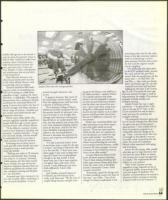
Sandor Davis hits the rowing machine.
"Exercise should be like brush-
ing your teeth; it's something you
muscle strength and power also
need to be doing on a daily basis,
occurs.
regardless of age," explains Dr. Steve
It appears, however, that much of
Korotkin, a cardiologist. The research
the physiologic decline doesn't come
demonstrates that a sedentary lifestyle
from the aging process itself but from
accelerates the unwanted factors of
a decline in physical activity.
aging.
b. Exercise slows down the loss of
The American College of Sports
muscle strength and helps maintain a
Medicine (ACSM) recognizes the car-
better range of motion, a healthy oxy-
diovascular benefit of resistance train-
gen intake, and cardiovascular and
ing. Previously, it was thought that
respiratory functions.
strength and endurance training pro-
What's more, older adults who
duced little or no cardiovascular ben-
exercise regularly typically outperform
efits, but the research now shows that,
people half their age in many sports
over time, resistance training reduces
and have fewer risks of heart disease.
stress on the heart. And for the first
To be effective, exercise routines
time, flexibility training has been
need to have frequency, duration and
added to the recommendations
intensity," explains Korotkin. "To get
because it decreases the potential for
the very best results, exercise should
injury and improves overall physical
be scheduled for five or six days a
function.
week, and last at least 30 minutes.
"I've had a personal trainer come
Exercising two or three times a
to
my
home twice a week for the past
week provides some benefit, but exer-
12
years,"
says Naomi Harwood, who
cising five times a week provides
is
in
her
late
60s. "I don't have unre-
twice the benefit.
alistic
goals;
I just want to keep mov-
"Walking two miles in 30 minutes
ing and I know I'm not disciplined
accrues more benefit than running
enough to do this myself. It took
two miles in 12 minutes. Intensity,
some time, but I have more stamina
within reason, isn't the most crucial
and agility than I did when I first
factor. Finally, the type of exercise
started. I walk differently and even
becomes important because there are
think differently. I don't shlep
different guidelines for aerobic exer-
around."
cise, resistance training and flexibili-
Jude Timlin, personal trainer at
ty," says Korotkin.
Orchard Lake Powerhouse Gym,
As people age, their connective tis-
works with Harwood. "We do a lot of
sue and muscles stiffen, resulting in a
weight lifting because strength train-
loss of muscle flexibility. A loss of
ing gives her balance and stability in
her daily activities," explains Timlin.
"For aerobic exercise with older
clients I use the treadmill or station-
ary bike because both have stability
and the client can control her pos-
ture. I don't want them using some-
thing like a Stairmaster because it
doesn't provide stability and an older
person could hurt their lower back
because it's difficult to maintain cor-
rect posture."
Timlin says stretching before and
after exercising is even more impor-
tant with older people to avoid
injuries. "These are static stretches
which set the joint in a position so
that the person can stretch her liga-
ments and muscles," says Timlin.
"My job is to make sure clients like
Naomi are performing the stretches
and exercises correctly because, unlike
someone 30 years younger, incorrect
technique is more likely to cause an
injury to an older person."
Lorraine Bayle and Ruth Gould
know all about exercise technique.
They've been taking stretching and
ballet-type exercise classes from Reva
Usher for many years at the Kahn
Jewish Community Center. Usher
recently turned 82.
"Exercising is good for all ages and
I've been teaching women for close to
60 years," says Usher. "One of the
things I've always emphasized is that
exercising works, but for the other
hours in the day everyone needs to
work at maintaining a correct
spine posture. Exercise alone won't
do that and the negative results
can be crippling."
The kibbitzing that takes place
in the JCC workout room, around
the track and on the gym floor
doesn't hide the perspiration of the
many men — in their 60s, 70s
and 80s — who work out almost
daily. Sol Dembs, age 78, uses the
treadmill and track and has been
walking for 20 years. Carl Carron,
age 70, lost 70 pounds 40 years ago
and uses exercise five days a week to
help maintain his weight. His exercise
program includes aerobic and
strength training.
Arnold Citron has run in eight
marathons — he placed first in his
class at the age of 72. Now, at 80,
Citron exercises five and six days a
week and uses the machines for
strength training.
The association between aging and
loss of muscle strength has often been
thought to be part of the natural
aging process — just another one of
those concessions accepted as an
undesirable physical change as we
age. Today, scientists know that loss
of strength in the elderly is not an
inevitable result of growing old, but
rather the result of a sedentary
lifestyle often associated with aging
and retirement.
Just as for the young, older people
who take part in high-intensity exer-
cise have the same ability to restore
and increase the muscle strength lost
to atrophy. The implications for the
elderly are very positive.
How much a person can do,
regardless of age, depends on his or
her general health, current level of fit-
ness and degree of disability. The
familiar recommendation to consult a
physician before starting an exercise
program holds true for everyone. ❑
12/25
1998
Detroit Jewish News 115