

0
Ayoung entrepreneur tries
kot tt4 to make waves in the crowded
, take-out pizza market.
ALAN ABRAMS
Special to The Jewish News
T
he Detroit metropolitan
area has already spawned
two of the nation's four
leading pizza giants, Little
Caesar's and Domino's. Can a third
be in the future?
If you believe the youthful enthu-
siasm of 25-year-old Michael
Weinstein, he's next in line for a
piece of the franchised pizza pie.
you re accustomed to eating in
Michigan? Taste, said
Weinstein. Good pizza, he said,
has thin crust and Sclafini
tomatoes imported from Spain,
and is baked on the brick. But
surprisingly, pizza was not
Weinstein's first choice when
he decided to go into business
for himself.
thought this vvas a good
-
business idea because while I
was in New York the last six
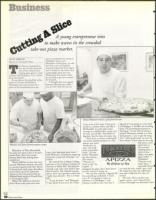
Weinstein removes a pizza
Michael
Weinstein and Tyrone Broadus prepare a pizza.
Weinstein, of West Bloomfield,
has only one store so far in his pro-
posed chain. But never mind,
because that's how the big boys
started too.
What's different is that this time
around, Weinstein believes the road
to success is paved with New Haven
(Connecticut) style pizza, the delica-
cy he dishes up at his Tomatoes
Apizza in the Concord Center on
Halsted Road north of Grand. River
in Farmington Hills.
What's the difference between
New Haven style pizza and what
12/18
1998
60 Detroit Jewish News
years, they had good pizza there,"
said Weinstein, in between preparing
pizzas for a store full of hungry cus-
tomers.
He studied first at Ithaca College
and later at the Culinary Institute of
America in Hyde Park. He knew he
wanted to go into some kind of fast-
food business. His original concept
was to serve up a gourmet steak with
"really nice potatoes." But is it feasi-
ble?
"It can be done," said Weinstein.
"I just think if you serve $4 of filet,
it has to be a $12 meal. It has to be
served in a decent room, just like a
McDonald's. It is the same exact
concept as a McDonald's, except you
use nice cuts of filet. And that's no
big deal. You fry them the same way.
"You'd have a crouton underneath
and some mashed potatoes or a flat
potato, put some
mushroom on
top, and you'd
have a beautiful
meal." So why
didn't Weinstein
go that innova-
tive route?
"Because it's
hard to do," he
replies. "I
designed the plan. But I don't know
exactly what I'm doing yet.
"For my first venture, I figured I'd
do something surefooted. I wasn't
sure if I was going to move to
Boston or to Michigan. I said
Boston would be cool, but then I
Figured if I was going to come back
to Michigan, I wouldn't do anything
fancy. I'd just bring good pizza to
Michigan." At the end of culinary
school, Weinstein worked in a New
York pizzeria, "just to get the hang
of it." After graduation, he went to
New Haven "where they do have the
best pizza, and I
spent four or
five months
training there. I
went to Lou
Abate, this great
pizza maker —
[President]
.1A
Clinton's even
eaten there —
and said I'd love
to work for him, could I get a job?
He asked me what my experience
was and I told him five years of
school.
"He said, 'Show me how you
make a pizza,' and I showed him.
Then he brought me downstairs into
API/
We Deliver to You