

William Levitt
"The illusion is that of draped velvet, but in reali
ty it's stone," says self trained sculptor William
Levitt, of Rochester. The Eye of the Fold, Levitt's
first menorah, is a conventional configuration made
of Indiana limestone. "Essentially, I took a menora h
that existed and draped it with a piece of velvet.
That became the model," he explains. "It's the vel-
vet drapery that reveals the menorah underneath.
When you carve the fabric you have what's known a
the eye of the fold (where the folds in the fabric
occur). It's at the eye of the fold where darkness
meets light. Because Chanukah is the festival of
lights, I decided this would be a good name for the
piece.
It was during a 1993 trip to Paris that Levitt, then
a graphic designer, decided to become a sculptor. "I
was walking around the streets of Paris in awe of all
the beautiful work. I was at this world-famous ceme
tery. Across the street was a company that supplied
monuments for the cemetery and a hardware store
with all the tools," he says. "I spent four hours in
that hardware store buying tools (with the help of an
interpreter). I bought an entire collection of hand
carving tools and had them shipped back." Within
six weeks of that trip Levitt had changed careers and
began calling himself a stone sculptor. "I decided
graphic design wasn't satisfying enough for me. I
wanted to work in a third dimension. I relive that
whole experience [in Paris] every time I hold these
tools in my hand."
Levitt will tell you that he enjoys the conceptual
process more than anything. "It's challenging. I'm
working my brain for
months and months
trying CO come up
r
with an origi.lal
• Irliar', 27 Lel '
r` leaele
idea." He recalls how
ROC/M:1er :111(110, eleSCribef
the idea for this
;-nenorah The Eve of the
Fold as dirkness
menorah came to
niuse ChaPiukith jj
him. "I was so
orliqhts,
I decialt..-ei
inspired when I fell
f
•
tie a good name
upon this idea that I
/Or th`
went right into the
- e
studio. You have to
Photo by Krista Husa
strike while the iron
is hot. I jumped right
in headfirst. It's that
process of contemplation that leads to actually pro-
ducing something, that gives me balance as an
artist," he says.
Levitt does everything from addressing markers
to creating furniture. He is currently working on a
220-foot-long stone wall landscape design for a cus-
tomer on Lone Pine Road in Bloomfield Hills. Most
of his work is commissioned and designed for specif-
ic applications. "When'you're self trained, you learn
all the shortcuts and ways to expedite the process.
There is value in that," he says.
44i(
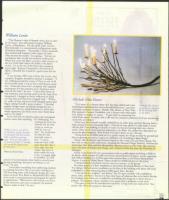
)ka Doner
"In a sense, it's a found object that has been edited and trans-
Michelle (Oka boners
formed into something that serves a household function," says inter-
menorah was inspired
nationally acclaimed sculptor, Michele Oka Doner, of New York.
by the burning bush
Her menorah, Coconut Candelabra, cast in bronze with white gold
in the Bible.
leaf, claims its origins in nature.
It goes back to extricating our
needs from nature. Certainly, this is the way our ancestors produced all of our accessori
containers, and objects."
Doner says this menorah actually evolved from an earlier piece entitled, Burning Bush, a
large casting of a multi-branched object. 'A friend of mine asked if I could Make a meno-
rah like that. I was looking in Genesis. It turns out that the burning bush was a thorny
acacia. There are so many botanical references in the Bible. You realize how dependent we
are on the plant kingdom. We're foolish if we don't think we are," she says.
"Going back to the Bible leads me to a certain respect for things we take for granted and
that are growing around us. It gives us a different way of looking at these things."
Doner, who divides her time between homes in New York City and Miami Beach, Fla.,
has work in major public collections, including the National Design Museum, Smithsonian
Institution, New York, and the Metropolitan Museum of Art in New York. She received
both a Bachelor of Science and Design, and a Master of Fine Arrs from the University of
Michigan.
Doner is also known for her monumental works in public places, including A Walk on
the Beach, which consists of 2,000 cast bronze representations of plants, marine organisms, --
and shells embedded in a 22,000-square-foot terrazzo floor at the Miami International
Airport. A native of Miami Beach, Doner recalls her childhood days on the ocean.
"I always looked at the beach and the trees as a resource, as life giving."
Her latest project is a floor installation at the Center for Jewish History in New York.
"I'm doing a biblical species installation on the floor of the building with about 300 units
embedded in a floor measuring about 4,000 square feet," she says.
"I was trained as a sculptor," says Doner," but I'm quite versatile. I do candelabras,
chairs, sinks, and floors. You have to leave that frame of reference that we've had in the last
few hundred years where art is confined to something that hangs on a wall or sits on a
pedestal. The Japanese culture considers every spoon that it produces a work of art.
"The same is true for the Scandinavian countries. Living is the true work of art. You
curate a life. We're all curators in that sense."
es.
12/4
1998
Jews
GO