
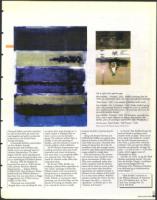
Left to right, from opposite page:
Mark Rothko: "Untitled," 1953. Rothko's paintings from the
1950s are celebrated for their color and unprecedented luminosity.
"Street Scene," 1937, is an example of Rothko's earlier work.
Mark Rothko: "No. 5 (Untitled)," 1949. Rothko disliked giving
titles to his paintings because he wanted the viewer to experience
them without preconceived notions. The paintings often were des-
ignated by numbers instead.
Mark Rothko: "Untitled," 1946 The Surrealists, especially Joan
Miro, were a major influence on Abstract Expressionists like
Rothko, who were learning to express their angst through art.
On the cover: Mark Rothko: "Self-Portrait," 1936
Photos courtesy of
National Gallery and other museums
as well as loans from the artist's son
and daughter and public and private
collections in the United States,
Europe and Japan.
It chronicles Rothko's metamorpho-
sis from Realism through
Expressionism and Surrealism and,
finally, to his own personal brand of
Abstract Expressionism. The show
begins with the artist's early figurative
work and moves through his later inter-
est in mythological and biblical themes.
Between 1943-46, Rothko (he
shortened his name in 1940) and the
other pioneer American Abstract
Expressionists — Jackson Pollock,
Clyfford Still, Hans Hofmann, Robert
Motherwell and William Baziotes —
had their first one-man shows at Peggy
Guggenheim's Art of This Century
Gallery in New York.
These post-war, existentially
charged artists were searching for ways
to express their angst through art. A
major catalyst in enabling them to
learn to do so was the Surrealist
group. The influence of Joan Miro is
evident in the early paintings of
Rothko, and this evolution is traced in
the first galleries of the exhibition.
All the Abstract Expressionists were
working toward the same end of self-
expression and viewer involvement,
but went about it in completely differ-
ent, personal ways. They began to
search for ultimate truths rather than
existential values.
By the late 1940s, Rothko was
working in almost direct opposition to
the "action" paintings of artists like
Pollock (whose work concurrently is
being shown in a retrospective at the
Museum of Modern Art in New
York). Pollock, in creating his "drip"
paintings, put his entire body into the
process of creating art; Rothko, how-
ever, wanted the viewer to totally
Whitmey Museum of American Art
immerse himself in experiencing the
work.
Along with Barnett Newman and
Clyfford Still, Rothko was creating what
came to be known in the 1950s as the
Color Field movement. Ultimately elim-
inating the figure from his work, the
nonobjective style that emerged consist-
ed of two color fields, almost floating in
a space unified by a single plane.
Soft and luminous, his canvases
were massive; they succeed in creat-
ing an environment of their own.
They were numbered, rather than
titled, consistent with the abstract
nature of his work, so as not to dic-
tate to the viewer what should be
experienced. An explosive energy is
inherent in the creation of this work;
it is in that sense sublime. Rothko's
canvases envelop the viewer: the size,
the space, the color — not to be
"grandiose," as Rothko put it, but
"intimate and human."
In the late '50s, Rothko became ill,
and was forced to produce much
smaller works on paper. These are on
view, along with studies for a mural
for the Four Seasons restaurant in
New York, a project from which he
withdrew. One can trace his decline,
mentally and physically, through the
color — or lack of color — in his later
works, which suggest traces of
Minimalism in form.
On Feb. 25, 1970, at age 66, Mark
Rothko committed suicide. One year
later the Rothko Chapel, a meditative
space he had designed for the
University of St. Thomas in Houston,
was dedicated as an interdenomina-
tional chapel. El
"Mark Rothko" continues at
the Whitney Museum of American
Art, 945 Madison Ave., in New
York City, through Nov. 29.
(212) 570-3676.
11/2
199
Detroit Jewish News
83,
Scanned image of the page. Keyboard directions: use + to zoom in, - to zoom out, arrow keys to pan inside the viewer.
November 20, 1998 - Image 131
- Resource type:
- Text
- Publication:
- The Detroit Jewish News, 1998-11-20
Disclaimer: Computer generated plain text may have errors. Read more about this.