
Mixed
, •
•
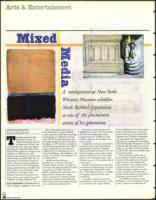
A retrospective at New York's
Whitney Museum solidifies
Mark Rothko's. :reputation
as one of the preeminent
artists of his generation.
LYNNE KONSTANTIN
Special to The Jewish News
T
ypically associated with
paintings of nature, of
volatile and stormy motion,
of depictions of God's and
nature's power over man, the massive
paintings of America's Hudson River
School artists typify the concept of the
"sublime" in Western art . The
Abstract Expressionism of Jewish artist
Mark Rothko probably defies that cat-
egorization in the minds of most art
critics. However, if you're heading to
New York City for the Thanksgiving
holiday, grab the chance to plant your-
self in front of one of Rothko's huge
"multiforms" on display at the
Whitney Museum of American Art,
and see if you can't employ the word
"sublime" to define what you feel.
Lynne Konstantin is assistant editor at
"Art & Antiques" magazine in New York.
11/20
1998
82 Detroit Jewish News
Be it melancholy, intense joy, or
even frustration or anger, Rothko's
works make the viewer feel something,
and strongly. An exhibition of more
than 100 of his paintings and works
on paper dating from the 1930s until
his death in 1970 will be on exhibit at
the Whitney through Nov. 29, follow-
ing an April debut at the National
Gallery of Art in Washington, D. C.
After the Whitney, the exhibition will
travel to the Musee d'Art IvIoderne de
la Ville de Paris.
Rothko was born Marcus
Rothkowitz in Gayok, a suburb of
Dvinsk, Russia, on Sept. 26, 1903. At
the time, Jews made up half of Dvinsk's
population of 75,000. His father,
Jacob, originally from Lithuania, was a
pharmacist in Russia. His mother,
Kate, came from St. Petersburg. Both
grew up in Orthodox Jewish families,
but in their home they emphasized pol-
itics, social issues and education.
However, as times became more
difficult for the Jews of Dvinsk, Jacob
Rothkowitz's religion grew more
important to him. Unlike his other
children, Marcus, the youngest, was
sent to cheder.
Conditions in Dvinsk continued to
worsen for Jews, and many of them
immigrated to America. Rothko's
father and brother arrived in 1911; he
and his mother, a sister and a second
brother followed in 1913. Soon after
their arrival in Portland, Ore., when
Rothko was only 10, his father died of
colon cancer.
Rothko remembered the transition
to America as embarrassing: He spoke
no English and "dressed like a poor
Jew." The feeling of being an outsider,
a foreigner, stayed with him until
adulthood.
A excellent student, he earned a
scholarship to Yale University in 1921,
at a time when Ivy League schools
were enrolling Jews on a strict quota
system. Discrimination at Yale was
overt at the time. At the end of his
freshman year, Rothko's scholarship
was eliminated. He responded by
founding an underground newspaper,
The Yale Saturday Evening Pest, in early
1923, but left Yale after rwo years of
study. In the fall of 1923, he moved
to New York, where he enrolled in his
first drawing class.
He continued to study, and in
many respects, Rothko considered
himself a self-taught artist. His early
style, however, was influenced by
other painters such as Milton Avery,
whom he knew well. In the late
1920s, he began to teach art at the
Center Academy of the Brooklyn
Jewish Center, where he maintained a
part-time position until i 952.
The Rothko exhibition at the
Whitney is a true retrospective of his
work. It draws on works from the
Scanned image of the page. Keyboard directions: use + to zoom in, - to zoom out, arrow keys to pan inside the viewer.
November 20, 1998 - Image 130
- Resource type:
- Text
- Publication:
- The Detroit Jewish News, 1998-11-20
Disclaimer: Computer generated plain text may have errors. Read more about this.