

SERENA DONADONI
Special to The Jewish News
T
he first stories Italian come-
_ dian Roberto Benigni heard
about the Holocaust came
from his father, an anti-fas-
cist who spent two years during World
War II in a German work camp build-
ing weapons for the Nazi army.
When he returned to his family,
weighing a skeletal 35 kilos (approxi-
mately 80 pounds), "he started, like
an obsession, to tell about these two
years," Benigni explained. "There were
nightmares, each night — and there
was a necessity to tell the story to be
free."
Benigni, who is not Jewish, began
to learn about conditions even worse
than what his father endured when he
was a teenager in the 1960s and was
introduced to the books written by
Italian Auschwitz survivor Primo Levi.
These two factors — the stark per-
sonal memories and an awakened.
political consciousness — greatly
inform his latest film, Life Is Beautiful,
which has already won prestigious
prizes at numerous film festivals. They
Include the Grand Jury Prize at
Cannes, audience awards in Montreal
and Toronto, and the Best Jewish
Experience Award at the Jerusalem
International Film Festival.
The film also earned eight
Donatellos (the Italian Oscars),
crat, but she is swept away by the live-
including best picture, and seems a
ly and creative Guido. Benigni infuses
shoo-in to receive an Academy Award
their courtship with a transformation-
nomination for Best Foreign Language
al, romantic intensity.
film
There is a sharp contrast between
,, In Italy, we can never forget,"
the
film's first half and what follows.
Ben igni said at the Toronto
Just
months before the end of the war,
Inte rnational Film Festival. "It's the
Guido and his precocious
cou ntry where fascism was
young
son, Giosue
born
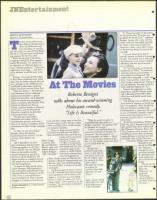
Above: Giorgio
(Giorgio
Cantarini), are
Li fe Is Beautiful is an amal-
Cantarini, front
rounded
up
by the Nazis
gam of elements that don't seem left, and Nicoletta
and
transported
to a con-
to bel ong together. As the film's Braschi, right, with
centration
camp.
In an
writer director and star, Benigni Roberto Benigni in
attempt
to
shield
Giosue
Roberto Benigni's
draws on his sizable comedic
from truly understanding
arsena and points it squarely at "Life Is Beautifid"
what
has happened to
the ho rror of the Holocaust. He
them,
Guido
creates
an elaborate fab-
the film as a magical story of
rication,
telling
his
impressionable
son
begins ople who are transformed by
that
the
camp,
and
everything
going
two
lOve pe
an d imagination.
on around them, is all part of an elab-
In fa scist-era Italy, Jewish waiter
orate
game.
Guido ( Benigni) falls hopelessly in
Guido's
attempts to protect Giosue
love wit h gentile schoolteacher Dora
stem from Benigni's
Life
is
Beautiful
in
(Nicolet to Braschi, Benigni's real-life
own
experiences
with
his father, who
om a conventional bour-
began
to
use
humor
as
a storytelling
wife). Fr ckground, Dora is already
device
in
order
to
cushion
the "horri-
geoisie
engaged b t o a pompous local bureau-
fying tragedy" of his experience for his
children. This also had an unforeseen
Serena Donadoni is a Detroit-based
beneficial effect.
freelance writer.
"As Primo Levi said, he 'discovered
he was Jewish when Mussolini pro-
mulgated the Racial Laws,"' explained
Benigni. In part, this is why the film-
maker made the thoroughly assimilat-
ed Guido, who's tolerant and kind-
hearted to a fault, naive when it came
to the growing danger for Jews in fas-
cist Italy.
"I am not showing the horror
directly, because my style is to evoke,"4 ,
he said. "It's another way to talk about
the Holocaust. I was aware I could be
offending with this movie because I
am a comedian.
"So I sent the script to the Jewish
community in Milan," he continued,
"and they told me a lot of things —
this couldn't have happened, that
couldn't have happened — and I told
them, 'I am an artist, I must have •
some license, I must be free. Tell me if
you are offended.' But they loved the
script, and they helped me a lot."
Despite the suggestions to make
events more realistic, Benigni made
Life Is Beautiful almost like a fable,
where love and family bonds mean
everything.
"My feeling is not to offend or to - N.
hurt survivors' memory or Jewish peo-
ple," he explained. "But I decided on
the story because I couldn't stop
thinking about it, because to my mind
it was a wonderful, beautiful, simple
story, protecting such purity in an
extreme situation such as a concentra-
tion camp."
"When he started to smile, he
It's merely coincidence, Benigni
stopped having nightmares, too,"
said, that Life Is Beautiful comes soon
Benigni explained. "He was free, like
after another film about Italians and
he liberated the trauma."
the Holocaust, Francesco Rosi's The
"I didn't copy anything from my
Truce; based on Levi's memoir, The
memories of the life of my dad," he
Awakening. In fact, Rosi considered
continued. "But the character of
casting Benigni in the lead role that
Guido resembles my father — full of
eventually went to John Turturro.
life, anti-fascist every moment of his
Ultimately, Benigni views Life Is
life, and very simple, a man who loves
Beautiful as the
to live, [and]loves his
way he has filtere#
family."
the Holocaust
Benigni has
through his own
achieved such popu-
particular sensibili-
larity in Italy that he
ty, and harks back
can pretty much tack-
to his initial reac-
le any subject matter
tion to Primo Levi's
he wants in his films,
books.
and in Life Is
"We are not the
Beautiful, he wanted
same
when we re4
to explore the
about
the
moment when Italy
Holocaust," he
_split into "us" and
explained.
"them."
"Something
changes deeply in
Right: A father shields
our souls, I was not
his son from the truth
the same. El
of the Holocaust in
"Lift. Is Beautiful."'
At The Movies
Roberto Benigni
talks about his award-winning
Holocaust comedy,
"Life Is Beautiful."
10/30
1998