

America's "Best Movie Laver"
comes to a theater near you.
PHILIP BERK
Special to The Jewish News
yen though Orson Welles
wasn't Jewish, he might as
well have been. His educa-
tion was supervised by a Dr.
Bernstein, who was the first to realize
that the-3-year-old Welles was a child
prodigy.
In 1941, Welles Created his master-
piece that recently Was named by the
:110
Philip Berk, a four-term president of
the Hollywood Foreign Press Association,
it is a Los Angeles-basedfi-eelance writer.
American Film Insitute as the "great-
est American film ever made." Since
Citizen Kane was first shown, no film
in history has been discussed and
debated more.
Kane is a psychological study of a
powerful man (often assumed to be a
thinly disguised version of William
Randolph Hearst) whose idealism is
corrupted as he rises to enormous
wealth and power. Produced, directed
and co-written (with Herman J.
Mankiewicz) by Welles, the film stars
Welles in the title role. Joseph Cotton
and Agnes Moorehead co-star, and
Ruth Warwick, better known as
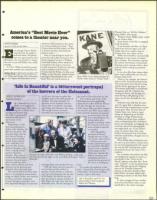
Orson Welles in his classic portrayal of
Charles Foster Kane in "Citizen Kane."
aramosommoximagoommewswww,
`Life Is Bewail:1M' is a bittersweet portrayal
of the horrors of the Holocaust.
SHELLI DORFMAN
Editorial Assistant
on his arm the same number that
Chaplin used in his 1940 parody of
Nazism, The Great Dictator). In
devotion to her husband and son,
Dora, who is not Jewish, accompa-
nies Guido and Giosue to the camp.
The couple's comic, romantic
courtship has transformed into a
get word to Dora that they are safe.
The violence and terror of the
Holocaust are never graphically
ife Is Beautiful (La Vita E
depicted but rather inferred. We see
Bella) is an imaginative
the film through the eyes of the
Chaplinesque fable, show-
child, whose father provides imagina-
ing how a father's love,
tive answers and offers funny expres-
courage and humor help
sions and even slapstick movements
his child to emotionally
to ease his fears. It's the
and physically survive
fierce deterthination of a
the horrors of the
loving father who,
Holocaust.
despite everything, wants
Beginning in 1939
7=7: his innocent son to con-
Italy and presented in
tinue to believe that life
Italian with subtitles, the
is beautiful.
film has two parts. The
Life Is Beautiful, a
first part deals with the
portrayal of life and
love story of Guido, a
change and war, is also
funny, quick-minded
very much a story of love
Jewish waiter (played
— between man and
with child-like inno-
woman and between par-
cence by film director
ent and child. The film's
Roberto Benigni), and
humor is not a mockery
Dora, a young school-
of the impact of the
teacher (Nicoletta
Holocaust. Instead, the
Giorgio Cantarini, f ront left, with Roberto Benigni, center, and
Braschi). They enjoy a
father's cleverness and
Nicoletta: Braschi, ar right, on the set of Roberto Benigni "Lift Is
carefree life filled with
imagination become a
romance, fun and opera Beautifitt”
means for the survival of
after he steals her away
his son in a world gone
from a fascist official, and seem
marriage filled with sacrifice for love.
scary.
oblivious to the growing anti-
With the father and son housed in
No wonder the audience at this
Semitism that surrounds them.
one barrack and the mother in
year's Cannes Film Festival gave Life
The second half of the film takes
another, Guido chooses to mask his
Is Beautifid a 10-minute standing
place in an unnamed concentration
own fear and exhaustion for the sake
ovation. I give it four stars.
of his family. He tells his son that
camp, to which Guido, now married
Life Is Beautiful, rated PG-13;
to Dora, and their young son,
they are living in a game and that if
opens today at the Landmark
they follow the rules, they will win a
Giosue (Giorgio Cantanari), have
Maple Art Theatre.
wonderful prize. He also manages to
been deported (Benigni has tattooed
L
.
Phoebe Tyler on "All My Children,"
plays Welles' wife, Susan.
Without Orson Welles, there would
be no Citizen Kane.
Every frame of the film is stamped
with his genius.
If you examine the film, as I have
done over and over again, you will
realize that every camera setup in
Citizen Kane was a labor of love.
Welles sets himself an inconceivable
challenge in every scene, no matter
how complex. He introduces impossi-
ble camera movements, symmetrical
framing, actors moving within a shot
and yet always ending up perfectly
framed.
In no other film have master shots
been used as effectively, not even by
director John Ford.
There is, for example, the famous
scene at Mrs. Kane's boarding house.
The scene opens showing the young
Charles Foster playing in the snow.
The camera pulls back to reveal both
his parents and Mr. Thatcher dis-
cussing his future. All through the
scene the boy, still playing in the
snow, can be seen through the win-
dow.
Someone once said that the mea-
sure of a great film is whether more
than one thing is happening on screen
at any given time. In every shot of
Citizen Kane, two, three or more
things are happening, so the film
becomes a voyage of discoveries.
Welles has always been credited
with revolutionizing film techniques
by his use of ceilings, overlapping con-
versation, deep focus photography,
low-angle shots, etc. In her famous
essay on Citizen Kane, film critic
Pauline Kael proved that all of these
had been used before, though never in
the same film.
What Welles did revolutionize was
the use of sound. Before Citizen Kane,
no one had experimented with sound
the way he did. Coming from radio,
obviously he knew the value of the
medium.
On a number of occasions the film
uses heightened volume to startle us,
specifically in the "News on the
March" opener, and when Mrs. Kane
calls, "Charles!" in the boarding house
scene. Who can ignore the clanging
door at the Thatcher Memorial
Library, or the echo chamber effect
there? Then, of course, there is the
screeching cockatoo in the final flash-
back.
To show passage of time, another
device borrowed from radio is used,
specifically in the classic montage
10/30