

D
the car, so it can be recharged later
by the generator.
Although the Sloans are reluctant
to discuss figures from product sales,
they say updated models have
recently been licensed to Johnson
Controls for standard production
within trademark Die-Hard
Batteries, as well as to original
equipment manufacturers. Sloan will
also market Battery Buddy as a
brand-name product in auto parts
stores.
Prompted by New York Times cov-
erage of Battery Buddy, other inven-
tors who lacked the business acumen
to market their own ideas contacted
sought the Sloans' help. Declining to
collect fees until Fortune 1,000
companies such as Chrysler Motors
and Playskool agreed to license their
new clients' ideas, Jeff and Richard
created a unique niche for uncover-
ing and promoting technology.
Sloan Enterprises' next step —
approaching universities with a
turnkey program to create and
supervise private companies —
occurred in October 1995. Sloan
Enterprises now writes business
,7plans, hires CEOs, provides neces-
sary market research and supervises
overall operations in exchange for a
co-ownership position with the uni-
versities and investors providing
technology and capital.
"The reason investors are willing
to invest in these companies is
because they know we'll be involved
m in guiding and steering them," says
Richard Sloan, 30. "We've done
seven companies since 1995, and
our vision is to
become the num-
ber one develop-
er of young,
high-tech compa-
nies."
Despite a con-
-rentious relation-
ship between
travel agents and
the airline indus-
try, Melissa
Mandell's travel
business has
managed to sus-
tain an average
720 percent
growth rate for
the past seven
years. She reads
business self-help
books, attends
seminars and
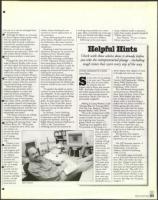
Bob Chmara
hand-delivers
-
tickets, always looking for new
touches to convey appreciation to
her customers.
Never allowing herself to think
about failure, Mandell's survival can
be attributed to her main business
strategy — becoming a consummate
salesperson.
Acquiring a taste for travel and
adventure during the 18 months she
worked overseas, Mandell began
searching for a business to buy
shortly after returning to Michigan
in 1991. Signature Travel's revenues
have since grown from $20,000 to
an anticipated $1 million in sales by
December. Her only regret about
going into business for herself is not
making the move sooner.
Controlling her fears and focusing
instead on developing a small-busi-
ness niche market helped alleviate
the looming question of whether her
business would survive into its fifth
year.
"It's good to be afraid, so you're
cautious in your business decisions,"
says Mandell. "If you spend all your
time talking about it and not doing,
it, you'll never accomplish your
goals. At some point, you have to
just do it. Even if you fail, you've
gained a lot of experience and wis-
dom you can use to help achieve
other goals."
In contrast, Carrie Goldring,
president of Executec Mortgage
Corporation, says she feels no need
to grow her business. Starting at
Ralph Manuel Associates Realtors in
1983, at the "bare bottom,"
Goldring learned the business by
working every position in a mort-
gage office. Currently, her work sup-
ports her lifestyle and offers enough
flexibility to raise two children.
Reflecting on his own experi-
**VATAK" .
ences, Chmara recalls a sentiment
taken from author Joseph Campbell:
"Follow your bliss."
Says Chmara, "To me, it means,
follow your heart." ❑
Helpful Hints
Check with those who've done it already before
you take the entrepreneurial plunge - including
tough tomes that cover every step of the way.
LYNNE MEREDITH COHN
Scene Editor
S
o you want to try making
it on your own? No prob-
lem. Just run your ideas
by mentors and col-
leagues who've flown solo success-
fully. And take a look at books
that other young adults have writ-
ten about their entrepreneurial
experiences. Here's a few that are
particularly insightful.
Making A Living Without A Job:
Winning Ways For Creating Work
That You Love, Barbara J. Winter,
Bantam Books, 1993. $10.95
This is the entrepreneur's bible.
Worried you won't have enough
money to make the rent while
you're getting your business
going? Check out chapter 13,
"Enjoying your spaghetti days."
The premise of this book is to
find what excites
you, and make
it into a career.
"Since passion is
so critical to
making a living
without a job,
identifying
where yours lies
is necessary
before you can
begin making
concrete plans,"
writes Winter.
This tome gives
careful steps to
follow for figur-
ing out what
makes your
world rock. And
then, once you
do and panicky
self-doubt sets in,
there's chapter after chapter to work
it through and come out on top.
The Twentysomething Guide to
Creative Self-Employment: Making
Money While Keeping Your
Freedom, Jeff Porten, Prima
Publishing, 1996. $14.95
Five well-dressed young adults,
multicultural as a Benetton ad,
beam from the front cover of this
book. With helpful tips about
how to figure out what your
dream career is and how long to
endure the one you're currently in
before going solo, this tome
teaches the tricks that the author
learned when he went out on his
own. It'll help you get on your
feet, and then once you're there,
direct you toward how to price
your services, how to send invoic-
es, how to find valuable research,
even how to dress like a pro.
There's also a chapter about how
to get by on a little cash until the
big bucks roll in.
My favorite? The chapter
called, "Read this in one year."
Optimistic, yet cautious.
Kiss Off Corporate America: A
Young Professional's Guide to
Independence, Lisa Kivirist,
Andrews McMeel Publishing,
1998. $12.95
A decidedly angst-motivated
text to kick your butt out of your
boss' office and make you your
own boss. Chapters come with
titles like, "If I'm still here when
they pass out those gold watches,
please shoot me." But still. It's a
helpful guide that, if you're hav-
ing doubts about NA rhether or not
to try it on your own, will push
you over the edge into the gutsy
category.
❑
10/16
1998
Detroit Jewish News
113