

On Their
Own
What does it take to make it as an entrepreneur?
-0
O
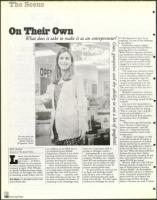
At some point you
have to just do it."
— Melissa Mandell
of Signature Travel.
ERIC BAUM
Special to The Jewish News
L
eisure time has become
increasingly precious —
and scarce — to Robert
Chmara since he opened
his own computer network , service
company. in April, 1996. Whether
he spend's Sunday mornings taking
his family out for bagels and coffee,
or launching model rockets with his
Eric Baum is a free lance writer in the
metro-Detroit area.
10/16
1998
132 Detroit Jewish News
•
two children on the fields next to
the Oakland County Health
Department, Chmara is one of the
growing number of entrepreneurs
who loves what he does but is des-
perately searching for a balance
between work and personal time.
Some would question this man's
decision to leave behind the security
of a steady salary and good benefits
package that came with his job at
Chrysler Corp., — especially with
his third child due any day now. Yet
he chose to shoulder the burden of
competing in the technology arena
where the environment shifts as
quickly as Michigan weather.
And apparently, it was a good
call. Today, Chmara's home-based
company, MindsEye, Inc., employs
three full-time technicians and pro-
jects sales near $1, million by 2001
(based on the company's prior 50
percent annual growth rates).
"It's always been my nature to test
my limits and challenge myself,"
says Chmara, who at 40 sports a
neatly trimmed goatee and a gold
hoop in his left ear. "If I don't create
constructive challenges for myself,
I'll find destructive ones. As an
employee, I've met all the challenges
I was offered."
Employment experts suggest
entrepreneurs like Chmara reflect a
growing shift in the workforce.
Walter Tarrow, corporate consultant
and coordinator of Jewish Vocational
Service's Corporate Opportunities 4
Program, cites studies suggesting
that 75 percent of workers will be
engaged in a variety of non-tradi-
tional and entrepreneurial enterpris-
es by 2010.
"The single most distinctive thing
I see about people who are entrepre-
neurs is that they're different from
and more independent than the
average job seeker," says Tarrow.
"People say entrepreneurs are risk-
takers, but I don't think they are.
They don't see it as risk; they see it
•
as opportunity."
MindsEye's technicians work pri-
marily from their homes and clients'
offices, which frees up dollars to
invest in technology - instead of office
overhead.
One recent hire responded to a
parent's skepticism about a job with-
out a traditional office by stating,
"This is a real job. I get a real pay-
check with real dollars in it."
Jeff and Richard Sloan provide a
no-nonsense story of unshaken
focus.
"When you've got this burning .4
fire at the core, it drives you to
achieve and succeed," says Jeff
Sloan, 37. "Unless you have that
entrepreneurial fire, you're in the
wrong career."
The Sloans' story began in 1982
when Jeff introduced his family to
the beauty and prowess of Arabian
horses, convincing his parents to
help him buy property on which to
breed and sell them. He was 21 at
the time. When the Sloans sold their
business five years later, Talaria
Farms' annual sales exceeded $3 mil-
lion, with certain breeds' sales aver-
aging $93,000 per animal.
Between 1986 and 1990, Jeff and
Richard used the savings from the
sale of Talaria Farms to develop
"Battery Buddy," the Birmingham-
based brothers' solution to dead bat-
teries. Constantly monitoring the
power level of a car's battery, the
device stops the flow of energy
before it becomes too weak to restart
•