

cern what's in your heart even if
you can't quite express it the way
you would like.
6. As you sit in your synagogue
on Rosh Hashanah and Yom Kip-
pur you are joined by millions of
Jews in synagogues all over the
world. You are a Jew, and by par-
ticipating in the holidays you are
making a powerful statement
about your commitment to
Judaism and the Jewish people.
Prayer Is ...
A Multifaceted Discipline
Prayer is at once childlike in its
simplicity and profound beyond
description. But that begs a ques-
tion.
How can I in the choppy water
of the 1990s relate to prayer in a
meaningful way, in a way that I
feel comfortable with. Because to be
honest, I do feel that there is some-
thing out there, call it God, the
force or whatever you want, and I
do want to connect with whatever
that something is. I just don't want
to be left feeling like some strange
religious fanatic in the process.
In the final analysis, we need to
understand that prayer is a highly
sophisticated discipline that is not
easily mastered. In its fullest
sense, it demands a lifetime of
careful attention and effort. How-
ever, there is no doubt that even
one sincere moment of prayer has
the potential to be the most mov-
ing of experiences.
Holiday
Survivalist
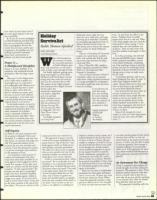
Rabbi Shimon Apisdorf
PHIL JACOBS
Contributing Editor
IV
hen God handed out
the warmest of smiles,
he was surely generous
to Rabbi Shimon Apis-
dorf. And sometimes, we all need a
smile to help us get through the day.
For Rabbi Apisdorf, getting some-
thing meaningful out of the Rosh
Hashanah and Yom Kippur services
brings back that smile not only for
him, but for everyone else as well.
The author of the highly popular
Rosh Hashanah Yom Kippur Survival
Kit has taken the
sometimes complicated
and made it digestible
and very spiritual.
Rabbi Apisdorf's com-
pany, Leviathan Press,
also has produced the
Passover Survival Kit,
The Survival Kit Fami-
ly Haggadah, The One
Hour Purim Primer
and others.
For Rabbi Apisdorf,
surviving Rosh
Hashanah wasn't really the issue
when he was a child and a teen-ager.
Growing up in suburban Cleveland,
he remembers getting home from an
Allman Brothers band concert in
New Jersey just in time at the request
of his mother for Rosh Hashanah
dinner.
Then as a University of Cincinnati
student, he visited Israel, studied a
little, and realized that he'd be mak-
ing several trips between the Holy
•
Land and Ohio.
Now a Pikesville, Md., resident,
Rabbi Apisdorf, attended the Telshe
Yeshiva in Cleveland and Aish
Hatorah in Jerusalem.
The survival kit format evolved in
Columbus, Ohio. As an outreach
rabbi there, Rabbi Apisdorf produced
a 15-page pamphlet for congregants
he hoped would help them get more
from the holidays.
It was obvious, he
said, that many
Jews were looking
for more meaning
from the holidays.
"For the majority of
Jews, Judaism is
peripheral in their
RABBI SHIMON
APISDORF•
Helping
us 'survive"
the holidays.
lives," he said from the office in his
home. "Judaism does not really
impact their lives in a real way. What
I hear from people who have read the
Survival Kit is them saying, 'I never
realized that was what Judaism was
all about.' They say they never real-
ized that Judaism could apply to their
lives."
In its four printings, the Survival
Kit has sold 80,000 copies. Indeed,
Rabbi Apisdorf remembers a more
recent Rosh Hashanah, wondering
not if he would get home in time for
dinner, but how he would get rid of
hundreds of boxes of books from his
dining room in time to make room
for the meal.
"I remember getting a call on erev
Rosh Hashanah one year," he said. "A
rabbi from England needed 100
copies. We got them out in time, and
then we had room to get ready for
our own Rosh Hashanah dinner. "
The Survival Kit has been taken to
services in locations all over the
world. Indeed, many people take the
books to services as a guide to be
used with the holiday prayer book.
Rabbi Apisdorf recommends in the
book that congregants take pieces of
paper with personal spiritual goals
written on them.
Most of all, though, he wants
readers to come out with what comes
easily for him, that smile of fulfill-
ment. ❑
Self-Inquiry
In Hebrew, the most common term
for praying is lehitpalel. This word,
lehitpalel, is a reflexive verb that liter-
ally means, to examine and judge one-
self. The particular objects of our
scrutiny are our own attitudes and
actions. From this perspective, prayer
is a private encounter with ourselves
in the presence of God.
It is axiomatic to any process of
inquiry and assessment that there
must exist some basic standard or cri-
teria against which judgment will be
made. For instance, if you take your
watch to a jeweler and ask the simple
question, "Is this a good watch?" the
jeweler can only give a meaningful
reply if he has a standard of quality
and craftsmanship against which to
judge your watch. At one end of his
scale is a $10 "throw-away" watch and
at the other extreme is the top-of-the-
line Rolex. The issue is, where on this
continuum does your watch fit in.-
This approach to prayer uses the
words and concepts embodied in the
prayer book as "top of the line" stan-
dards against which we hold up our
own feelings, attitudes and actions.
We reflect on where we fit in, ponder
why we rate ourselves the way we do,
seriously consider our actions and
think about how we can improve.
In life it is essential to know "where
you stand." Be it on the job, in a rela-
tionship, or on a particular social or
political issue. In Jewish life you must
also know where you stand. If we read
in the daily prayer book the words,
sound the great shofar for our free-
dom, raise a banner to gather our
exiles and speedily gather us together
from the core concerns of the earth to
our land," then we have to ask our-
selves: a. In addition to sending my
"
checks to various worthy causes, am I
really bothered by the fact that there
are Jews in Syria or Yemen who are
unable to emigrate to Israel? b. If you
are, how bothered? Have I ever cried
at the thought of a Jewish mother
whose husband languishes in prison
for no reason? And if we read the
words, Vekabtzenu (and gather us)
Eartzenu (to our land), do I really
think of Israel as my home? Would I
be proud of my children if they chose
to settle there? Do I in any way long
for the Jewish people to be united
again in Jerusalem.
These are not easy or comfortable
questions, but then again self-assess-
ment is never easy. To grow you must
first know where you stand. When
using this approach to prayer, I sug-
gest you choose one or two concepts
to focus on each time you pray. You
can either decide ahead of time which
concepts they will be, or you can
choose them as the prayer service pro-
gresses. In either case the idea is quali-
ty and not quantity. One concept is
certainly sufficient if you earnestly
reflect on it. This approach can open
up a whole world of self-discovery as
well as personal, spiritual and Jewish
growth.
An Instrument For Change
There is a question that students of
Jewish thought have been asking for
centuries. The question is this: "If (as
Judaism claims) whatever God does
for us is exactly what is best for us,
then why do we ever ask for anything
in our prayers? Isn't what we already
have precisely what we need?
The approach to dealing with this
9/18
1998
Detroit Jewish News
51