
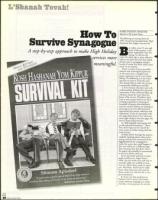

How To
Survive Synagogue
A step-by-step approach to make High Holiday
services more
meaningful.
Shitnon Apisdorf
ces
High Holy Day servi
spend
"people who usually
pay attention: 1
the ceiling tiles will sit up and
counting
9/18
1998
50 Detroit Jewish News
-Baltimore Jewish Times
RABBI SHIMON APISDORF
Special to The Jewish News
The following are excerpts from the
1997 revised and expanded book, "Rosh
Hashanah Yom Kippur Survival Kit."
ut rabbi, even if I can read
some of the prayers, I still
don't understand what I'm
saying. To tell you the
truth, I'd rather take a quiet reflective
walk in the park this year than spend
all that time in synagogue saying a
bunch of words that don't really mean
much to me anyway.
Prayer is meant to be a powerful,
relevant and meaningful experience.
At the same time, a lengthy syna-
gogue experience can be a bit intimi-
dating. The following is a list of per-
spectives to keep in mind this year
that should help to make the services
as personally uplifting as possible.
1. Five minutes of prayer said with
understanding, feeling and a personal
connection to the words and their sig-
nificance means far more than five
hours of lip service. Therefore, don't
look at your prayer book as an all-or-
nothing proposition consisting of
hundreds of prayers that absolutely
must be recited. Rather, try looking at
each page as its own self-contained
opportunity for prayer, reflection and
inspiration. If you are successful with
one page that's great; if not, then just
move right along to the next page, the
next of many opportunities.
2. "Self-imposed expectations led
to self-induced frustrations." There-
fore, don't expect to be 'moved' by
every prayer to follow along with the
entire service.
3. Reid slowly through the prayers,
carefully thinking about what you're
saying, and don't be concerned about
lagging behind the congregation.
Look, the worst that could happen is
that you will be on a different page
than everyone else, but don't worry,
the pages will probably be announced
so you can always catch up.
4. If a particular sentence or para-
graph touches you, linger there a
while. Say the words over and over to
yourself, softly, but audible to your
own ear. Allow those words to touch
you. Feel them. And if you're really
brace, then close your eyes and say
those words over and over for a cou-
ple of moments.
5. You're not that proficient in
Hebrew? Don't worry, God under-
stands whatever language you speak.
And like a loving parent, he can dis-