
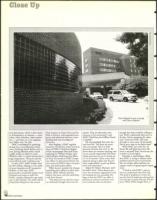

Sinai Hospital is soon to merge
with Grace Hospital.
sions downtown, which it then enacts
in all hospitals in its domain — some
urban, some suburban, some commu-
nity -- and then we, as an organiza-
tion, follow suit," he said.
DMC consolidated its pathology
testing into a core laboratory down-
town, shrinking Sinai's facility and, in
turn, leaving Herman with a much
smaller milieu in which to work.
While he calls it a "good decision for a
huge corporation," Herman said the
move left him with "nothing to do."
In early 1997, DMC bought Sinai
for $65 million, adding it to its stable
of seven hospitals and 45 outpatient
facilities. A year later, DMC
announced it would fold nearby Grace
Hospital and merge its staff with
Sinai's, a project expected to get under
way in late October. The result will be
Grace-Sinai Hospital in the current
9/11
1998
76 Detroit Jewish News
Sinai location at Outer Drive and Six
Mile in Detroit, with expanded emer-
gency and obstetrical services, a new
parking deck and reconfigured
entrances.
Anne Regling, a DMC regional
executive, has become senior vice-pres-
ident of DMC's Northwest Region,
which encompasses Sinai and Grace,
replacing Dr. William Pinsky, a Jew
who had been chief executive officer
of Sinai. He moved to DMC's corpo-
rate offices in downtown Detroit and
now serves as DMC's senior vice-presi-
dent and chief quality officer.
While doctors consider the changes
something of an affront to their sensi-
bilities, DMC officials said they
believe they have, and will, deal fairly.
with Sinai doctors.
"The physicians are the key reason
we ultimately brought Sinai into the
system. They are obviously a key
resource to the community," said
DMC Chief Executive Officer David
Campbell.
He acknowledged that some doc-
tors have left, "but there are many
who are staying. This is a fairly
dynamic business that we're in. We
know there are contracts expiring, and
we are actively negotiating with those
whose contracts are up or coming up
in 16-18 months. I have a new man-
agement group in place that has pri-
mary responsibility to pick up discus-
sions with physicians."
Added Dr. Robert Michaels, chief
of staff at Sinai, "Some doctors per-
ceive that economic negotiations with
the hospital are not successful. My
hope is that the DMC can offer to
physicians contracts economic and
non-economic that are attractive
enough that they would be willing to
stay. DMC understands they have to
do that. You're competing for talent
and I think the DMC will come
through in most cases. I'd personally
like to put a stop to the brain drain."
While DMC says only four of
Sinai's 88 staff physicians have left
since it acquired Sinai, doctors say the
number is much higher.
Michaels, a nephrologist, added
that DMC is trying to address other
problems doctors have encountered,
like out-of-date office facilities, lax
support staff and aging hospital equip-
ment.
"I think it took DMC a year or
more to understand what they had.
The kind of employees we have are
not the kind of employees doctors had
10 years ago, because jobs pay $10 per
hour. When DMC bought Sinai, it