

early two years ago, Sinai
Hospital was acquired by
the behemoth Detroit
Medical Center, ending its
44-year history as the community's
only Jewish hospital and bowing to an
economic inevitability for small, free-
standing medical institutions.
And even though the death knell
had sounded years earlier for the hos-
pital — Sinai was losing $1 million a
month in the late 1980s — doctors
valiantly tried to save the hospital.
Some of them are happily working at
DMC-Sinai today, and DMC admin-
istrators say they intend to keep the
hospital's Jewish traditions alive.
But at least half a dozen doctors
have either left or are on their way
out. The reasons for their defection
range from disaffection with new con-
tractual arrangements to better offers
from other hospitals to a realization
that Sinai has undergone a cultural
transformation that has left them
bewildered and angry.
"Sinai was a fairly small institu-
tion," said neurologist Richard Trosch,
who left DMC-Sinai in August. "You
knew who everybody was, if you had
to get something done, you knew
whom to speak to. DMC is a gigantic
corporation, and half the time nobody
knows how to get something done or
whom to talk to. There are layers of
bureaucracy you're not used to dealing
with."
Trosch, 38, had had privileges at
other hospitals, including William
Beaumont in Royal Oak, for some
time. And while he was satisfied with
the contract DMC offered him, it sig-
nalled that it was time to re-think his
practice. He decided to join
Beaumont while maintaining his staff
privileges at DMC-Sinai.
"Physicians are going where their
practice is. If a patient living in
Southfield gets sick, they're more like-
ly to be taken to Beaumont or to
Huron Valley," Trosch said. "Chances
are, they won't go to Sinai. Even doc-
tors who've been on staff have been
forced to have other affiliations, just
out of necessity, just because their
patients are ending up in those other
hospitals."
On the surface, Sinai feels like a
Jewish hospital, albeit an aging one.
Its wings and auditorium are named
for generous Jewish contributors and
its lobby partitions are hung with col-
orful drawings by Jewish schoolchild-
ren. Poster-size black and white pho-
tos of Sinai in various stages of its life
line the hallways, along with blocks of
text that describe the hospital's begin-
nings as a haven for Jewish doctors
who were denied staff privileges and
positions at secular hospitals.
Trosch's contentions are partly
backed up by a 1998 Simmons Jewish
News survey of randomly sampled
Jewish News subscribers. According to
the survey, half of those subscribers
who used a health care facility in the
last 12 months used Beaumont. Since
1993, when the first Simmons-Jewish
News survey was done, Jewish corn-
munity usage at Sinai has dropped
from 35.4 to 25.9 percent. Sinai draws
38 percent of its patients from the
suburbs, according to a DMC
spokesperson.
Huron Valley Hospital in
Commerce Township, which became
Huron Valley-Sinai soon after DMC
acquired Sinai, has, according to the
Simmons- Jewish News survey, increas-
ingly become a destination of choice
for Jews. However, the numbers are
small: From 1993 to 1998, Jewish
community usage rose from 3 to 6
•
percent.
Dr. Arthur Efros, an internist, left
Sinai for Providence Hospital on May
1. His choice was simple: "In a nut-
shell, Providence was more interested
in having me than Sinai was in keep-
ing me."
Efros, 47, asserted that DMC has
"shown a disregard" for its medical
staff, that it 18 not as "physician-
friendly" as Sinai.
"The entire [merging] process has
been gradual. The change has more to
do with philosophy than saving
money. I don't think you save money
by alienating your medical staff, doc-
tors who've been the mainstays of your
programs for years, creating scenarios
where they are not glad to stay.
"[DMC's] philosophy is in the con-
tracts. There's almost an absence of
cohesiveness ... Everybody's bewil-
dered, everybody's in the dark, every-
body has a sense that their input does-
n't count for much, that rather than
being negatively responsive, they are
unresponsive," Efros said.
After 17 years at Sinai, Dr. Gilbert
Herman joined the staff of Botsford
General Hospital. When he left on
Dec. 31, he was chief of Sinai's pathol-
ogy department.
Herman, 48, didn't leave because of
problems hammering out a new con-
tract with DMC. What ate at him was
the change in operations and attitude.
"It wasn't Sinai Hospital any more.
It was just a job. This is a huge corpo-
ration that makes huge corporate deci-
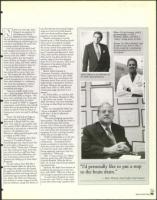
Below: Dr. Jay Levinson, chief of
gastroenterology in DMC's
Northwest Region, said there's a
"sadness" among doctors at Sinai.
Bottom: Dr. Robert Michaels, chief
of sta at Sinai, believes DMC is
rrn y committed to maintaining
and expanding Jewish services at
the hospital
Mark Schlussel is vice-chairman of
the DMC board of directors.
"I'd personally like to put a stop
to the brain drain."
— Robert Michaels, chief of staff at Sinai Hospital
9/11
1998
Detroit Jewish News
75