
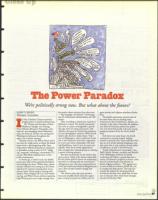

The Power Paradox
We're politically strong now. But what about the future?
JAMES D. BESSER
Washington Correspondent
I
n May, President Clinton received a
stinging lesson in Jewish political clout.
Mr. Clinton and Secretary of State
Madeleine Albright were fuming;
Prime Minister Binyamin Netanyahu, they
believed, was sabotaging Israeli-Palestinian
talks, the threat of violence was soaring and
Washington's influence throughout the
region was a distant memory.
Insistent voices at the White House said it
was time for tough action to elbow the Israeli
leader back to the bargaining table. State
Department officials proposed an ultimatum
to Jerusalem: accept a series of U.S. "bridg-
ing" proposals, including a controversial 13.1
percent West Bank redeployment, or face
public chastisement.
As threats go, it wasn't much, but Jewish
groups got wind of the proposed showdown
and sounded the alarm. Within days, admin-
istration officials were staring at a stern letter
signed by 81 senators warning them not to
squeeze Israel. House leaders, starting with
Speaker Newt Gingrich (R-Ga.) were breath-
ing fire, and White House political operatives
beganIearing the same tough message from
the people whose opinions they value most
— big campaign contributors. The barrage
sent an embarrassed administration into full
retreat.
That, according to almost any measure or
definition, is clout. The Jewish community
has come to a place unimaginable a genera-
tion ago. Jews are strong and secure, with
influence that goes far beyond the communi-
ty's tiny demographic presence. When Jewish
leaders talk, decision-makers listen. That's
true in Washington, where traditional Jewish
ties to the Democrats have been augmented
by a new and robust relationship with lead-
ing Republicans. And it's true in many state
capitals, where local Jewish organizations
have emulated the national groups in creating
a potent lobbying presence.
But there are portents on the horizon that
raise concern. Some of the factors responsible
for this Jewish political boom are evaporating
into thin air, starting with the community's
willingness to put a few key commandments
of the pro-Israel creed ahead of disagreements
over a host of other matters, foreign and
domestic.
The relative unity that once served to
focus and amplify Jewish clout like a giant
laser is losing its punch as conflict over the
peace process and religious pluralism divides
Jews.
The Jewish community mirrors some of
the same forces that are leading many
Americans to shun involvement. Apathy, not
activism, is the order of the day; the stridency
and sleaze of American politics has spilled
over into the Jewish world, and many young
people are turned off by the whole sordid
mess.
And there's one more factor: the Jewish
community is turning inward, looking
toward its spiritual core. Many celebrate what
they see as a Jewish spiritual renaissance, but
also worry that it may undercut Jewish politi-
cal influence, at least in the short term.
"Jewish political power has peaked," says
Rabbi Sidney Schwarz, president and founder
of the Washington Institute for Jewish
Leadership and Values, a group that uses a
variety of innovative programs to foster a new
kind of activism based more directly on
Jewish religious tradition. "The agenda now
is more to lead an authentic Jewish life, not
to increase and keep power. That may not
provide the impetus for keeping political
activism at the same fever pitch that we have
seen in the past, when Israel faced emergen-
cies like the Six-Day War."
7/31
1995
Detroit Jewish News
97