

The Chosen Ones
You don't have to look far to find the
good news about Jewish political clout.
There's a full minyan in the Senate —
10 Jews, an all-time high.
Numbers in the House have fallen
sharply in recent years due to retire- •
ments and redistricting, but the 23
Jewish House members still play a sig-
nificant role in domestic and foreign
policy legislation, thanks to seniority
and important committee assignments.
A striking example of how far Jews
have come: both senators from
Wisconsin, a state where a mere 0.6
percent of the population is Jewish, are
Jews.
Jews occupy a staggering number of
high positions in the Clinton adminis-
tration, and the president has appointed
two Jews to the Supreme Court, break-
ing an informal quota of one. The
national chairman of the Democratic
National Committee is Steven
Grossman, former president of the pro-
Israel lobby, the finance director of the
Republican National Committee is Mel
Sembler, a vice-chair of the National
Jewish Coalition, a Jewish Republican
organization.
A network of congressional aides
who broke into politics with pro-Israel
groups occupy key staff positions; the
American Israel Public Affairs
Committee (AIPAC) is a veritable train-
ing camp for Capitol Hill staffers.
Expanding Jewish lobby groups in
Washington means that the communi-
ty's special concerns get addressed at the
highest levels, and not just on Middle
East issues.
"There's been a dramatic increase in
the Jewish presence on a wide range of
domestic issues," says Diana Aviv,
Washington director for the Council of
Jewish Federations. "Israel is very
important in Jewish political activism,
but it isn't just Israel anymore."
Increasingly, Jewish power extends
beyond the Beltway, as well. A new gen-
eration of Jewish leaders, more overtly
Jewish than their predecessors, more
willing to stand out among their non-
Jewish colleagues, are working their way
up the rungs of political life in state-
houses and city halls across the country.
•••
•
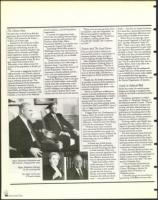
Above: Binyamin Netanyahu and
Bill Clinton: Feeling Jewish clout.
Right: Madeleine Albright:
On the receiving end.
Far right: Carl Levin:
A Senate minyan.
7/31
1998
98 Detroit Jewish News
"Many of us are more up front about
our Judaism," says Sara Feigenholtz, an
Illinois state legislator representing a
suburban Chicago district. "Sometimes
it's difficult, teaching people from
Danville (Ill.) Yiddish. But I celebrate
my faith."
Dissent And The Israel Factor
Even as today's leaders celebrate the
community's arrival as a major player in
American politics, many see signs it
may be slipping through their fingers.
Johns Hopkins University political
scientist Benjamin Ginsberg Points to
several alarming portents. "The first is
the obvious one: assimilation," he says.
"The rate of intermarriage continues to
be at an all-time high, and that has a
direct impact on Jewish political influ-
),
ence.
Simply put, the Jewish community,
at less than 3 percent of the population,
feels each loss particularly hard — in
terms of community, but also in terms
of political influence.
Almost as insidious is a fading con-
nection to Jewish political and commu-
nal institutions. Membership in Jewish
"defense" organizations is down, and
groups that focus mostly on Israel,
including the pro-Israel political action
committees (PACs) and AIPAC, have to
rely on bier donations from a dwin-
dling core of givers.
A bigger factor, Mr. Ginsberg says, is
dissent within the Jewish community
and the loss of Israel as a factor that
transcends deep religious and cultural
differences. "Israel has been the rallying
point for the community," he says.
"Without Israel, there would. be
many American Jewish communities at
war with one another over social, cul-
tural and religious matters. Without the
focus, there isn't an American Jewish
community, just a lot of different
American Jews."
A decade ago, Jewish groups
emphasized things like maintaining
American aid and thwarting arms sales
to Arab countries. There was
almost universal agreement that
Israel's survival depended on
how effective American Jews
were in advocating those issues.
Today, Israel enjoys a first-
world economy and an over-
whelming military advantage.
The top issue is now a peace
process that has become a
bloody, internecine battlefield.
American Jews still care about
Israel — the polls show that
clearly — but they no longer feel driven
by a sense that a precarious Israel needs
them to put aside their differences and
unite behind a handful of core issues.
"About five or six years ago, some-
thing unusual happened in Israeli poli-
tics," says Rep. Benjamin Cardin (D-
Md.). "There was an open effort made
[by the Likud opposition] to gain polit-
ical support in thiscountry for a politi-
cal party in Israel. That was something
that had never been attempted before.
Most Jewish legislators try to avoid
being dragged into Israeli politics, he
says, "but it is still a factor that was not
present before. And it can add to the
growing disunity we see."
Once, AIPAC was the undisputed
Capitol Hill voice of the Jewish consen-
sus on Middle East issues; today, legisla-
4-1•0
tors routinely hear from groups as
diverse as Americans for Peace Now and
the Zionist Organization of America.
"
Cracks In Political Wall
Slowly but surely, the nation's power
brokers are starting to recognize these
chinks in the Jewish community's politi-
cal armor.
"In politics, perception is reality"
says Arthur C. Abramson, director of
the Baltimore Jewish Council. "There's
a perception that we're a united com-
munity, and that's what has kept our
strength up. But in small increments,
politicians are becoming aware of the
fact that we're anything but united in
the Netanyahu era. As that realization
seeps in, we will have a problem."
Growing conflict over Middle East
questions, he says, may be offset to a
degree by growing Jewish political clout
on domestic issues and in many state-
houses around the country.
But those domestic issues don't-pro-
vide the emotional rallying point for
Passionate Jewish activism that Israel's
battle for survival once provided. On a
growing number of hot domestic issues
— like school vouchers — the Jewish 41•0
community is deeply divided.
Once, domestic Jewish activism was
synonymous with liberal Democratic
politics; today, a small but vocal band of
Jewish conservatives is bringing very
different views to the table. The same
goes for Orthodox Jews.
"The Orthodox community has
come of age, politically" says Abba
Cohen, Washington director for
Agudath Israel of America, an
Orthodox group.
Orthodox groups are succeeding in
generating involv-enent because they