

affirming — what I want viewers to
feel — is an appreciation of how
human creativity uniquely and bril-
liantly adapts them to a world culture
that is increasingly monolithic.
Blame It
On Barbie?
busty," Steiner-Adair said, "and it's
not us — it's the Scandinavians."
Steiner-Adair said that women
who do not mirror society's ideal
body image have been judged very
harshly by the culture — and by
other women, as well.
Weave this "weightism" together
with anti-Semitic stereotypes and the
toll they take on Jewish women's
self-esteem, she said, and what you
get is a greater vulnerability to eating
disorders among Jewish women.
"If you have a Jewish girl who's
feeling wobbly about herself, and who
feels a lot of pressure on her to assimi-
late, to achieve — it's easy for a girl to
say, 'I can't be all those things. I know
what I'll be good at: I'll be thin."'
The educator has written a pilot
curriculum, "Full of Ourselves:
Advancing Girls' Right to Throw
Their Weight Around," in an effort
to help teen-age girls develop self-
esteem and a healthy body image.
"There are some things we can do
as a community," Steiner-Adair told
her overwhelmingly female audience.
"The most radical thing — the
healthiest and most radical thing you
can do today -- is to not participate
in body-hatred.
"Change that inner dialogue. Find
a dialogue of self-acceptance," she
said. "You want to start the revolu-
tion? This is it." ❑
sions and made a
good profit.
"Like any other
kind of investment, I
have to wait for the
1ff ary Altman's
right time to sell."
interest in Barbies
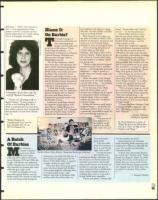
Barb ie collector Mary Altman: "Sometimes Barbies get a bad rap."
During the years
came as an adult,
that Altman was
after she began
Depression, when she had only one. It
building her Barbie collection, she
collecting other dolls as travel sou-
also involved an appreciation for the
became active in Barbie clubs and
venirs. Between 1970 and 1984, she
beauty of the doll's clothes as opposed
attended conventions. She found
bought 100 Barbies and additional
to paper clothes for paper dolls.
what would become her favorite col-
outfits, keeping most in boxes so that
"Now that there are so many gener-
lectibles at meetings and gets the
they maintain or increase their value
ations that have played with Barbies,
most enjoyment from a bridal party
when she gets ready to sell.
some people might be collecting them
series, which includes Barbie in a
It wasn't just thoughts of invest-
to recapture their youth," said
wedding dress, Ken in a tux and a
ment that moved Altman into the
Altman, who lives in Rochester Hills
formal bridal party ensemble.
Barbie world. Her interest in dolls had
and has sold a few of her older ver-
"They're just pretty," Altman said.
to do with being raised during the
"It's like another art form."
Altman found a lot of friends
while attending Barbie meetings and
building her collection, although she
never met another Jewish Barbie
enthusiast locally.
"I think that sometimes Barbies
get a bad rap," Altman said. "Some
people are negative about the dolls,
saying they're one of the causes of
things that are wrong with society.
They think Barbies present unreal-
istic images, but the dolls don't cre-
ate what's in society. They reflect
it." ❑
P ho to by Va lerie Jaco bs
and explored such issues as eating
disorders, the role of food in Jewish
culture and body hatred.
Body hatred was the subject on
the plate of Catherine Steiner-Adair,
director of education, prevention and
treatment at the Harvard Eating
Disorders Center in Lexington, Mass.
"Every morning, 80 percent of
women wake up with body
loathing," said Steiner-Adair in her
keynote address. "Eighty percent of
the women in America don't relate
to their bodies in a healthy, respect-
ful, loving way.
"Women judge themselves based
on what they eat. This is very dan-
gerous — psychologically, spiritually
dangerous — when it comes to a
point where you literally weigh your
self-esteem."
What, she asked, is the relation-
ship between all this body loathing
and the body politic — the political-
cultural climate of America?
In the America of the 1960s,
observed Steiner-Adair, just as
women were reaching out for equali-
ty, the general culture embraced a
singular image of the successful
woman: the ultra-thin, breast-less,
tush-less Twiggy.
In fact, the educator said, today's
image of beauty — the Barbie-like
statuesque, willowy, busty woman —
is genetically impossible to attain for
the overwhelming majority of
women.
"One percent of
our population is
genetically preclis-
26- posed to be really
5 tall, really thin and
Filmmaker Susan Stern rips the
roof of "Barbie's Dreamhouse."
"There's a lot of strange stuff in
`Barbie Nation.' To some people, it
will be a very shocking film, but I
think it communicates my own sense
that reality is always more complicated
than we think it is and more interest-
ing."
❑
"Barbie Nation: An
Unauthorized Tour" airs 10
p.m. Tuesday, July 14, on
WTVS-Channel 56.
A Batch
Of Barbies
T
he mixed messages of
American and Jewish cul-
ture concerning food,
hunger and the body were
at the top of the menu at "Food,
Body Image & Judaism — A
Conference on Ethnicity and Eating:
Cultural Patterns, Disorders and
Resources for Change" held in
Philadelphia recently.
The all-day conference, which
drew more than 250 educators, ther-
apists, Jewish communal profession-
als, parents and teens to the local
Jewish center, was jointly sponsored
by Kolot: The Center for Jewish
Women's and Gender Studies at the
Reconstructionist Rabbinical College
and the Renfrew Center Foundation,
a women's mental health facility spe-
cializing in eating disorders.
"I think this is really a ground-
breaking event," said Lori Lefkowitz,
director of Kolot, who co-chaired
the event with Karen Smith, a
licensed clinical social worker with
the Renfrew Center.
Conference workshops whetted
the appetites of participants with
such titles as "Zaftig Women in a
Barbie Doll Culture" and "Chopped
Liver and Chicken Soup: Soothing
Food for the Traumatized Soul,"
— Marilyn Silverstein
JTA/Jewish Exponent
See Mixed Media for a review of
"When You Eat at the Refrigerator,
Pull Up a Chair: 50 Ways to Feel
Gorgeous and Happy"
— Suzanne Chessier
7/10
1998
75