

a
O
stories are spoken by fans, foes,
fetishists and even Barbie manufactur-
er Ruth Handler. Viewers soon learn
how this doll becomes an expression
of longings, fears and creativity in a
world of mass production.
"People have done television pieces
about Barbie before, but my docu-
mentary is not really about Barbie,"
said Stern, 44, who played with a
Barbie while growing up in Illinois.
"It's really about the people who
have strong feelings for or against the
doll, and it's about the issues that tell
a good deal about ourselves and our
country at the end of the 20th centu-
ry ,"
Stern, who was 6 when she received
a Barbie for Chanukah and Christmas
— her family celebrated both —
decided to do the documentary after
watching her daughter play with yet
another version of the cultural icon.
"I began my research by calling the
national Barbie magazine and getting
contacts for Barbie clubs around the
country," said Stern, who had been an
investigative reporter for newspapers
and a news writer for TV. "I also
called dealers and collectors.
"I started working on the film in
the 35th anniversary [year] of the
Barbie doll when events were breaking
out all over the country. I followed
people to them, and I met Ruth
Handler at Mattel's Barbie festival.
"I was surprised at how utterly
Barbie cut across all lines — race,
class, income, level of hipness, sex,
anything."
Handler and her husband, Elliot,
co-founded Mattel Inc. in 1959 and
•
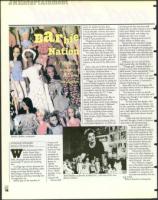
Barbies, Barbies, everywhere.
SUZANNE CHESSLER
Special to The Jewish News
hile documentary film-
maker Susan Stern
claims to be perfectly
neutral about Barbie
dolls, the people she's taped for an
upcoming TV special are anything
but.
A college-age woman discusses her
battle with anorexia and bulimia after
trying to emulate Barbie's perfect
body image, and gay men living in
San Francisco talk about dressing like
the legendary toy.
Barbie play in the trenches of
7/10
1998
74
Croatia and
Barbie prayers
in the deep
South are only
two more
examples of
the kinds of
Barbie mania
shown in
"Barbie
Nation: An
Unauthorized
Tour," which
airs July 14 on
WTVS-
Channel 56.
Diverse doll
introduced the first American doll
shaped like an adult woman as one of
many toys. Barbie met with success
around the world, and today, two
Barbies are sold every second.
Last year, Mattel grossed over $1
billion dollars in Barbie sales.
Named after the Handlers' daugh-
ter, Barbara, Barbie was intended to
open up new thoughts for young girls,
who were limited to playing mommy
because baby dolls were the only ones
available. With an adult doll, Handler
thought, a girl could truly act out her
dreams.
Adding to the mix was the Ken
doll, named after the Handlers' son.
"Though girls' interest in Barbie is
sexual, it's not what we think of as
adult sexual," Stern maintained. "Girls
are interested in the adultness of
Barbie's body. That's what I was inter-
ested in as a child — what I was going
to be like as a woman. It becomes a
fantasy of growing up."
Stern did a lot of traveling to talk
to adults whose interest.in Barbie con-
tinues for many reasons.
"For those of us who are Jewish,
there's a subtext to this story that we'll
all get even though it isn't explicit in
the film," Stern said.
"It's the irony that Barbie, who
many see as the ultimate `shiksa,' was
in fact created by a Jewish couple who
went to Germany after the.war and
saw a doll called Lilli, a German men's
novelty toy that looks almost exactly
like Barbie.
"They took this German post-
war doll, brought it back to America
and made it the quintessential
American (shiksa' doll."
Stern's show offers no
-7,
expert psychological analysis
_, of the doll's popularity. She
.° believes the analysis should
take place in viewers' homes
after hearing the doll's fans
and detractors discuss the
issues raised by Barbie
body image, sexuality, sex
• roles and consumerism.
"Ultimately, [the film]
•
came to be what happens to
o creativity in this increasingly
mass-produced world that
we're living in," she said.
"Our children's imagina-
tion is furnished with prod-
ucts that are copyrighted and
trademarked, and we're sur-
rounded in a consumer cul-
ture that overwhelms the nat-
ural world.
"What I found so exciting and
o
Ruth Handler, cofounder o Mattel Inc., with some of her most
famous creations.