

he Scene
Real agitate
,,,
Th illonth
. „, , . . , ,
.
A Soulful 1Viensch
EVAN KARL CUTLER
Special to The Jewish News
.
MARC KOGAN
Special to The Jewish News
B
fore approving a mort-
gage, a lender consid-
ers five major criteria:
income, debt, credit,
employment and property.
Income is used to determine
what kind of home you can
comfortably afford. The reason-
ing goes that the smaller the
house payment, the more easily
you will be able to make the
payment. Lenders consider your
monthly gross income — earn-
ings before taxes — for this cal-
culation.
Lenders use two ratios to
determine what payment you
can easily make: Housing
Expense Ratio (HER) and Gross
Debt Ratio (GDR). The HER is
calculated by taking the monthly
cost of the home — including
principal and interest on the
loan, monthly county/city taxes,
home owner's insurance and
mortgage insurance/association
dues — and dividing it by your
gross income.
Calculate the GDR by adding
monthly housing cost to the
minimum monthly payment of
all installment and revolving
payments (which include car and
." credit card) divided by monthly
gross income.
So, if your gross income is
$2,500 per month, your pro-
posed monthly housing expense
$700, and your minimum
monthly installment/revolving
payments $275, what would
your HER and GDR be? (The
ratio should be 28/36.)
Professional realtors suggest
that you see a lender before
looking at homes.
Marc Kogan is a loan ofJzcer with
Capital Mortgage Funding in
Southfield. The information
expressed herein is not necessarily the
opinion of The Jewish News.
7/3
1998
62
I
t's easy to respect Jeremy
Haberman. Here is a young
man who makes a living from
the universal urge to relax and
party.
Jeremy loves music. And at 26,
this Detroit native (bar mitzvahed at
Congregation B'nai Moshe) has
made his love his business.
Three years ago, the former lead-
singer and manager of an East
Lansing band called "Solstice,"
Jere my felt he understood some-
thing about the music business. An
alumnus of Michigan State
University, he was selling software to
insurance agents — and feeling
unsatisfied.
"It would be cool to run a night
club," he thought.
So Jeremy formed a plan: Take
over the Magic Bag, then a faltering
Ferndale 'nightclub. With his father's
faithful support, he secured a 30-year
loan in April of 1996 and got to
work.
It was, he says, far more work
than he had expected — 60 to 70
hours a week. But in two years he
had turned his dream into a fun and
profitable reality.
Aggressively seeking new and
established talent leaves him little
time to pursue his own music.
Instead, he focuses on booking, mar-
keting and producing shows, and
puts the urge to star on hold.
When a UPS driver arrives with a
box of compact discs, he beams like
an 8-year-old opening much-antici-
pated presents and begins rattling off
a string of names from the six new
CDs. He settles on a 1969 album by
Rubin Wilson, a "funky organ-jazz-
player-from-the-'60s." Jeremy loads
the disc and says Rubin is still going
strong, playing shows.
The multimedia personal comput-
er on his desk, stacks of CDs and
posters venerating musicians of many
genres attest to Jeremy's passion for
music. The man is a mensch, with
soul.
The Magic Bag reflects Jeremy's
eclectic tastes — artsy and comedic
movies to nationally acclaimed jazz,
blues and ska performances, and on
to a divergent range of acoustic, clas-
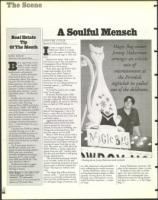
Checking the set: Jeremy Haberman.tends to details.
sic, folk, electronica and psychedelic
rock, sotnething for nearly everyone.
Jeremy Haberman, clean-cut and
striving businessman, keeps an office
upstairs. During shows, he rotates
through every staff position, so you
might find him anywhere — except
on stage.
Jeremy Haberman, musician, still
plays in his basement, alone, to relax.
Someday, he may play in public
again. For now, however, you can
appreciate the unrecognized man-
behind-the-scenes by taking friends
and dates to a show — at the Magic
Bag. Ell