
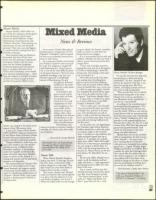

Master Mischa
Mischa Kottler (1899-1994) was
one of the last exponents of the grand
Russian Romantic school made
famous by Josef Hofmann, Sergei
Rachmaninov, Josef Lhevinne and
Vladimir Horowitz. Their playing was
spontaneous, fervent and intensely
personal. Their style was also flagrant-
ly sentimental but underpinned by a
Pr steel-like technique.
Many pianists today are bland per-
fectionists; they have all the notes
down, but their playing is impersonal
and square. Kottler, who for many
years was the Detroit Symphony
Orchestra's pianist and who labored
long as a teacher (privately and at
Wayne State University), never would
have tolerated insipid playing — either
Ip from his students or himself. A student
of Emil von Sauer (a pupil of Liszt)
and the Swiss pianist Alfred Cortot,
Kottler was steeped in the plush extrav-
agance of the 19th-century style.
A new CD, Pianist Mischa Kottler
(WSU-01M97), whose proceeds bene-
fit the Wayne State University Mischa
Kottler Memorial Scholarship Fund,
captures Kottler's individual qualities.
Chopin's Ballade in A-flat may con-
tain a few clinkers, but note-perfect
playing was not a hallmark of the
Romantic tradition. A few botched
notes were happily sacrificed in the
name of artistic expression. Kottler's
sense of rubato on the Ballade is
strong and natural, and his playing is.,
spacious and rhapsodic.
His interpretation of Chopin's Noc-
turne in F-sharp major is free of per-
fumed fussiness, yet remains sweetly
sentimental. Kottler pulls out all the
stops in a flamboyant performance of
Chopin's "Minute Waltz" and exudes
passion in Rachmaninov's Prelude in
G-sharp minor.
Mixed Media
News 6. Reviews
As an encore, Kottler often played
Rachmaninov's arrangement of Fritz
Kreisler's "Liebesleid," and it's includ-
ed here as an unabashed musical love
letter to old Vienna.
As a composer, Kottler was limited;
his Prelude is repetitive and structural-
ly weak. The program is topped off
with Rachmaninov's Piano Concerto
No. 3, one of the most difficult pieces
in the piano literature. There are more
polished recordings to be sure, but
Kottler's'approach is refreshingly
devoid of showboating. He gets
through the technical
hurdles, but he under-
scores the work's poetic
melancholy.
A drawback is the
spotty sound quality.
Some tracks are from
live performances,
which have the usual
complement of audi-
ence intelference, but
some studio perfor-
mances are no great
shakes, either. More
troubling is the absence
of information in the
liner notes about the
dates of performances.
Nevertheless, this
tribute to Kottler is welcome indeed, a
reminder of a heroic style that's sadly
out of fashion.
— Reviewed by George Bulanda
Howie Talk
When Howie Mandel's daughter,
Jackie, was born 13 years ago, he and
his wife, Terry, waited three weeks
before taking her on the road. Then
they would stay away from home as
long as three.months at a time.
Very 'much a family man, Mandel
made sure that his clan stayed together
as it grew with the addition of a son
and another daughter, now 8 and 5.
When the eldest child was old enough
to go to school, the frenetic comedian
made it a point to work from his
home base in Los Angeles.
If it is inconvenient for his wife and
children, Mandel, 42, does not book a
club or concert date beyond the Mis-
sissippi River.
"I don't stay overnight anywhere
during the week and we're all to _ gether
if I have a weekend gig. I don't like
being away. I love being in the same
city my family's in."
Now older and much wiser than
the madcap days of pulling latex
gloves over his head and inflating
them with his nostrils (which ended
when he literally blew out a sinus cavi-
ty while on stage one night), Mandel
has simplified his family life by agree-
ing to host the daily one-hour chat
program "The Howie Mandel Show."
It tapes daily in Studio One, John-
ny Carson's old haunt at the NBC
Studios in Burbank, Calif.
"This is really cool," says Mandel.
"Jay Leno moved his show next door,
to Studio Two, and this is all mine
now The old bleachers are still in
place. I took a tour bus out here and
sat in one of those seats when I was 23
years old and visiting California for
the first time."
On the same visit, the legend goes,
the Canadian high school dropout's
buddies dared him to tell a few jokes
on amateur night at the Comedy
Store. A producer in the audience that
night promptly signed him up to
appear in 15 episodes of a comedy
game show called "Make Me Laugh,"
which led to becoming an opening act
for such singers as Diana Ross. In
1982, with no acting experience, he
became Dr. Wayne Fiscus on the hos-
pital drama "St. Elsewhere" for six
years.
By the mid-1980s, Mandel was a
staple on all the daytime and late-
night talk shows — each appearance
prompting lucrative offers of a chat
show of his own.
But it wasn't until last year that
Mandel seriously entertained a gener-
ous offer from -Paramount to host
"The Howie Mandel Show" in the
wake of a "Regis and Kathie Lee
Show" guest host role for a week.
Howie Mandel: No Jerry Springer.
"It was the most fun I've had with-
out getting on a plane and going
somewhere," he says, "because I was
told to do whatever I felt like. I was
interviewing big stars, like Bette
Midler, and taking camera crews on
the street to talk to passersby.
"That was the first time I realized
that besides being able to do every-
thing I love to do as a performer, I
was allowed to not be a performer —
just be me," says Mandel.
According to the comedian/actor/
writer/producer/entrepreneur, "The
Howie Mandel Show" will not rein-
vent the wheel. "It'll be a very conven-
tional format with an announcer/side-
kick (Brianne Leary) and a bandleader
(Steve "Goldie" Goldstein), but I will
provide it with unpredictability just
because that's what I do. But it's a real
variety show. We'll have big stars and
great musical performances. And
you'll see real people in the street
along with plate-spinners."
Mandel does not see the crowded
field as competition; he only worries
about himself — his worst critic. "I
love watching Rosie O'Donnell —
who sent me a wonderful note saying
good luck — Oprdh Winfrey, Regis
Philbin and Kathie Lee Gifford. But I
couldn't do what Jerry Springer does.
He is much like the reason why we
slow down to gaze at a car accident. I
must admit that I have been enter-
tained by things on his show, as I have
been by professional wrestling, but I
do not let my children watch it."
— Eirik Knutzen, Copley News Service
6/26
1998
87